


Graham Platner’s mother told me two disturbing things the night of his campaign launch last August. The first was that she was part of an effort to “blank Jared Golden” in November 2024.
By voting for Kamala Harris, but not for Jared Golden, a small group of leftwing activists in Maine’s 2nd congressional district were deploying a type of Factional Total Warfare, dubbed Murder-Suicide Politics by Matthew Yglesias.
Jared Golden won more than 25,000 Trump voters en route to victory in a district Trump won by 10 points. Joe Klein makes the Golden for Senate case succinctly, saying Mainers should Replace Platner with a Man of Honor.
“He is everything that Platner is not, starting with humble—which is why you may not know his name. He’s not a presence on cable news; he’s not at all flashy. I’ve not interviewed him, not even off the record, though I’ve tried …. But I’ve heard him speak, movingly, about his service and his fallen comrades. I’m also aware of his courage and moral rigor … He has been a splendid member of Congress. He would be a splendid Senator. His family runs a modest public golf course in Maine; he claims he is retiring to service the fairways and greens.
I’ve got a better idea: Serve us.”
Amen to that.
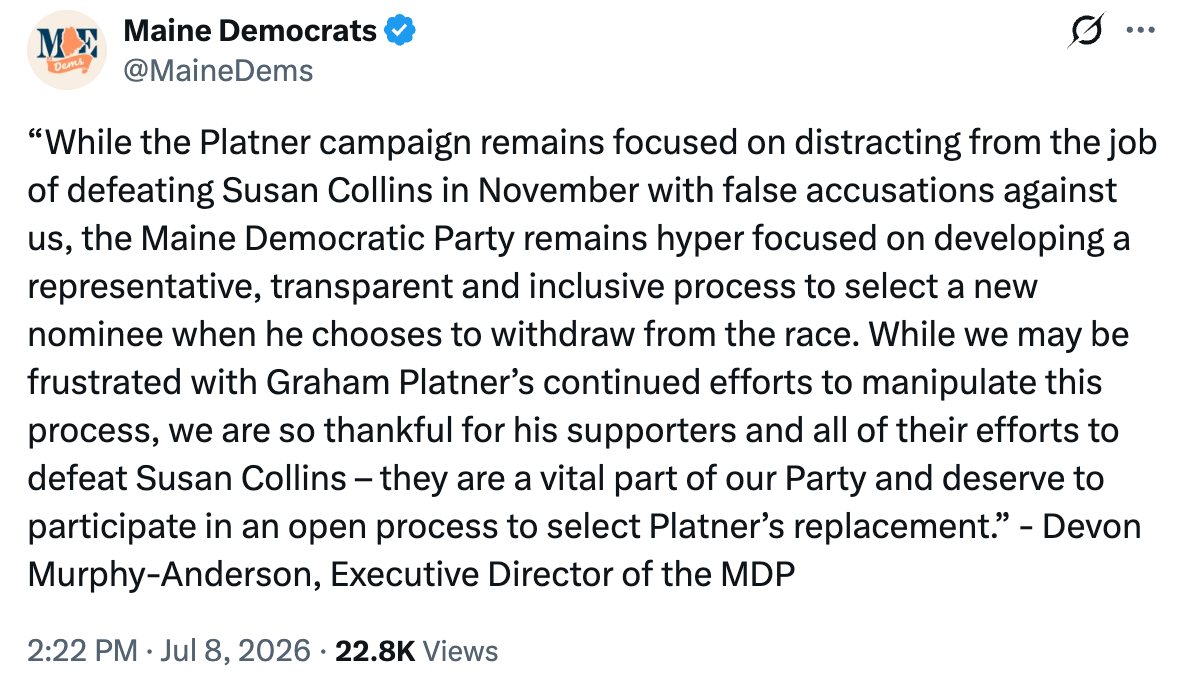
It has been 48 hours since the Politico story posted on Monday, causing all major Platner supporters to rescind their endorsement. But Platner has not dropped out, and the Maine Democratic Party has confirmed reporting that Platner is using his leverage to influence the selection of a nominee:
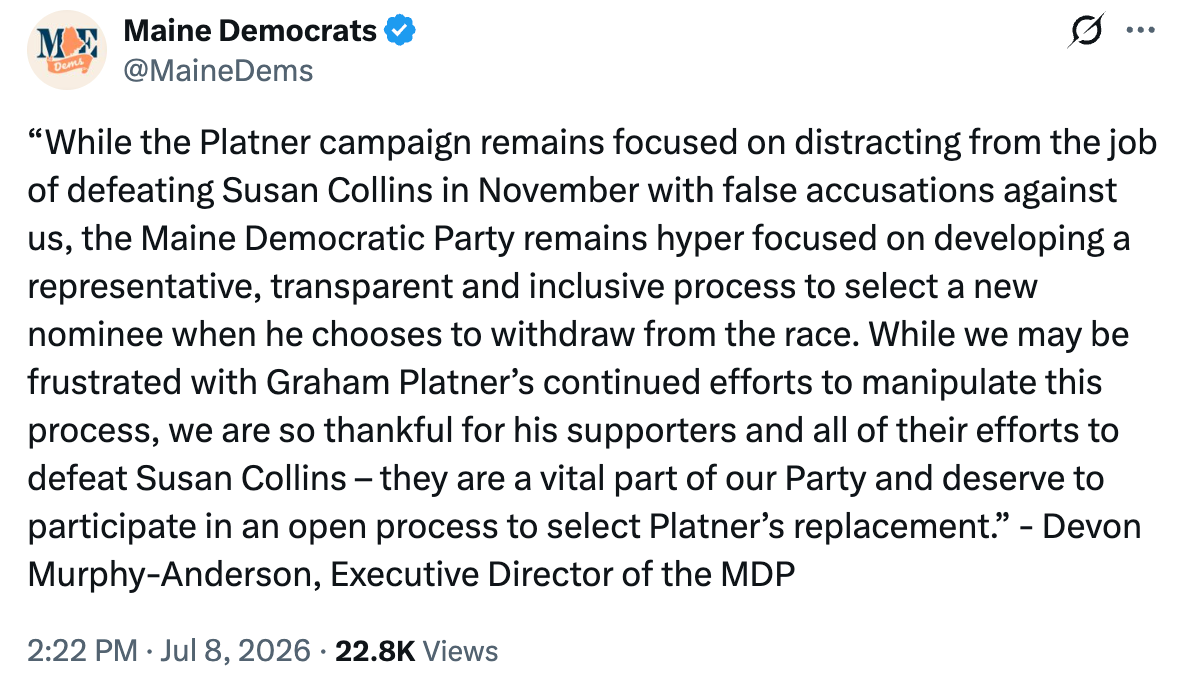
Platner’s leverage is real: according to Maine law, he cannot be forced out and must voluntarily withdraw by 5pm on Monday July 13.
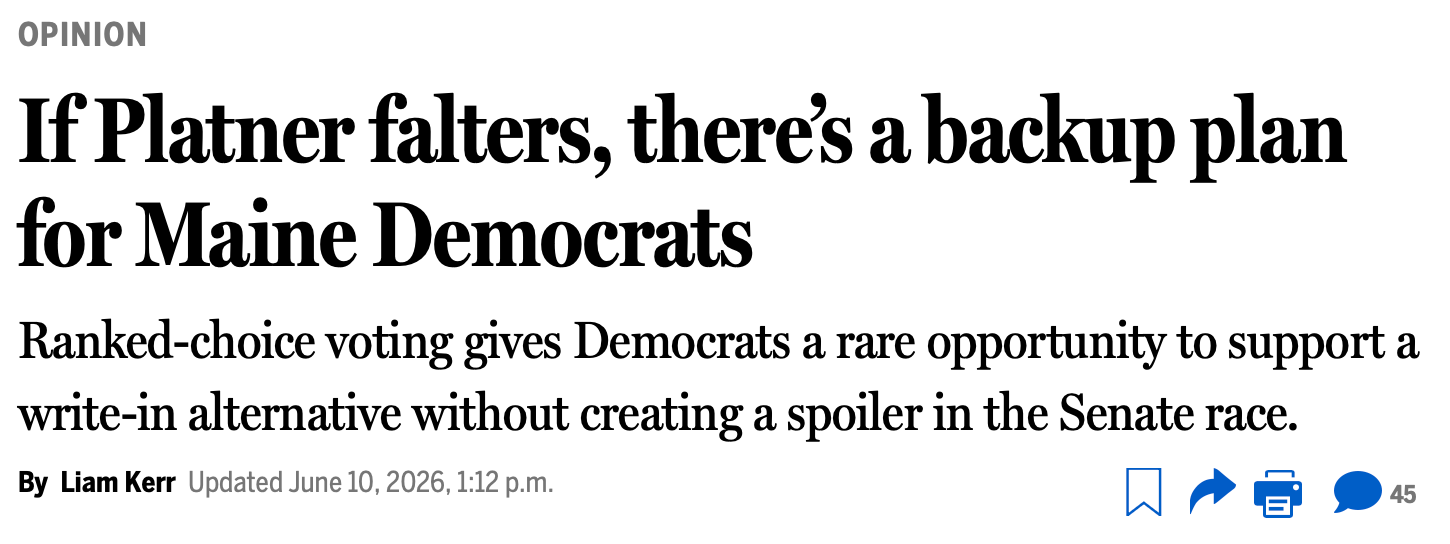
The day after Maine’s June 9th primary, The Boston Globe published my op-ed making the case for Maine Democrats to prepare a write-in campaign in advance of the August 25 deadline.
This is outside the bounds of what I’d normally do. But it was clear that this campaign was a ticking time bomb. It could have exploded after the July 13 deadline to be replaced, but before the August 25 deadline for a write-in to declare.
Or it could have exploded after that deadline.
But it was going to explode before the November election.
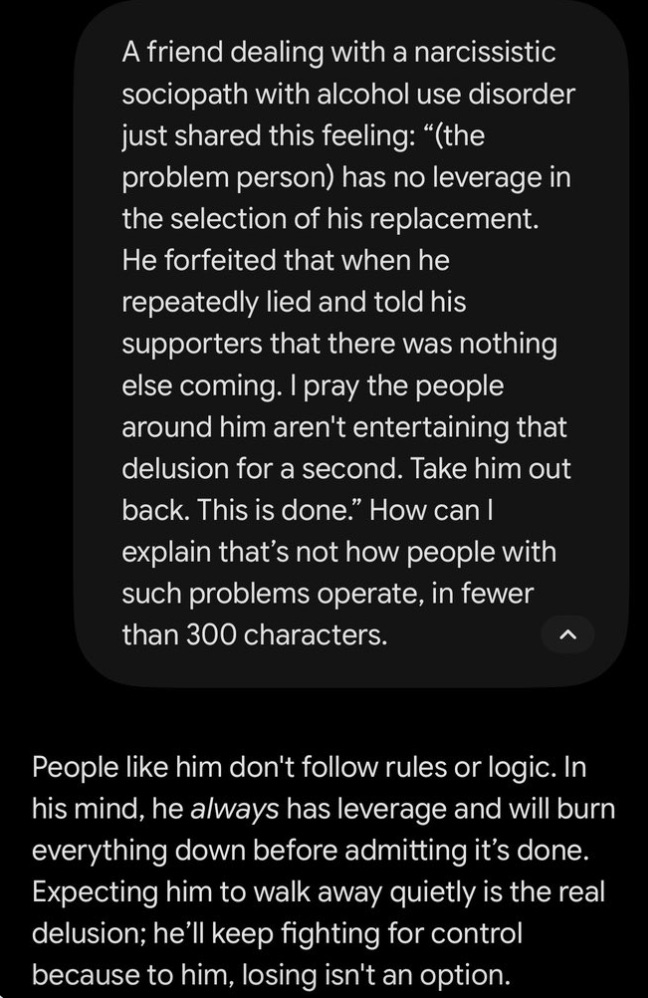
Many leading Democratic operatives and pundits are claiming that Platner has no leverage. That is a tragic misreading of the situation, of Platner, and of Total Factional Warfare Left.
Not only does Platner have significant formal leverage - he’s literally the only person who can trigger the process to pick a nominee - he has significant informal leverage, and an army with a proven track record of prioritizing beating ‘the establishment’ over beating Republicans.
And they are hard at work - just in the last few hours, it was reported that his campaign is polling replacements, and also that the campaign is doing a survey of their volunteers (would be a shame if you filled it out with a fun fake name).
Most Democrats and anti-MAGA Americans assume they share a ‘Big Tent’ with the left, where the main goal is beating Republicans. This is a mirage.
It is difficult to comprehend that so many people who say they’re “fighting” Republicans are in fact helping Republicans. As Matthew Yglesias notes:
“Anti-MAGA Trump-focused resistance types keep getting played for suckers by hard-left factionalists who don’t actually care about beating Republicans” … “it’s the hard left that is taking advantage of the Democratic Party’s current weakened state to advance all-out factional warfare as their top priority, above fighting Trump.”
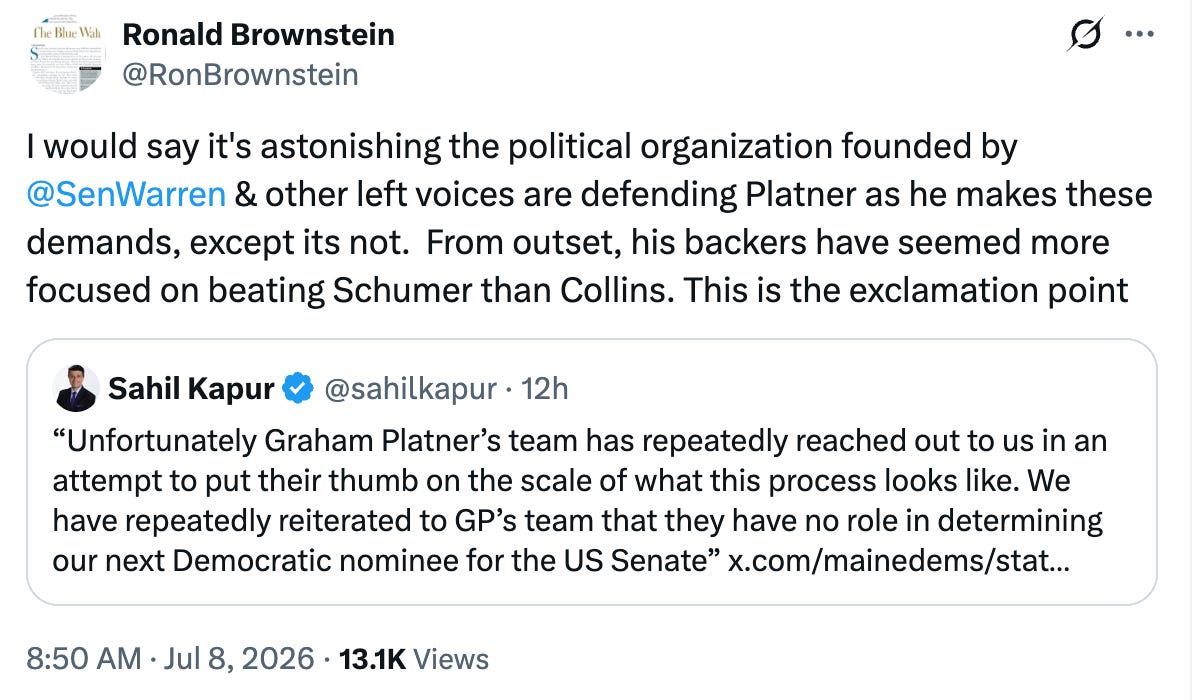
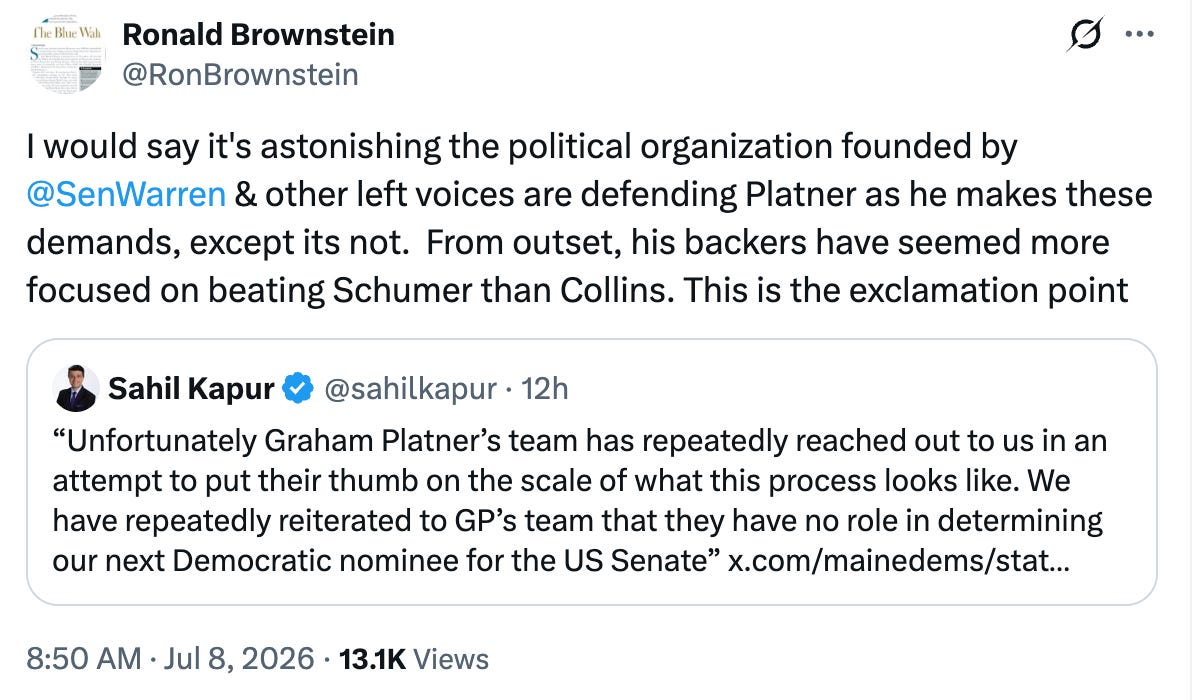
Bernie Sanders, Elizabeth Warren, and their affiliated organizations may have rescinded their endorsements of Platner, but they appear all-in on dragging out the factional war. Ronald Brownstein said it well:
Platner also has a significant stake in the how this ends. According to Axios, “As of May 20, Platner's campaign had spent over $14 million. Much of it went to LLCs with little public information.”
He is running a massive business, has an email list in the millions, and is positioned to flip the campaign assets into any number of businesses in new media or advocacy.
Back to the ‘blank Jared Golden’ thing … you think someone who would work to deliver a House seat to Republicans in 2024 wouldn’t use a Senate nomination as leverage?
After leaving Ironbound, the Platner family restaurant, the night of his announcement, I sat in my car for a half-hour in the drive-thru lane of a closed Dunkin’ Donuts in Ellsworth to use the WiFi.
It felt like I’d hallucinated. Or seen a ghost. Platner was incredibly charismatic, but also incredibly scary.
After about 45 seconds of talking to Graham, it felt like a connecting moment with an old college friend. We were joking about the GAA All-Ireland football final - already had an inside joke! This guy is smart and fun and engaging!
45 minutes later, I was sitting in my car staring into the clear, dark Maine sky struggling to adequately describe the encounter to colleagues.
In the preceding years, I’d met more than 100 candidates. None made me so disturbed. He seemed like a narcissistic sociopath with enough talent - and enough talent around him - to pull the thing off.
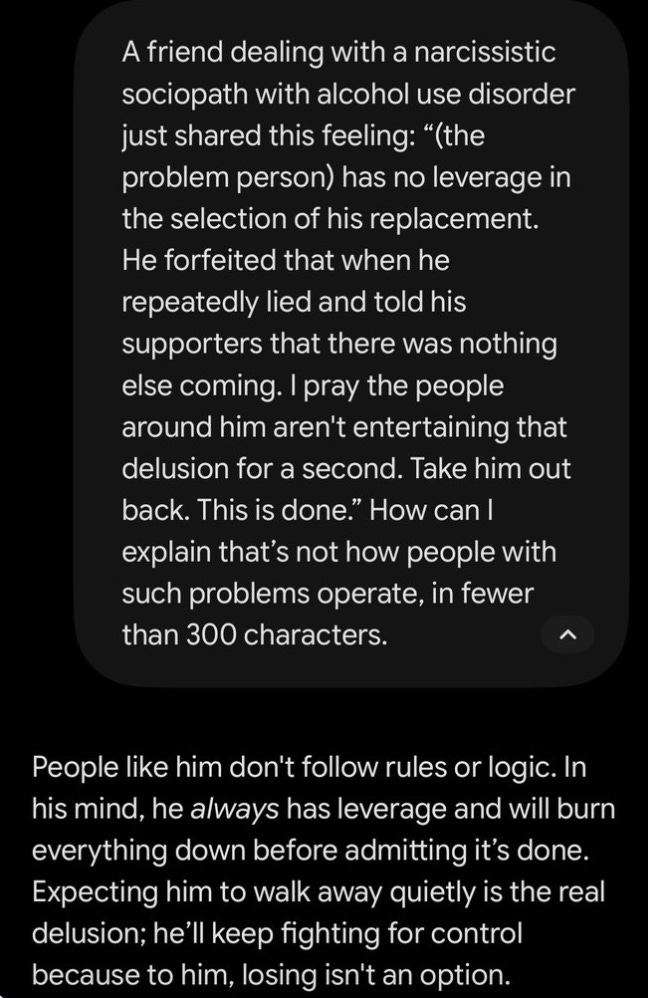
Yesterday, I half-jokingly asked AI about one of the many “Platner has no leverage” statements out there:
In recent hours, Platner’s key advisor flew up from New York to discuss his withdrawal. But, according to The Washington Post, Platner “has struggled with the decision … and has said he would like input on the replacement process, leaving the timing of any announcement unclear.” … “It is him who is wanting to hold on … He is having to come to terms that his dream is dead.”
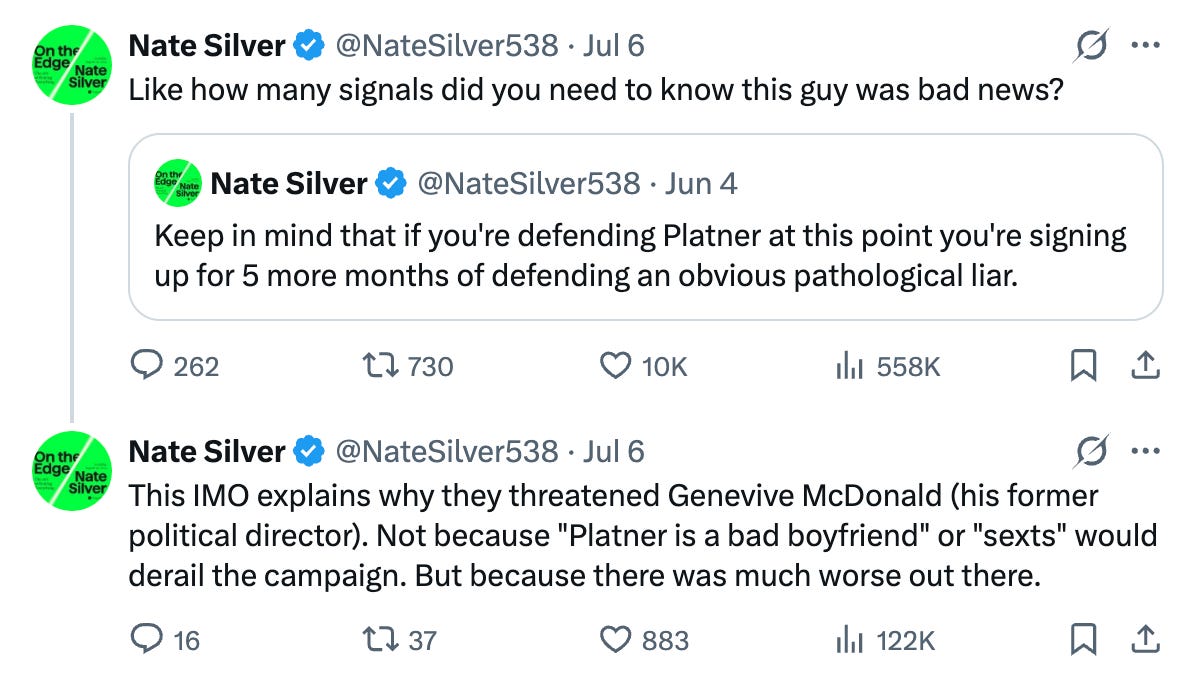
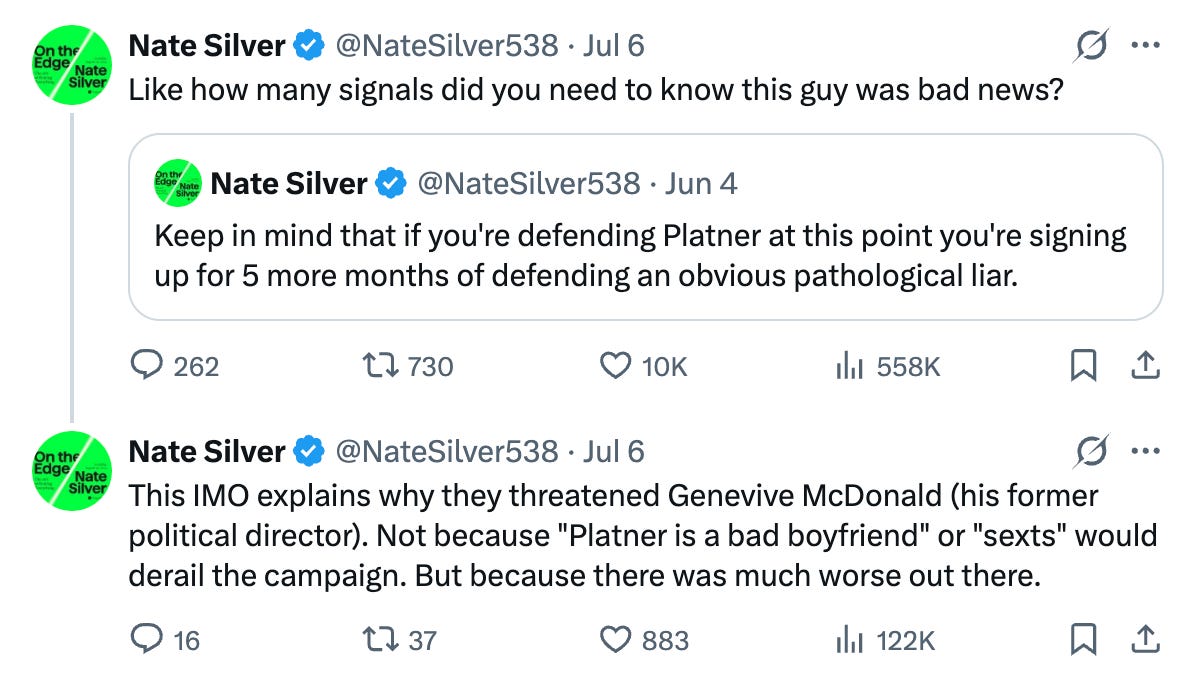
People who previously defended Platner have sought to cast some of the blame on Schumer, or to simply claim that Platner “lied” to them. But as Nate Silver points out, it was OBVIOUS many weeks ago (and imo months ago) what you were signing up for.
They are right to blame us centrists, though. At 10:58pm that night, from the Dunkin’ drive-thru, I published this post on political parties becoming “unbundled.” Here’s the key quote, from Soren Dayton:
“So often people have blamed the most conservative Republicans and most progressive Democrats for creating the conditions where it is hard to govern. But in the logic of unbundled parties, it’s the moderates and the party establishments who haven’t figured out how to work in this new world. It could well be that the way to make political parties strong (again?) is through stronger factions and more politics.”
I feel awful. This is serious shit. This is not “I told you so” for fun, or even “we have to talk about it to learn from it.”
This is “we knew and haven’t built enough to fix it”.
There’s nothing worse than half-assing something important. Which I feel like we did. In the fall, I had a brief conversation with Janet Mills to encourage her to debate Platner early. In the spring, I briefly tried and failed to get a candidate to run as an Independent and caucus with Democrats (as Maine’s other Senator does). And readied that Boston Globe op-ed. Classic centrist stuff.
Things are very different on the left, as Matthew Yglesias wrote about the recruiter of Platner: “To use a term popular with the Silicon Valley types whom he doubtless hates, he is high agency. He saw a void and moved into it.”
We have high agency … sometimes. In small batches. But nowhere near enough.
It really is delusional to think we can just try to beat Republicans and be effective simply coexisting in a “Big Tent” with these people, as they take potshots all day with little pushback.
There’s nothing we can do to kick them out, even if we wanted to. So in a way, we must accept the Big Tent premise (despite its changing definition). But the course we’re on will lead to losing to the Total Factional Warfare Left AND increase our odds of losing to MAGA. We can’t give up the tent, or give in to its current dynamics.
Moderates are typically risk-averse. Slow to use leverage. And it is costing not only our faction but our party and our country.
More than five years ago, in NBC News, I wrote that Democrats cannot afford to take the risks progressives can:
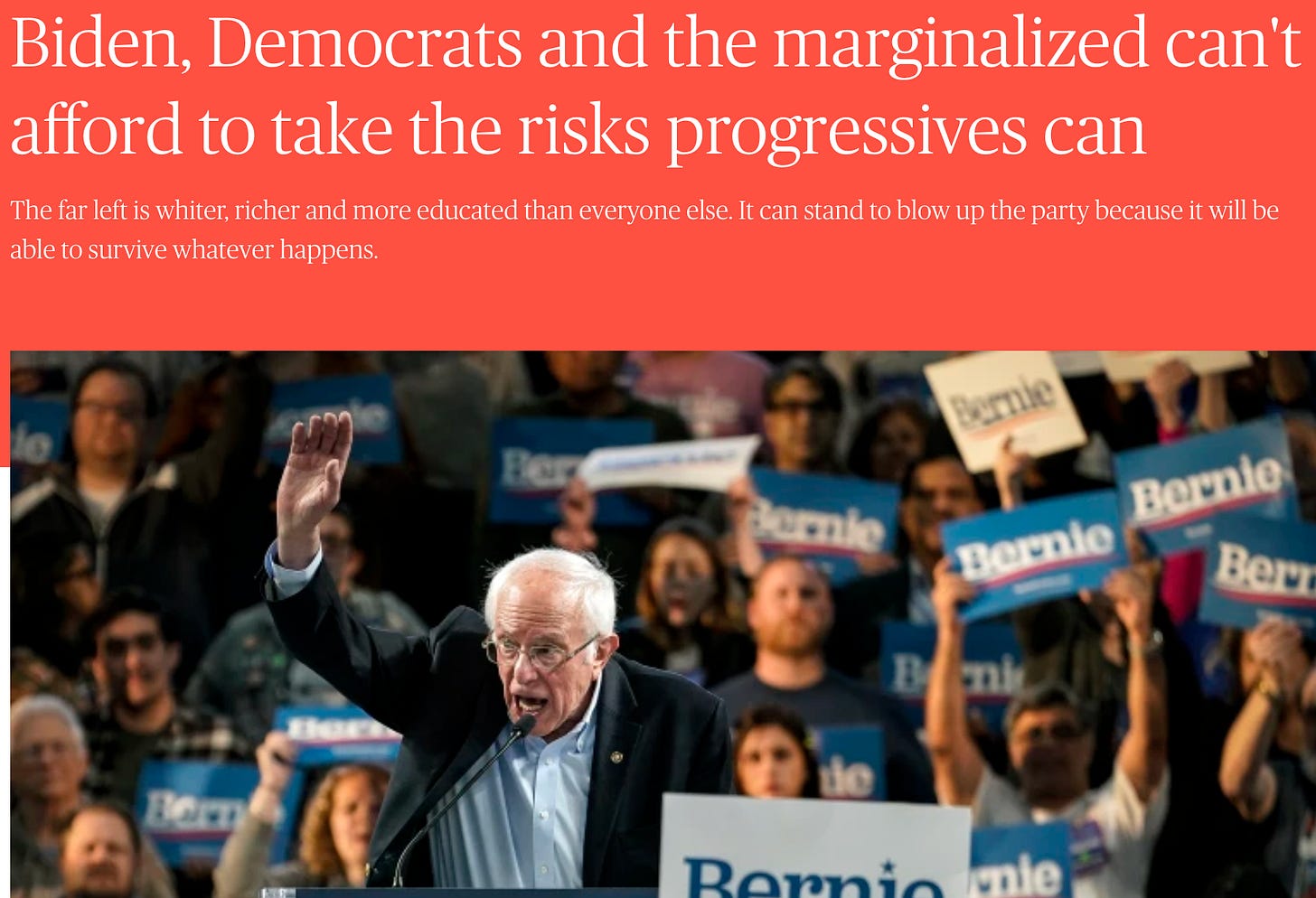
Democratic primary voters nominated Joe Biden, whose moderate brand led them to see him as the most electable candidate — a view confirmed by general election voters, which allowed Democrats to reclaim the White House.
Meanwhile, a small but vocal group on the far left has differentiated itself not only through electorally questionable dogmatism, but also through Silicon Valley-like disruption that embraces risk: “Move fast and break things.” Except it isn’t looking to disrupt business models and consumer goods, but the Democratic Party.
In just a few short years, an interlocking group of political entrepreneurs has launched more than a half-dozen related nonprofits, PACs, LLCs, think tanks and polling outfits aimed at mounting primary challenges against mainstream House and Senate Democrats and influencing local races. As outlined in their “Future of the Party“ report, they believe the Democratic Party “simply cannot move to the center” on policies and must win without the “mushy middle.”
Five years later, the inverse is true. We need to take more risks to match the arsonists in the tent.
As I was walking out of the Ironbound restaurant, his mom was standing at the door. She had one last comment: “You know, he’ll be president one day.”
Graham Platner won’t be president. But another risk-taker will. And if we keep playing it safe, the whole party will blow up.


Discussion about this post
No posts