


When my kids started elementary school in 2021, the average baseball game lasted 3 hours and 11 minutes. In 2022, attendance dipped below 65 million for the first time in decades. In 2023, the World Series averaged just 8 million viewers, the lowest ever recorded.
The word parents used for baseball was boring. Slow. Expensive.
Baseball was mostly dead.
But, as a former Yankee said, mostly dead is slightly alive.
I’m in The Boston Globe this morning with an essay on the lessons from our pastime’s recent comeback:

This spring, the resurgence of a storied American institution just might offer an antidote to tech doomerism. Baseball is back.
The pitch clock, instituted in 2023, shortened game lengths without cutting any of the excitement. And this season’s introduction of the robo-umpire, which is not really a robot but a system of specialized cameras set up to review challenges to umpire calls, made it the first sport to make instant replay a thrill rather than a commercial-inducing slog.
The modern renaissance of the nation’s pastime is clear in the data: The average duration of baseball’s notoriously long games has dropped by more than 30 minutes. Attendance is up three years in a row. And the last World Series game drew the largest audience in three decades.
But it was even more obvious in the stands at Worcester’s Polar Park on Opening Day of the Triple-A season, when a Red Sox minor leaguer tapped his helmet to instigate a challenge to the called strike. The crowd rose to its feet in anticipation. In 15 seconds, we got a clear call from the robo-umpire and the chance to exult in the correction of the human umpire’s mistake. It was downright exhilarating.
Read the full thing in The Boston Globe here, with the case for how lessons from baseball’s resurgence can be applied to other parts of American life.
Many American institutions are in crisis. But they have irreplaceable assets: multigenerational history and inimitable nostalgia create the opportunity for network effects that ground you.
Baseball is back.
My younger son/editor was displeased that I used that phrase in the Globe. After all, baseball never went anywhere. But it has changed - largely thanks to the rules changes shepherded through baseball’s Competition Committee by our own Theo Epstein, whose curse-breaking leadership of the Red Sox (ok, and the Cubs) was a prelude to staving off baseball’s decline.
The significant uptick in popularity and cultural cache matters!
Talking to my boys about the Sox outfield logjam is a joy. But overhearing them in February arguing with friends about whether the Sox should release Masataka Yoshida?
That is transcendent. It makes me think I’ll be talking about it with their kids one day.
Missing that was the big fear. An uncertain future, without baseball.
Bart Giamatti has one of the most well-known quotes about baseball that pops up each spring. So popular it shows up on those quote cards when you google it:
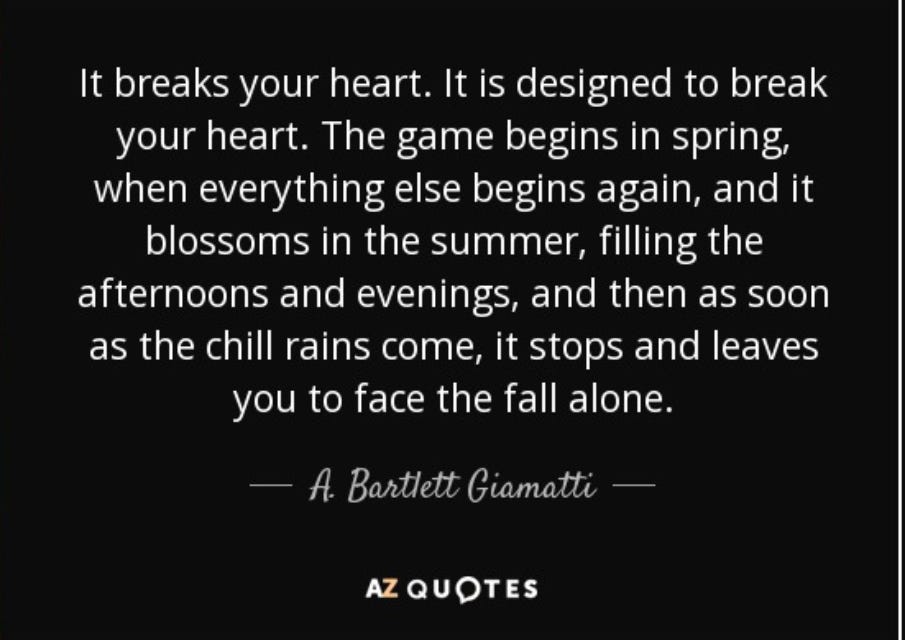
But it is actually the line following this oft-cited quote that captures what was so hard about baseball’s cultural irrelevance:
You count on it, rely on it to buffer the passage of time, to keep the memory of sunshine and high skies alive, and then just when the days are all twilight, when you need it most, it stops.
We were counting on baseball. Just like we were counting on going into the office each day after grabbing the newspaper, and the kids going off to college after years of schooling and churching, and America leading the world.
Baseball’s 21st century decline was leaving us to face a larger fall alone.
Giamatti was a Renaissance scholar before becoming president of Yale and then Commissioner of Major League Baseball. The Green Fields of the Mind closes with a pitch for a deliberate immaturity:
It breaks my heart because it was meant to, because it was meant to foster in me again the illusion that there was something abiding, some pattern and some impulse that could come together to make a reality that would resist the corrosion; and because, after it had fostered again that most hungered-for illusion, the game was meant to stop, and betray precisely what it promised.
Of course, there are those who learn after the first few times. They grow out of sports. And there are others who were born with the wisdom to know that nothing lasts. These are the truly tough among us, the ones who can live without illusion, or without even the hope of illusion. I am not that grown-up or up-to-date. I am a simpler creature, tied to more primitive patterns and cycles. I need to think something lasts forever, and it might as well be that state of being that is a game; it might as well be that, in a green field, in the sun.
In the climactic scene of Field of Dreams, the oracular James Earl Jones pronounces “they’ll watch the game, and it’ll be as if they’d dipped themselves in magic waters.” Fewer people are getting literally baptized anymore, but walking up the Fenway ramp feels like walking into an old church where you feel preternaturally at home. It “reminds us of all that once was good, and it could be again.”
America may fall from world supremacy.
The Catholic Church may never revive.
Newspapers may stop being delivered.
Schools may just be screens.
AI may destroy humanity.
But baseball is constant.
First pitch on Saturday is 4:10pm. I’ll be at Fenway with my family and an old friend and, while the sun may hide, the green grass doesn’t know anything is different than in 1912 or 1989. For a few hours, I won’t either.
Thanks again, Theo.