

Dear readers of The Long View and WelcomeStack,
It is hardly an overstatement to say that the late Massachusetts Congressman Barney Frank was one of America’s most influential national political figures during his time in office. From 1981 to 2013, he helped the Democratic Party secure several consequential policy wins, the most prominent of which was a generational overhaul of financial regulations following the Great Recession. Frank was known by many political observers for his unrivaled command of the legislative process, his often acerbic communication style (including a quick wit), and his strong convictions—all of which engendered admiration not just by members of his own party but even by many Republicans.
But perhaps more than anything else, Frank was viewed by allies and foes alike as a liberal lion. A gay-rights pioneer, he was the first member of Congress to voluntarily come out while serving in office and helped lead the push for policies promoting same-sex equality. He was a fierce critic of the Bush administration’s war in Iraq—before the war even began. He supported a strong social safety net, robust workplace protections, and more affordable housing.
So it is especially noteworthy that, in the final months of his life, Frank offered this stark message to his party: beware the growing influence of the left flank. In an April Politico interview, he said that progressive Democrats have a place in the party, but that they had “embraced an agenda that goes beyond what’s politically acceptable,” adding, “Until we separate ourselves from that agenda, we don’t win.”
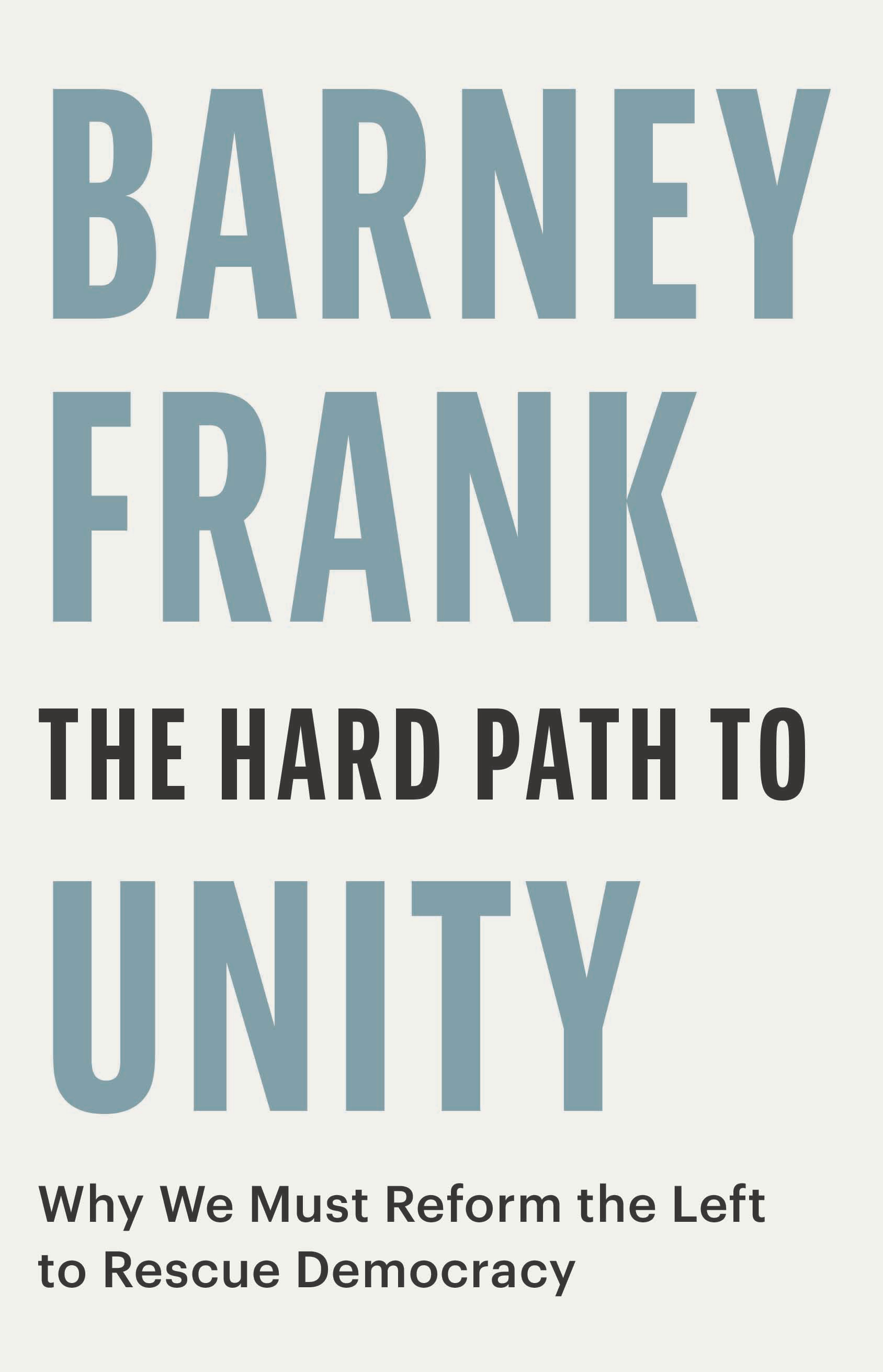
Frank spelled out his argument about the future of the Democratic Party in a posthumous book that is out today, The Hard Path to Unity: Why We Must Reform the Left to Rescue Democracy. We are pleased to share an exclusive excerpt from his book below.
Many—especially on the Left—have an unshakable faith in the basic decency of the common man and woman that excludes the possibility that they will fail to do the right thing. Others suffer from the effect of living in an environment in which they rarely interact with people with whom they disagree—an echo-chamber effect that is significantly magnified by the algorithms of social media. Finally, some fail to trust their own judgment that their ideological allies are greatly overestimating the strength of their support, or are intimidated by the fear of being accused by true believers of being faint of heart.
Whatever combination of reasons produces this capacity to believe what is most comfortable, it is widespread among the strongest partisans. After losing by two of the most decisive margins in American history, many Goldwaterites in 1964 and McGovernites in 1972 blamed their favorite’s defeat on a lack of ideological zeal, rather than on the clearly evident excess of it. Similarly, after the 2024 US elections, the Justice Democrats attributed Democratic losses to our candidates’ refusal to support abolishing private medical insurance (Medicare for All), impose a ban on fracking in Pennsylvania (the Green New Deal), tolerate unconstrained looting in retail stores (ending mass incarceration), and pay sufficient inattention to the offensive nature of gendered words by instructing their interlocutors on the bias-free employment of pronouns.
While this form of self-hypnosis exists across the ideological spectrum, it is most problematic when practiced by those on the Left. More than their counterparts on the Right and center, they make the case for their agenda not just on its substance but also on the claim that it represents the true wishes of “the people.” (Among non-populist conservatives who follow the tradition of Edmund Burke, being in the minority on an important issue can be a sign of one’s intellectual and moral integrity.)
Where important variables can be measured with reasonable precision, the inclination of partisans to see what they want to see may not significantly distort their strategic choices. But as the questions that must be answered in order to decide on a course of action become more subjective, the likelihood increases that the judgment of those involved will be clouded by passion. And because this phenomenon affects the effort to assemble a sufficiently large coalition of defenders of liberal democracy, it has both first- and second-order negative impacts.
Directly, absent a massive, wholly unforeseeable shift in the ways that non-college-educated, non-professional, ethnic-majority workers in the developed world view immigration, race, and the urgency of countering climate change, the commitment to forging an all-encompassing coalition to demand far-reaching social and economic restructuring will continue to be a doomed distraction from the hard work of assembling a sustainable anti-populist majority.
No skill is more important to a political strategist than the ability to count votes without being swayed by either hopes or fears. Allowing false optimism about your position’s popularity to shape your approach leads to failure, in legislative bodies and elections alike. Conversely, underestimating your strength can result in your aiming too low, leaving achievable gains unrealized. (Nancy Pelosi’s ability consistently to avoid both of these errors is a major reason for her great success as Speaker of the House.)
Since in the kaleidoscopic circumstances of the real world you have a finite number of opportunities to achieve major social change, making a flawed choice substantially diminishes your chance to make a good one. Reclaiming a place on the necessarily limited list of measures that can be put to a vote; rallying troops who have been through one losing battle to refight a similar one; repositioning candidates who have become identified with an unpopular set of issues so they will be electable—difficult as each of these tasks is individually, trying to achieve all of them in a fraught political context is a recipe for failure.
And failure in this case means much more than merely a tautological lack of success in restoring liberal democratic rule. It increases the difficulty of doing so in the future. The damage inflicted by the militant left’s refusal to accept less than complete victory for their ideals goes beyond the loss of support for a more achievable rollback of populism’s gains. When this emotionally powerful vision of a united front of society’s victims is rejected by a mainstream skeptical of its viability, the angry reaction of those who share that vision deepens the conflict between the two factions—even though a successful democratic counterattack against populism will require their unity.
There are, in intra-party dialogue, two arguably acceptable reasons why one faction may dissociate itself from the issues advocated by another. One is disagreement on the merits. The other is a judgment that the policies in question are not only unpopular but also so repugnant to a critical mass of voters that association with them means defeat at the polls.
To zealous advocates who believe that their agenda is not just substantively correct but morally compelled, and are led by their fervor to believe that the majority of voters agree, neither explanation is valid. Many of these zealots are convinced that the source of their abandonment is some form of corruption, usually the influence of lavish campaign contributions from those who, having profited from the status quo, spend freely to preserve it. Intra-party debates about the merits of various policy proposals or the mood of the electorate get displaced by attacks on each other’s motives, intensified by the familiar human propensity to react more angrily to heresy than to outright disbelief.
The blame for this vitriolic tone in the argument about how to counter populism is not equally borne. It begins with the dissidents accusing the mainstreamers of selling out their professed principles and often progresses to those dissidents instructing the party faithful to punish the “sell-outs” at the polls. The response of those pursuing a less complete but more achievable victory is then muted by the fear that escalating the intra-party invective will make it harder to secure cooperation from their leftist detractors in the fight against the Right.
Editor’s note: This article has been excerpted from The Hard Path to Unity, by Barney Frank, new from Yale University Press. Copyright © 2026 by Barney Frank. Published by permission. All rights reserved.
I don't find much to agree with on Barney Frank's view of the contemporary political situation in terms of the value or success of moderate Democrats, but the thing that really strikes me about these arguments is, however well reasoned they are, I believe they will continue to be meaningless in terms of effecting change because they're bringing a lumber saw to fix a flat tire. It's the wrong tool for the job.
Noting that the elite left power center is defined by its religious certainty and moral self-aggrandizement is an absolutely fantastic observation, and labeling them the Brahman Left is a fitting name. But I think the problem I'm seeing with these efforts to correct them, is that the modern American left is not defined by their religious character, but rather by the thickness and opaqueness of the bubble they live in.
The regular Democratic voter is not actually a member of the Brahman caste, they don't make the money peddling social justice or grifting socialism, nor are they winning political office or rising in social power thanks to the movement. They're every day Americans who just form the poor bloody infantry of the Democrat's movement for power and prestige. And these arguments I keep seeing might be relevant to the shepherd (who's not going to give up their grift no matter how many times you explain to them why it would be a good thing), but have no relevancy to the sheep who actually wield the ultimate political power through their numbers in voting and donating.
Look at how these regular leftwing voters are actually engaging in politics. Just today I got recommended a Peter Zeihan video about what happens politically after Trump, and you can take it for granted it was just copium served up by a Youtuber grifter, bashing Trump, bashing Vance, mocking the idea that the GOP has any future, what was of value were the comments to the video. So many cringey comments about how they can't wait for Trump to die, and they're tired of the traitor, fascist, KKK-GOP, and on and on and on. Same trite, embarrassing rhetoric they've been spewing for ten years now. One of them actually said, well the GOP's a zombie party at this point, we're just waiting for them to realize they're dead and collapse. You know, that zombie party who controls the White House, the House of Representatives, the Senate, the Supreme Court, and a majority of the states, THAT zombie party. It's all about blowing off angry hot air with mindless sloganeering and really transparent projection.
And I was thinking to myself, well here's the people Democrat reformers really are talking to, and should be trying to talk to, and yet, they're aren't really talking to them. The Democratic voters aren't really about policy positions, I think it's been whipped out of them to have opinions about such high matters, they're more simple creatures of emotion and outrage. If the leadership of the left are the Brahman Left, then these are the dirty worshippers prostrate before them, screaming slogans of hate for the nonbelievers, heretics, and despised 'other.'
They're a fed a constant diet of ontological misinformation from NPR, the New York Times, CNN, MSNBC, ten thousand Youtube podcasts, academics and intelligentsia, and all this talk about establishing a workable majority of the electorate to gain political success is just lost on them, they don't even hear it, and if they do, it's unintelligible to them. All they think about is Trump, wacky conspiracy theories about Trump, ways they can call MAGA names, and then revel in the incredibly brief emotional reward of posting the outcomes of this thinking. There's no intelligent political engagement here. These sort of high minded political arguments are falling on deaf ears at best.
The arguments can be made to the Brahman Left leaders, who will ignore them because perverse incentives mean they're winning even while Democrats are losing elections, and they can be made to intellectually open, heterodox individuals, who because of being intellectually open don't believe in the fantasy hysteria around Trump, conservatism, or populism, meaning they have no reason to buy in, but they are meaningless to the rank-and-file who could actually enact change through their collective will. Because the issue isn't a lack of wisdom, it's a lack of lucidity. These people aren't that aware of the world around them to be able to make sense of higher level arguments about political strategy. If you want to reach them, your focus should be their collective stupefaction, and constantly playing into the Trump derangement only works against you there.
Dorothy Rabinowitz, then of The Wall Street Journal, one wrote, "The difference between Liberals and Conservatives is that Liberals believe that people, if left alone, will generally do the right thing. Conservatives are under no such illusion". This may be a paraphrase. I am not a scholar, but once tried to look up that quote. I found others by Rabinowitz, but not that one. Go figure.