


Dear readers,
Welcome to The Long View. Most of you have likely heard by now about our new publication, which serves as an intellectual successor to the Liberal Patriot. If you are new to the project, we encourage you to read our inaugural post, which outlines our vision for what we hope to build here.
We want to thank our friends at Welcome who have graciously given us a home to continue our work. You can still expect us to bring the same independent voice and candid analysis you came to expect from us at TLP.
Finally, as we learned in March, this work truly cannot happen without your support. If you value what we’re doing, please consider becoming a paid subscriber today and helping us build The Long View.
Many thanks,
-Ruy & Michael
In the wake of Democrats’ catastrophic defeat in the 2024 election, there was an obvious need for serious party-wide change. The yawning gap between the cultural and policy priorities of a Democratic Party dominated by liberal professionals and those of the median working-class voter had already become screamingly obvious and was ratified by the election results. The logical response to this would have been to close that gap by bringing the party closer to the views and values of the working-class voters they were losing.
There was indeed a brief shining moment right after the 2024 election when it did seem like the scale of the debacle would force a real reckoning within the party. But that trend quickly dissipated as #Resistance fever gripped the party, the usual suspects mounted stiff resistance to any revision of party positions, and momentum shifted to the energized progressive left within the party.
That trend has continued to the present day. That brings us to the remarkable spike in success for Democratic Socialists of America and DSA-backed candidates. First, there was the victory of DSA member Zohran Mamdani in the 2025 New York City mayoral race. This has been followed by a surge of DSA triumphs in the 2026 midterm primary elections. Perhaps most famously, Mamdani and the DSA backed three Democratic primary candidates in New York City House districts—Darializa Avila Chevalier, Brad Lander, and Claire Valdez—all of whom won. Notably, all the DSA victories came not against moderate but progressive Democrats, including Chevalier’s ouster of Adriano Espaillat, chairman of the Congressional Hispanic Caucus. And given the nature of the electorates in these districts, all of the DSA candidates are sure to win in November and take their seats.
Other high-profile DSA victories include Chris Rabb’s securing of the Democratic nomination for a Philadelphia House seat and Milat Kiros getting the Democratic nomination for a Denver House seat (ousting a 30-year incumbent). Rabb will be unopposed in November—his future seat is rated the most Democratic in the entire nation—and Kiros is almost certain to win (her likely future seat is rated the most Democratic in the Mountain West), so the DSA can count on adding these seats as well. In addition, DSA member Donavan McKinney in Michigan (Detroit/Wayne County) garnered the party nomination for a heavily Democratic House seat and therefore is also likely to swell the DSA congressional delegation.
And it’s not just House seats! DSA member Francesca Hong mounted a strong primary campaign for the Wisconsin Democratic gubernatorial nomination and fell just short while DSA-backed (though not a DSA member) Abdul El-Sayed grabbed the Michigan Democratic nomination for U.S. senator. El-Sayed is generally favored to win the seat. Recently, DSA member Janeese Lewis George secured the Democratic nomination for Washington, DC, mayor. Given strong Democratic lean of DC’s voters, this assures her of victory in the general election. And there’s Nithya Raman, a DSA member who’s managed to advance to a runoff against incumbent Democrat Karen Bass for mayor of Los Angeles.
These are remarkable developments. But what does it all mean? Does it mean that DSA is about to “take over” the Democratic Party? I don’t think so. But it does signify a big hit to Democrats’ ability to de-Brahminize their party and make it more attractive to working-class voters.
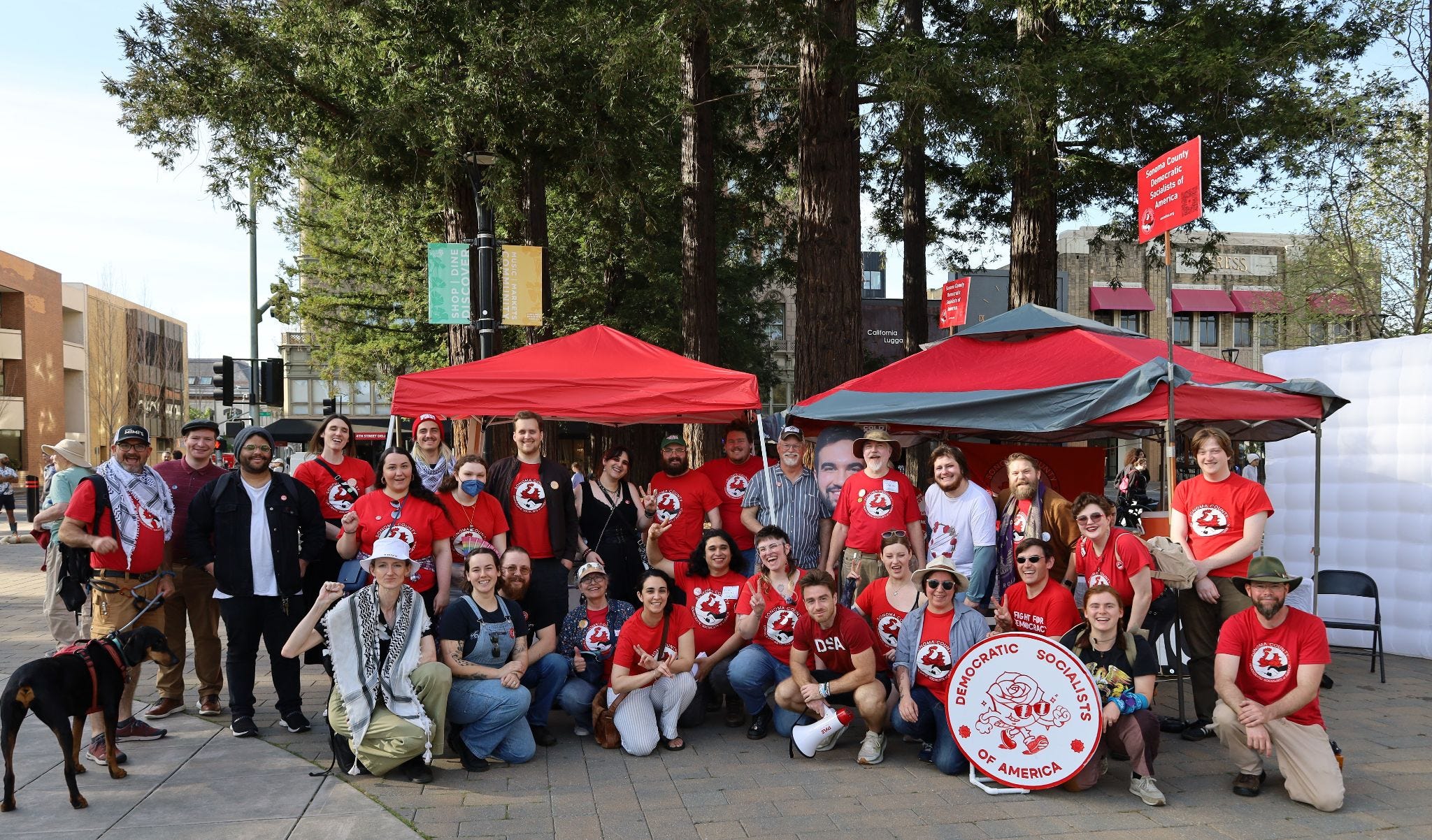
Start with the takeover question. Sure, the DSA has had significant successes and recently hit 120,000 members, making it the largest socialist membership organization in American history. But it’s a big country! As Kyle Saunders points out, to match the per capita membership of the Debs-era Socialist Party, the DSA would need more like 400,000 members.
Furthermore, DSA successes, such as they are, have been confined to very blue, urban areas of the country where securing the Democratic nomination is equivalent to winning the general election. Today’s Democratic Party, despite ongoing trends, includes many, many politicians and voters who do not hail from the most intensely blue parts of the country and are therefore far less likely to succumb to the blandishments of the DSA (as Hong’s recent defeat in Wisconsin suggests).
A better way to think about the DSA is not so much that they are taking over but rather that they are the vanguard of the radical professionals. In that sense, they are a continuation and expression of a long-standing trend in the Democratic Party: the party has become increasingly hegemonized by the professional class, and professionals themselves have become more radical, especially in the Trump era.
Thus, when we see poll findings like 66 percent of Democrats are favorable toward socialism but only 42 percent toward capitalism, this does not mean that two-thirds of Democrats are about to join the DSA or, indeed, that they have any idea what they mean by favoring “socialism.” Rather, it means that professionals are being further radicalized by their fervent opposition to Trump and Trumpism and are willing to pick a “brand” that expresses maximum opposition. This radicalization of course provides a fertile ground for DSA recruiting, even if the overwhelming majority of those professing a liking for socialism think it just means vague principles like “be kind” or “the government should do stuff.”
The appeal of DSA has been particularly strong among younger professionals, who have been heavily hit by this radicalization trend. Many of them reside in metropolitan areas where housing and overall living costs are high, and their preferred jobs are not compensated well enough to make up for the high costs. In their view, their upward mobility is frustrated and unjustly so. This bleeds into their extreme dislike of Trump and utter contempt for a Democratic establishment they believe has neither stood up to Trump nor the billionaire capitalists that supposedly enable him and rig the system.
The more political among these radicalized young professionals are naturally drawn to the DSA. They recognize it as their organization that crystallizes their grievances and functions as the leading edge—the vanguard, if you will—of their priorities, both economic and cultural.
Of course, the conceit of the DSA is that they’re a working-class organization and their rhetoric and program monotonously use the phrase “working class” over and over again, as if repeating that phrase would magically make them working class. But, of course, they’re not.
As anyone even vaguely familiar with the DSA in real life knows, blue-collar workers are as scarce as hen’s teeth among actual DSA members. They are overwhelmingly college-educated and have professional jobs or are students, unless they’re over-educated “skidders” who’ve wound up in low-level retail jobs or are slumming it to organize the proletariat. The culture of the organization is such that any normie non-college-educated worker who wandered into a DSA meeting would run screaming in the other direction, bewildered by the language used and frightened by the radical positions taken.
Consider some of these positions. One might think, given that the DSA has become more of an electoral force, that they would be tempted to soften some of their radical stances to appeal to more voters. Nah. Instead they are becoming more radical. They very recently (July 14) released their updated national platform. Among other things, it calls for abolishing the U.S. Senate and replacing the president and Supreme Court with “an executive and judiciary chosen by and subordinate to Congress”(!) Funding for police departments should be diverted to public services along the way to full abolition of the police and prison system. All illegal immigrants should be given amnesty, ICE should be abolished, and open borders established. Not to mention: reparations for slavery, a Green New Deal, universal rent control, defunding the Pentagon, a 32-hour work week, no restrictions on “gender-affirming care,” and public ownership of the largest corporations. It is difficult to find a radical, impractical, unpopular proposal that is not in this platform.
Of course, DSAers running for elected office frequently soft-pedal their support for these radical ideas, preferring instead to talk about “affordability” and how they’ll stand up to Trump and the billionaire class. Once elected, they may even, as in Mamdani’s case, try to portray themselves as simple problem-solvers and providers of effective public services—sewer socialists or, in Mamdani’s preferred phrase, practitioners of “pothole politics.”
But the fact remains that these aspiring and current electeds do, in fact, generally support these ideas and are on record as doing so. These are hard commitments to erase, even assuming these politicians wanted to. And they likely don’t want to because not only are these things they believe in but things they must promote as the vanguard of the radical professionals. Their activist base simply will not tolerate deviation.
This ties the hands of DSA politicians who can’t escape the branding and dictates of DSA’s radical commitments. So, instead of hiring more cops, as initially promised, the Mamdani administration is ramping up support for “gender-affirming care,” immigration law services, a new Office of Community Safety, and countless other programs dear to the hearts of radical professionals. That doesn’t have much to do with sewer socialism. As for making the city more affordable, which might fit into sewer socialism, that is simply very hard to achieve in a large blue city, given the morass of bureaucracy, NGOs, and municipal unions that must be reckoned with—and that includes many of Mamdani’s strongest supporters, who will stoutly resist anything that encroaches on their interests. Far easier are gestures like rent freezes for already-regulated units—already done—which, ironically, are likely antithetical to the larger goal of increased housing supply and affordability.
Indeed, expecting DSA politicians to practice a politics that would genuinely appeal to working-class voters is a fool’s errand. They are what they are—creatures of a vanguard organization of radical professionals determined to pursue their own priorities. As such, they should be thought of as an even more Brahmin Left faction within the broader Brahmin Left formation of the Democratic Party.
Not only does it make no sense to think of the DSA as a group that could reacquaint the Democrats with the working class and help them de-Brahminize, but the reverse is true: the DSA is and will be a force for the continued and intensified Brahminization of the party. Any tendency within the party that resists this Brahminization and embraces positions more congenial to the working class will be ferociously resisted by an increasingly well-organized and powerful DSA. This is the real problem with the DSA: not that they will “take over,” but rather that they will be an aggressive force preventing the Democrats from the brand reinvention they need to reconnect with working-class voters.
Consider three recommendations from New York Times columnist Tom Edsall in his recent piece, “Three Things Democrats Have To Do If They Actually Want To Win”. These recommendations would go some way toward shoring up the weaknesses that tanked the Democrats in 2024. In each case, the DSA and its supporters can be counted on to lie down on the railroad tracks to prevent any of these recommendations from even being entertained by the party.
1. Democrats will firmly enforce laws on illegal immigration, including tough border enforcement and deportation of unauthorized immigrants who commit crimes. Unauthorized immigrants with no criminal record who have been in this country for at least five years, along with Dreamers, should be offered green cards with a path toward citizenship. More recent arrivals should be deported.
2. The Democratic Party supports aggressive prosecution of those accused of violent crime and those who engage in crowdsourced “teen takeovers” of stores, as well as for all forms of child abuse.
The party backs restoration of bail requirements in the case of felonies, lifetime sentences for offenders convicted of multiple violent crimes, tough enforcement of child support laws and the death penalty if supported by the voters in a state and endorsed by a jury.
3. There are two sexes: men and women.
A man can claim an identify [sic] as a woman, and the same in reverse for a woman. They have every right to do so. Their claim should be respected and they should be protected from any form of discrimination for their choice.
Their claim does not, however, alter their biological sex.
Consequently, it is legitimate in areas such as sports where a transgender person would have a competitive advantage over non-trans people to bar such participation. Similarly, a claim to a sexual identity does not give a trans woman the right to incarceration in a woman’s prison.
Finally, the debate over gender affirming surgery and hormone treatments is fraught with contradictory assertions. For now, because there are credible scientific claims of irreversible harms, such treatments for those under 18 should be barred pending further study.
This is the nub of the problem. The unchecked Brahminization of the Democrats, which has only been accelerated by the #Resistance and intense negative polarization against Trump, has encouraged the radicalization of the professional class. That, in turn, has fed the growth of the DSA, the vanguard of the radical professionals, who now stand in the way of a serious Democratic course correction like the one recommended by Edsall.
The road back to the working class for Democrats is likely long and difficult, and the growth of the DSA makes it even more difficult. Or, perhaps it will knock Democrats off the road entirely. I would not underestimate the peril this now presents for the Democrats.
Editor’s note: a version of this piece first appeared in Commonplace
I'm so glad you (Ruy Teixeira and Michael Bahareen) are back! When The Liberal Patriot closed, I was positively heartbroken. Where else could I -- as a normie type, always an independent, but generally leaning Dem -- find sanity? So thank you for heading back into the fray. And I look forward to reading more on Welcome Stack. It's so nice to feel normal in a crazy political world!
The DSA WILL take over the Democratic party. The reason is that outside of a small handful such as Senator John Fetterman, there are no elected Democrats WILLING to fight them. They will adopt the radical positions out of expediency. It has already happened and will continue to happen until a time (if it ever comes) in which the party suffers a massive 80's style debacle.