



Thanks to everyone who submitted article recommendations and mailbag questions this past week! A reminder that if you would like to recommend an article or submit a question, please leave a comment on any TLV post published in the seven days leading up to our Friday Five posts (including this one). We’ll collect our favorites and include them in future editions!
Weekly Mailbag
Matt: Why do you think someone like Matt Yglesias went on Mehdi Hasan's show in the first place? Is the juice worth the squeeze?
I have a great deal of respect for anyone who is willing to go into the lion’s den and make their case to a large audience that is likely to be unsympathetic to their views, especially if the primary interlocutor has a history of arguing in bad faith and doesn’t seem interested in a productive discussion. It’s why I credit Democrats like Pete Buttigieg for regularly appearing on Fox News or Republicans like Scott Jennings for playing the odd man out on CNN, despite knowing they’ll face tough questioning by hosts on networks that largely do not share their values or beliefs.
I think we need more of that. At a time when more and more people have retreated into increasingly insulated, ideologically homogeneous information ecosystems, there’s a case to be made for showing up and introducing perspectives they likely rarely hear. When your side fails to do this, it leaves a vacuum that more partisan voices on social media and cable news are happy to fill, often with caricatures of people like you and the views you hold.
Right now, few moderate Democrats would likely dispute that their influence over the party has diminished while the far left’s has grown. There was a brief window after Trump’s election in 2024 in which a large plurality of Democratic voters wanted to see their party become more moderate. But that window quickly closed after he took office, and many Democratic voters channeled their anger at Trump into support for more left-wing candidates.
So there’s an argument that moderates have no choice but to engage with the left, even on its home turf. Showing up in hostile spaces and making your case may not win you many converts overnight, but some people will likely respect you for at least engaging with them. And you never know whose minds you might change in the process.
-Michael
Jim: What reforms did the Democratic Party make between 2004 and 2008?
Jim was skeptical of TLV’s argument that the Democratic Party has not seriously reformed itself since losing in 2024, which we believe will make it harder to win in 2028. His perspective echoes others who believe Democrats should be fine in 2028, either because of the natural swing of the electoral pendulum back toward them or because the party can expect to capitalize on voter anger or exhaustion with Trump in two years—just as they are poised to do this year.
Let me concede one point: that perspective could prove correct. Trump’s second term has been politically disastrous for the Republican Party, and I expect they will pay a penalty for it next Tuesday. It’s also true that in our era of political volatility, Democrats could be the beneficiaries of normal electoral dynamics and win in 2028 simply by being the out-party.
However, if Democrats win in that fashion, they’ll be merely perpetuating a trend that TLV’s Ruy Teixeira has dubbed “politics without winners.” Rather than making a serious attempt to reform the party—by shedding the more unpopular elements of left cultural politics or doing more robust outreach to groups of voters who have proven over the past decade to be less loyal than Democrats assumed—they would be choosing the path of least resistance: simply capitalizing on the other party’s unpopularity. Republicans more or less did the same thing in the lead-up to 2024, which is arguably why they entered office without a coherent governing agenda and have failed to convince voters that they take their number one issue—inflation—seriously.
This is why we believe it’s important for the party to look beyond just the next election and take The Long View: genuine reform offers a better chance of long-term success. So how did Democrats approach this challenge after their second consecutive defeat to George W. Bush in 2004, before going on to win decisively in the 2006 midterms and 2008 presidential election?
A big factor is that they made a serious effort to compete everywhere. DNC Chair Howard Dean famously launched the 50-State Strategy, which sought to identify and recruit candidates and build party infrastructure all across the country, including in places Democrats had previously written off. Of course, today’s party is making an effort to do the same this cycle, which is good!
But a key difference between today and the post-2004 period is that Democrats back then made a concerted effort to find candidates who were genuine moderates or even conservative-leaning and thus good fits for redder states and districts. Think of Heath Shuler (North Carolina), Brad Ellsworth (Indiana), Bobby Bright (Alabama), Travis Childers (Mississippi), and Walt Minnick (Idaho)—all of whom represented heavily rural, conservative districts, and whose wins helped Democrats build a massive trifecta by 2009.
If Democrats want to expand their capacity to build robust, durable majorities, they should look for candidates like this in all corners of the country.1 They would make it so that moderate and conservative-leaning candidates feel just as at home in the party as DSA members increasingly do. But there seems to be little appetite for this in today’s Democratic Party.
For now, many Democrats are content to stay the course and ride the politics-without-winners pendulum: winning when the country gets tired of Republicans, but remaining on a shaky foundation that could crumble once they find themselves in charge and facing headwinds of their own.
-Michael
2 things from this week
Only Principles, Not Tribalism, Can Save Us – Erez Levin
In the real world, we cannot take our ball and go home. We do not have the luxury of total separation. We share the same economy, work in the same offices, live in the same neighborhoods, and inhabit the same constitutional republic. We are stuck with each other. In a free, diverse society with competing factions, differing priorities, and clashing interests, conflict is inevitable. The only way a pluralistic democracy survives that friction is by agreeing in advance on neutral principles to balance those competing demands.
Will AI kill us all—or just make mathematicians obsolete? – Sergiu Klainerman
AI’s recent advances have fueled predictions of human intellectual obsolescence and fears for the future of mathematics. I argue that, impressive as these achievements are, they do not establish AI’s capacity to invent new concepts and theories or sustain autonomous recursive self-improvement. Human intelligence also involves judgment, imagination, and embodied experience that standard measures fail to capture. Mathematics extends beyond proving theorems: its creative core lies in conceptual discovery and understanding. AI can strengthen this enterprise, but realizing its promise requires protecting attribution, open exchange, confidentiality, and mathematical training. I propose an academic AI consortium to provide powerful research tools with enforceable guarantees safeguarding unpublished ideas.
2 things from the archive
The Problem With Democrats’ Favorite Policy Proposal – Marc Novicoff
Outside Democratic politics…universal child care has limited appeal. Most parents of young children don’t use center-based child care, and they don’t want to. Making day care free, while offering nothing to stay-at-home parents, appeals to the educated, urban, affluent voters who have come to make up the Democratic base, but not to the electorate at large. Universal child care, in other words, might not be the political winner that Democrats seem to think it is.
Are We Really on the Path to AGI? – Yuval Levin
I’m a recovering political scientist whose work is focused on the health of American political and social institutions. But in the course of exploring the possibility of a short book about the social and ethical challenges inherent in our society’s early engagement with AI — a book that would not pretend to substantial expertise about the technology but would reflect on the risks involved in taking shortcuts around vitally formative work — I have had the opportunity to explore some of the literature being produced by leading thinkers and practitioners in AI, and also to engage with a few such people personally. The experience has taught me a lot, and has shed light on my own limitations of knowledge and ability.
1 data visualization
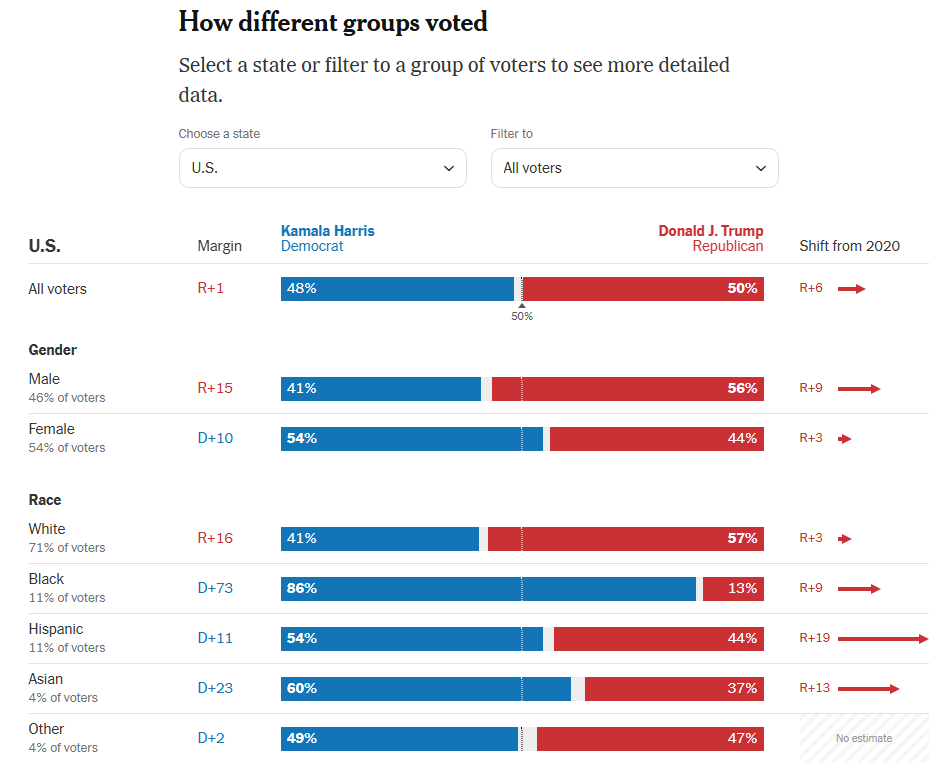
When the dust settles on election night, the story won’t simply be about who won, but who decided the outcome: Which demographic groups shifted the most, stayed home or delivered the decisive votes to the winners?
This year, we’re going to tell the demographic story of the election as we never have before. We will publish a new comprehensive portrait of how each of the key demographic groups in the country voted, called Times Voter Trends. It will break down estimates for the results of U.S. House and Senate elections by age, race, education and gender in every state in the country.
Anticipating some pushback on this point, I’ll add that it’s hard to look at candidates like James Talarico—specifically, their very left-wing past statements—and believe they are genuine moderates. He may win anyway next Tuesday, but it is taking potentially a historically bad midterm environment for the GOP (and an awful candidate of their own in this race) to make him competitive. It’s possible that if he wins he will leave that baggage in the past. But a candidate like Bobby Pulido, who is running in a Trump district in the Rio Grande Valley, would likely have put this race to bed already.