



Dear readers,
We know that in today’s oversaturated media environment, good journalism is often hard to find. So each Friday, our team highlights five pieces—analysis, interviews, editorials, and more—that caught our attention from both the past week and weeks prior. We may not always agree with every writer’s arguments, but we nonetheless think they are worth sharing.
We also want to thank you for being a reader of The Long View. And if you like what we’re doing here and are willing to do a little more than simply read, we’d greatly appreciate your becoming a paid subscriber today.
2 things from this week
Eboo Patel: DEI Demeans Minorities
But the great tragedy of DEI is that it opened up so much space for talk about racism that it crowded out any room for the kinds of activities that help people excel. Indeed, it did just the opposite. By building programs on concepts like white supremacy culture (which explicitly states that good writing, punctuality, and following protocols of excellence are “white supremacist” values) it created the impression that lowering standards for minorities (rather than raising expectations and supporting people to succeed) was morally superior and intellectually sophisticated. In fact, the DEI regime’s singular focus on racism and other forms of discrimination created perverse incentives: the more minorities failed, the more evidence there was for the ideology that the system was set up for minorities to fail.
Dino Guastella: The Earners, the Owners, and the Donors [paywalled]
As midterms elections inch closer, the Left seems to have some wind in its sails. Big victories in New York City, and a primary win in Michigan suggest, to some, that socialists and progressives have learned real lessons about how to campaign on their popular economic critique while downplaying those social positions that put them at odds with the majority of voters. Across the board, there seems to be a consensus: if the Left ditches the culture war and courts the working class by focusing only on the ways progressive policy can improve the lives of the have-nots, then the Left can win. Even Alexandria Ocasio-Cortez now claims that the era of “woke” was a kind of mania and that Democrats would be better off focusing on health care and grocery prices.
Yet there is good reason to doubt that this sort of disciplined, anti-manic approach will be widely adopted. “Woke 1 was crazy,” but Woke 2 feels almost inevitable. After all, this isn’t the first time such a conclusion has been reached. We’ve been here before.
In his 2004 bestselling book What’s the Matter with Kansas?, author Thomas Frank castigated liberals for choosing “to forget blue-collar voters and concentrate instead on recruiting affluent, white-collar professionals who are liberal on social issues.” And decades before that, works like Christopher Lasch’s The Culture of Narcissism, Irving Howe’s Beyond the New Left, and Bayard Rustin’s many writings and speeches all offered compelling arguments that that the Left ought to build a political program based on the shared economic interests of the popular classes, and not upon those moral-cultural issues that deeply divide us. Yet, repeatedly, we have proven incapable of heeding this advice. Instead, every decade or so we find some new moral-cultural crusade that only succeeds in undermining the Left’s social and economic agenda. No amount of reasoned critique or political experience has generated the capacity for the Left to act in the way we all periodically agree we ought to act. Why?
In large part it’s a story about interests. And in this case, the interests of three distinct, sometimes overlapping, social groups: professional-class high-earners whose occupations and income predispose them toward cultural issues, corporate-class owners chasing the tremendous spending power of the prior group, and uber-rich liberal donors, who—perhaps lacking anything more interesting to do with their money—seem to enjoy sponsoring endless cultural skirmishes.
Against that trifecta, what chance does common sense stand?
2 things from the archive
Matthew Vines: I’m Gay, Not Queer. It Matters.
Since then, the broad support that made marriage equality possible has grown more vulnerable. This is in part because a key message behind it — that being gay is not a choice — is being undermined by those who argue that same-sex orientation is better thought of as a part of a wider rebellion against social norms.
This worldview is best expressed in one word: “queer,” which is often used interchangeably with “gay” these days. The two words don’t mean the same thing. And in that difference lies a danger for our hard-fought equality. […]
…the capaciousness that makes “queer” appealing to some also makes the term remarkably easy for anybody — regardless of orientation — to adopt as a kind of radical chic identity label. Because the word “queer” can describe any departure from social norms, it becomes an open door through which almost anyone can walk. Polyamorous? Queer. Vaguely uncomfortable with gender expectations? Possibly queer, too.
That elasticity has helped fuel a sharp rise in young people identifying as something other than straight, even if they are unlikely to ever pursue a same-sex relationship. Some of this increase represents people who were previously closeted but are now free to be honest about their sexual orientation, which is a welcome development. But the broader trend of casting the queer net ever wider has muddled a once-clear public message about who gay people are. Being gay begins to look less like an inborn trait and more like a chosen ideology or aesthetic.
Maarten Boudry: How to Hijack a University
Long story short: our research group gradually thinned out, attracting fewer and fewer students, and entered something of a death spiral. Somewhat disillusioned, my supervisor opted for early retirement and now devotes the rest of his career to public outreach. Almost immediately, you could feel the department’s ideological center of gravity shifting. Braeckman was not right-wing by any stretch, but he cherished academic freedom and viewpoint diversity and loathed all forms of dogmatism. A few other liberal professors retired, and the new generation tended to be more ideologically homogeneous. There were still plenty of reasonable and moderate people, but they preferred to keep their heads down.
Some students felt emboldened to complain about the remaining biological approaches in our courses, deriding them with the standard slur of “scientism.” The few remaining courses in anthropology and biology disappeared from the curriculum. Some colleagues even expressed satisfaction that right-leaning students dropped out of the program after a year or two, having realized they didn’t really belong there. […]
The ideological slant became even more noticeable at the level of the Faculty of Arts and Letters as a whole. In 2020, in the wake of George Floyd’s death, our dean signed a letter on “decolonization,” along with dozens of professors. It was a nakedly ideological document calling for decolonization to become a compulsory goal across all faculties, rehashing all the familiar activist slogans about “Eurocentric” and “Western” frameworks and “racialized minorities” who supposedly don’t feel represented by academic staff with a different skin color. […]
At the time, as I wrote in Quillette, I didn’t take the whole decolonization issue seriously. When the proposal was discussed during a department meeting, I was even inclined to lean back in mild amusement. As a naturalist, I’m primarily concerned with real-world problems of today, not with poring over the great works of Kant, Hegel, and Aristotle. But how, I thought, would my progressive colleagues square the circle of dedicating their lives to all those Dead White Males while still staying in the good graces of the activists? You can’t exactly rewrite the history of philosophy. It struck me as somebody else’s problem. (I was dead wrong.)
1 data visualization
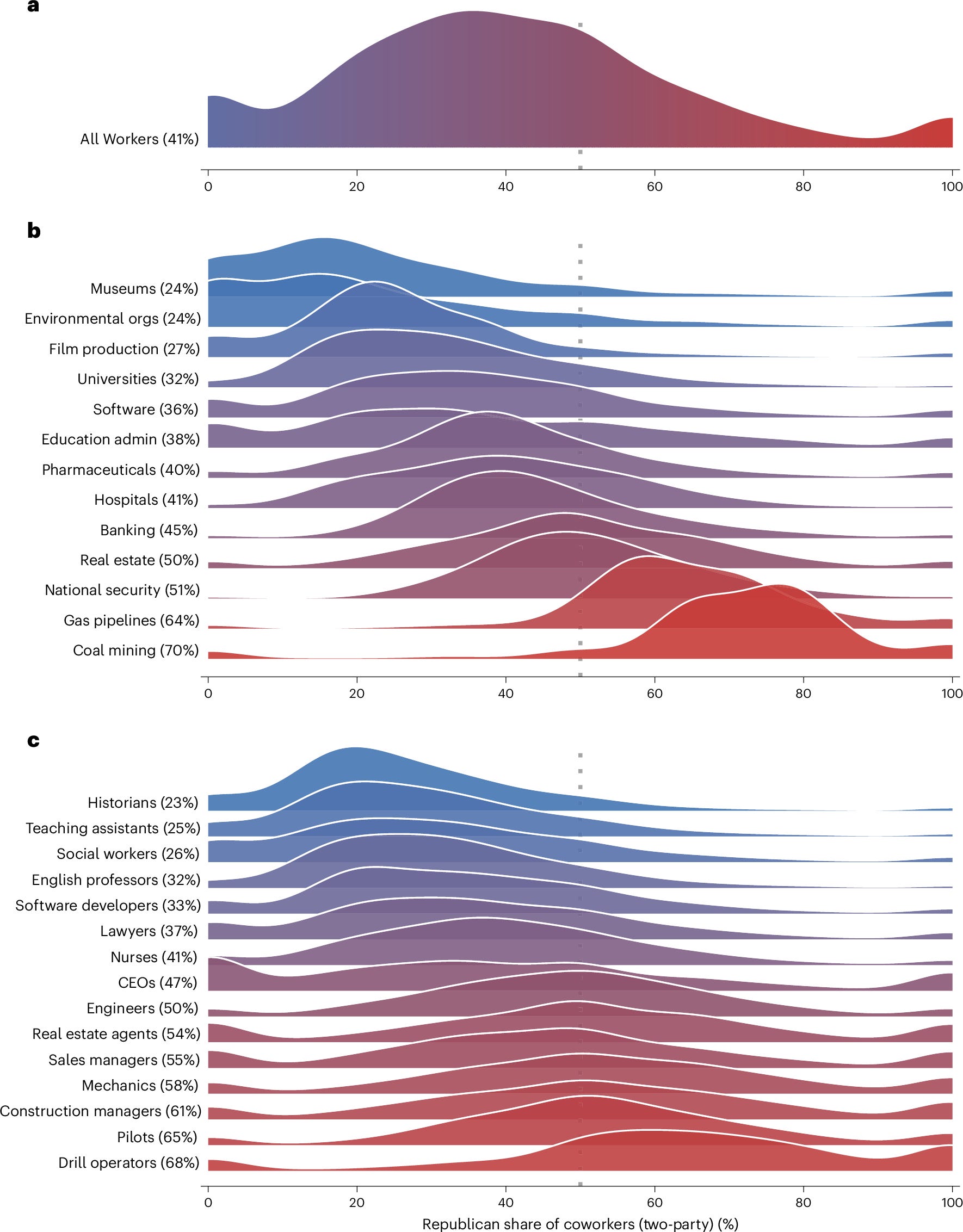
Dominic Packer & Jay Van Bavel: Partisans are highly segregated by workplace
Museums and environmental organizations have the fewest Republicans, gas pipelines and mines have the most Republicans.
Historians are most likely to be Democrats, drill operators are the most likely to be Republicans.
Political Segregation is largest among the politically active and those with more market power (senior executives).
Republicans experience higher exposure to Democrats at work: the average Republican’s coworkers are 50% Democratic versus 32% Republican for the average Democrat.
"...shared economic interests of the popular classes" become elusive in a world whose class dimension has been heavily eclipsed by gender and race. Where once the larger contours of the majority of the US population were perceived as class ones -- as in most of the best literary fiction from Dreiser and Wharton through Fitzgerald, Farrell and O'Hara to Cheever and Updike -- the contours of everyday life for most vanished from media. The closest discussed facsimile to class became "inequality." Country club exclusiveness and exploitative workplace authoritarianism remained, but for most these were no longer articulated in the public sphere until Right-wing populists swooped in to exploit them for moneyed ends.