



Dear readers,
Starting next week, the Friday Five will take a slightly different form as we work to make it a more community-driven feature. We’ll continue to share links to articles and other journalism we think are worth your time, while also soliciting recommendations from you, our readers, and incorporating some of them in our list.
We’ll also be adding a “mailbag” feature, where we—and occasionally some of our friends from the Welcome team—answer your questions about topics and themes that we regularly cover, from electoral politics and the Democratic Party to moderation, polarization, the working class, and more.
To recommend an article or submit a question for our mailbag, leave a comment on any TLV post published in the seven days leading up to the Friday Five. We’ll collect our favorites and include them in future editions.
And as always, we want to thank you for being a reader of The Long View. If you like what we’re doing here and are willing to do a little more than simply read, we’d greatly appreciate your becoming a paid subscriber today.
2 things from this week
Europe Can’t Appease Protesters Anymore [paywalled] – Dario Marino
At stake in the current crisis is the legitimacy and sustainability of Western Europe’s political and economic model. In the postwar decades, robust economic growth allowed legislators to extend social programs, which shared the benefits of economic growth immediately with them. During France’s Trente Glorieuses from 1945 to 1975, which coincided with Italy’s Miracolo Economico, output grew fast enough that each concession cost only a small share of the growing economy.
But in the wake of the 1968 protests that shook France and the rest of Europe, economic growth faltered. The regulatory state expanded, unions and other interests were able to extract ever more concessions, and a greater share of the economic pie was needed to appease the periodic demands of strikers and protesters. For a time, even with anemic economic growth, debt could be used to buy peace, shifting the problem to the next administrations and generations. What could not be paid for with economic growth was covered with debt. The establishment of the European Union only incentivized further increases in debt, due to the lower perceived default risk.
Today, the bill is coming due. All European countries are seeing an increase in bond yields as the interest they have to pay returns to pre-EU levels. Some might hope that productivity increases from artificial intelligence will unleash enough economic growth that debt will be paid without any painful reforms. But the more likely scenario is that European countries will need to take a less tolerant approach to violent disruption.
They Fled Trump’s America. Now They Regret It. – Sarah Manavis
Thousands of Americans have…relocated to Europe in the last few years. Some left seeking adventure; others, the promise of a “slower” lifestyle outside the American grind. But, for many, these reasons were just bonuses to another kind of escape: political refuge in the wake of Trump’s second term. […]
For left-leaning Americans concerned about Trump’s reelection, relocation to Europe was presented as a lifeboat: Some claim you can live gentler, freer, and, most of all, morally lighter. Celebrities, including Ellen DeGeneres and Portia de Rossi, and Rosie O’Donnell, all fled the US for political reasons. Courtney Love announced she was applying for UK citizenship in early 2025, describing the political climate at home as “frightening.” Digital nomad visas introduced after the pandemic in countries like Spain, Greece, and Portugal have made the jump logistically easier. […]
But while Trump 2.0 has more than fulfilled the worst nightmares of many Americans who left, online posts reflect a growing number of them are quietly—and at times apologetically—plotting a move back home, if they haven’t already returned.
2 things from the archive
Get the Middle East out of my politics! – Noah Smith
Today is September 11, the anniversary of the terror attacks 25 years ago. Though I don’t agree with the leftist line that those attacks were blowback from American involvement in the Middle East, it’s unquestionable that 9/11 inaugurated an era of heavy U.S. involvement in that area of the world — the Iraq War, the follow-up war against ISIS, the War on Terror, greater support for Israel, an increased military presence in the region, and finally the war against Iran.
I don’t believe that all of that involvement was a bad idea — in particular, as I’ll argue, the War on Terror, including the fight against ISIS, was generally successful and necessary. But overall, the era of heavy U.S. involvement in the Middle East has been a disaster for U.S. power and prestige, and it’s time for that era to end. […]
[It] is simply bad for America. We have so many pressing issues to worry about — Trump’s corruption and authoritarianism, inflation, AI, etc. We should not be nominating Democratic politicians based on whether they support Israel or Palestine; we should be nominating them based on their stances on issues of direct relevance to Americans, and on their ability to oppose Donald Trump. Furthermore, mobilizing Muslim and Jewish voters to vote based on Israel/Palestine, rather than on issues of importance to Americans in general, provides fuel for rightist attacks on both groups.
What the United States needs, now more than ever, is general disengagement from the Middle East — an end to military adventures, a dialing back of support for Middle Eastern “allies” (including Israel), and a forceful rejection of Middle Eastern issues in American domestic politics.
Geography of Opportunity – Joel Kotkin and Michael Lind
The migration of people and businesses has continually rewoven America’s national fabric; this process has been part of our story even before the revolution. People and firms now move to suburbs, exurbs, and even small towns. Urban cores struggle to create economic opportunities for their residents while most new business concentrates elsewhere.
These trends contradict the long prevailing notion that dense inner cities are destined to dominate the future. Numerous forces have undermined this premise. One is the rise of remote workers, who now account for more than three times the number of those who commute to work by transit. Expensive new urban rail transit projects have not increased the share of commuting by transit in nearly all cases.
Urban cores have not died, but urbanism’s trajectory is clearly shifting. Great legacy cities like New York will survive, but it is the communities on the suburban periphery, planned new cities, and restored small cities that are shaping the American future more than ever. Many of these new residential and commercial areas are not traditional “cities,” as epitomized by Manhattan, Paris, or London.
But the urban landscape is always changing; it is not eternally fixed.
1 data visualization
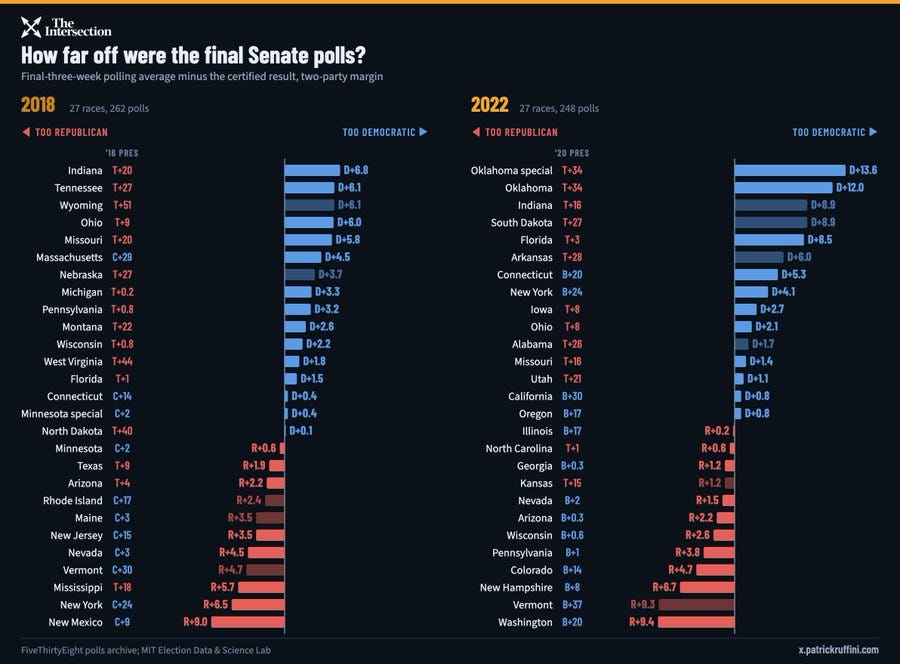
How far off were the final midterm polls? – Patrick Ruffini
We’re in the last 3 weeks when polls get graded. I built a tool that breaks down polling error in the last 2 midterm cycles in the last 3 weeks. Nationally, the polls were pretty good, but red state polls were too blue and blue state polls too red.
And this is exactly the pattern we’re seeing in current polls: Dems bullish on Kansas and Rs bullish on Minnesota. But history suggests this mean reversion is an illusion, even when the polls overall are pretty good. This aspect of polling error isn’t random.
This also looks at polls of Governor’s races. It’s a bit more random as Governor’s races are, but the same story.
Overall, Senate polls in the average red state missed by 2.7 points in a pro-Democratic direction in 2018 and 5.5 points in 2022. Errors going the other way were 2-3 points.
It's hard to believe that any Americans actually fled the country because of an election.... who are these people!
For your mailbag consideration: Why do you think someone like Matt Yglesias is going on Mehdi Hasan's show in the first place? Is the juice worth the squeeze?