



Dear readers,
We know that in today’s oversaturated media environment, good journalism is often hard to find. So each Friday, our team highlights five pieces—analysis, interviews, editorials, and more—that caught our attention from both the past week and weeks prior. We may not always agree with every writer’s arguments, but we nonetheless think they are worth sharing.
We also want to thank you for being a reader of The Long View. And if you like what we’re doing here and are willing to do a little more than simply read, we’d greatly appreciate your becoming a paid subscriber today.
2 things from this week
Mike Solana: Doom Analysis [paywalled]
If we keep building artificial intelligence, are you, and everyone you know and love, going to die?
Artificial intelligence poses several real and obvious risks, from the integrity of our internet, and by extension really almost everything that upholds our modern way of life, to the future of war. But I think our risk of accidentally building something roughly as powerful as God, which is, without exaggeration, how most major safetyists conceive of this threat, and of that God killing every human alive as it rearranges all matter in the galaxy in such a way as it finds pleasing, is negligible.
This may seem to you an odd thing to argue. It may even seem unfair. Surely, I must be cherry-picking the most extreme safetyist views to make them seem insane. But while I disagree with them to some extent, I don’t think AI safetyists are insane. And this is not a fringe idea.
The motivating safetyist fear, which has now made its way to your evening news, is the runaway artificial superintelligence (ASI) taking over a company, or companies, then infrastructure throughout the material world, where it will rapidly conquer our planet and kill everyone. Yes, they will talk about a terrorist or whatever learning how to build a bioweapon. Yes, they will contribute to the latest “chatbots made me do it” crime or suicide hysteria. And yes, they will fret, as do I, about the future of the internet. But their central concern is we are accidentally building a malevolent God.
Francis Fukuyama: The AfD Emerged From a Respect Deficit
The AfD’s political base is in the states of the former East Germany, what used to be the Communist German Democratic Republic (GDR). After unification in the early 1990s, the former West Germany made impressive efforts to incorporate the GDR into its own thriving economy, transferring wealth and welfare state benefits to the East, as well as a rule of law that granted equal rights to the former Communist society.
This formal equality was not matched, however, on a social level. […]
Many Easterners felt that they were being looked down upon by their Western compatriots. They bore a subtle social stigma that showed up in phenomena like regional accents and the Easterners’ inability to speak English well. While the latter were receiving social benefits from the West, politics remained dominated by that region’s mainstream parties.
Prior to 1989, there had been virtually no non-European immigration into the GDR, and therefore no experience of living in a culturally diverse society. West Germans did a lot after 1945 to educate their young people about the Holocaust and the militarism of the Hitler era, something that did not happen in the East. This omission fed the AfD narrative that Germans needed to stop feeling guilty for the Nazi era and to be proud of their history. Younger, less educated men in particular saw their social status decline in the liberal culture brought on after unification.
2 things from the archive
Jesse McKinley: America Is Atomizing
It’s an article of faith that America is polarized. Its people are bifurcated and bunkered, engaged in a never-ending Spy vs. Spy with each camp finding it nearly impossible to relate to the other side of the divide. That certainly describes our ruptured two-party political system: The very concept of a United States, it seems, is now misleading.
But what if that idea doesn’t quite sum it up?
Some social scientists and cultural observers are increasingly considering a more extreme concept: atomization, or the scattering of people — not into two opposing factions but into countless smaller tribes.
Like groups of atoms, those subsets can form — and dissolve — at quicksilver pace, leaving people in ever-tinier bubbles, devoid of connection with one another and the larger social fabric. Even subgroups have subgroups, dividing amoeba-like into combative factions, creating a nation of us vs. them and them and them.
John B. Judis: The Myth of a Professional-Managerial Class
In the wake of Kamala Harris’s defeat in 2024, one heard often that Democrats needed to focus on class rather than identity. But what exactly does it mean to focus on class? And what class is it that Democrats need to focus on? The party’s surging left wing has a clear answer—the working class—and usually offers an expansive conception of who is included in that category. “I think if you have to work to pay your bills,” New York City Mayor Zohran Mamdani has said, “I think that is one definition of being a part of the working class.”
However, some have taken exception to this characterization and questioned whether Democrats like Mamdani are really speaking to the working class. Citing the high levels of education and relative affluence of voters supporting progressive candidates, they claim that Mamdani and his allies’ true base is the “professional-managerial class,” or PMC.
As the centrist blogger Noah Smith put it, “The ‘PMC,’ as it has become known, was beginning to dominate the political left even in 1977; today, it arguably forms the Democratic Party’s most important voter base.” “Fifty years ago, the professional-managerial class swung right. Today, in America’s biggest cities, they’re voting for leftists like Zohran Mamdani,” wrote River Page in The Free Press.
The idea of the PMC was popularized by the left-wing social critics John and Barbara Ehrenreich in a 1976 essay in Radical America. Over the past decade, writers from various points on the political spectrum have revived versions of this concept in discussions of resurgent progressive politics, from Julius Krein and Michael Lind to Gabriel Winant and Catherine Liu, whose 2021 book was entitled Virtue Hoarders: The Case against the Professional-Managerial Class.
Is the distinction between the working class and the professional-managerial class, common to all these accounts, useful? Returning to the origins of the PMC concept makes clear how it seemed plausible at the time, but also why it has now outlived its usefulness except as a polemical term against left-wing politicians.
1 data visualization
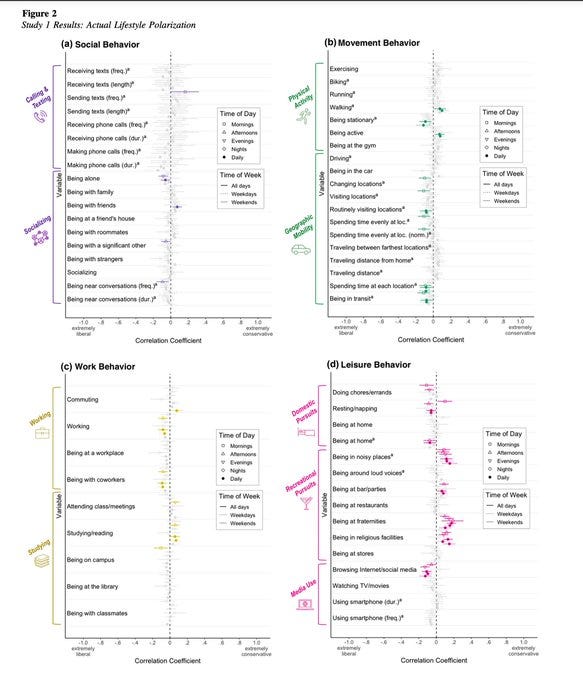
Liberals and conservatives behave differently in everyday life--conservatives seem to be out with others at lot more while liberals stay home and doom-scroll.
This study analyzed activity using smartphones to track college students and found that conservatives were more likely to be at parties, noisy places, fraternities and religious facilities. Liberals were at home, resting, doing chores, and browsing social media.
This helps explain why conservatives are, on average, happier than liberals.
The behavioral differences were small but robust, not accounted for by other plausible factors (e.g., demographics), and most pronounced in the leisure domain.
Psychoanalyzing the AfD is just a bad idea. It is really bad policy by the Establishment parties that is driving the growth. Open borders, crime, green energy extremism and its attendant economic decline, suppression of dissent and the insane war on Russia are the causes. Notably, the BSW (a definitely leftist party) and some unknown members of the CSU voted for the AfD candidate to establish a government in Saxony.
So Fukuyama is wrong again.
I don't even agree with "typical" current definitions of "liberal" and "conservative". One is used as a derogatory term...the other is used as a faux-thoughtful/measured ideological statement. I think they are both Bravo Sierra.