



Dear readers,
We know that in today’s oversaturated media environment, good journalism is often hard to find. So each Friday, our team highlights five pieces—analysis, interviews, editorials, and more—that caught our attention from both the past week and weeks prior. We may not always agree with every writer’s arguments, but we nonetheless think they are worth sharing.
We also want to thank you for being a reader of The Long View. And if you like what we’re doing here and are willing to do a little more than simply read, we’d greatly appreciate your becoming a paid subscriber today.
2 things from this week
Conor McGlynn: How Effective Altruism Took Over the World [paywalled]
The resignation of Anthropic researcher Jacob Coxon, who warns that AI could “kill us all by the end of the decade,” has prompted a new wave of attention to existential risk from AI, while drawing scrutiny to what the people working at frontier AI companies really believe about the technology they are developing. Many of those who continue to work at Anthropic and OpenAI share Coxon’s fears. Evan Hubinger, Anthropic’s Alignment Science Lead, declared in a post following Coxon’s departure: “We really do earnestly believe AI could kill all humans!” Anthropic CEO Dario Amodei likewise reiterated once again his belief that the technology his company is creating could pose grave risks to humanity.
How is it that those seeking to build superintelligent AI can also believe that doing so might end life on earth? The weakest explanation is that these statements are attempts to generate hype for marketing purposes. It is obvious when one talks to these people or reads their writing, often dating to long before the current AI boom, that these are genuinely held beliefs. Another influential attempt to make sense of this paradox comes from Timnit Gebru, a computer scientist and former AI ethicist at Google, and philosopher Émile Torres, who in a 2024 paper described what they call “the TESCREAL bundle,” standing for transhumanism, extropianism, singularitarianism, cosmism, rationalism, effective altruism, and longtermism.
TESCREAL refers to a set of ideas developed over the past forty years that Gebru and Torres take to be the key intellectual influences on current thinking about AI. Understanding this ideological cluster, the authors claim, explains the close connection between AI development and AI doomerism, and allows us to see these as “two sides of the same coin.” To make their case, they trace current thinking about AI back to an explicit ideology, namely transhumanism. In doing so, however, the TESCREAL authors mistake the origins of these ideas for how they are wielded today. Only by understanding how these ideas escaped the small transhumanist circles in which they emerged can we reckon with the influence this thinking exerts today.
Jennifer Weber: What Nikole Hannah-Jones Wouldn’t Let Herself See
Ten years ago, New York Times Magazine writer Nikole Hannah-Jones explained her decision to enroll her daughter, Najya, in a segregated, high-poverty Brooklyn public school, P.S. 307, despite having the resources and knowledge to send her elsewhere. Now, a decade later, in a follow-up essay, she concludes that her choice failed her daughter—and that segregation was to blame.
How does a child with two educated, affluent, involved parents, in the highest-spending school system in the country, reach ninth grade without knowing fractions? Hannah-Jones’s own reporting shows how: through failed pedagogy. The failures that Hannah-Jones recorded demonstrate how schools trained teachers in ill-conceived but fashionable instructional methods—at the expense of proven approaches—while also incorporating equity policies that eroded standards and made no one truly responsible for student learning.
2 things from the archive
Michael Powell: The Cities That Said Yes to Drugs
Seattle is one of the wealthiest and best-educated cities in the world. It can afford to try various strategies to address its drug epidemic and high rate of fatal overdoses. Yet many of the city’s leaders, apparently supported by voters, view enforcing bans on the open sale and use of narcotics, and forcing addicts off the streets and into treatment, as akin to an act of state repression.
Seattle, like a striking number of other liberal American cities, has embraced a radical form of “harm reduction,” which is more a philosophy about treating addiction than a scientific approach to it. Harm reduction’s adherents hold that police and outreach workers should “meet the addicted where they are,” which is to say without judgment. The New York State Department of Health, a bastion of harm reduction, describes it as a “social movement” committed to “building leadership” among drug users. In these places, de facto and sometimes legal restrictions on narcotics use have been greatly loosened; cities fund teams of workers to hand out drug paraphernalia, and in some rare cases they’ve created dedicated spaces for addicts to shoot up. Meanwhile, police departments struggling with staffing shortages and budget cuts have stopped devoting resources to sweeping users and dealers off the streets or out of parks and playgrounds. […]
Harm reduction isn’t just a problem for addicts. In many cities, the autonomy of drug users has taken precedence over nearly everything and everyone else, not least working-class families like Monsegur’s who must live alongside addicts and accept dystopian decay. Keith Humphreys, a Stanford psychiatry and behavioral-sciences professor and a former adviser to President Obama, supports needle exchanges and opposes the widespread jailing of users. But when he argues that drug policy must take into account the impact on communities, he told me, some critics dismiss him as a reactionary. Their arguments, he said, “sound a lot more like gun rights and vaccine refusal. It’s no longer about the whole population; it’s about the subset who use drugs.”
In recent years, officials in cities such as San Francisco and Philadelphia have moved to rein in the excesses of harm-reduction policies. Nevertheless, these policies retain a powerful hold on public-health and political leaders in blue parts of the country. I witnessed this in visits to Seattle and Burlington, Vermont—two of America’s more progressive cities. Both are afflicted by high overdose rates, overwhelmed police forces, parks and public squares often captive to drug use, and the theft and disorder that accompany all of that. Yet many of their elected officials continue to insist, despite everything, that harm reduction is the most effective and moral solution to addiction.
Brink Lindsey: Liberalism hasn’t failed, but many liberals sure have
In my most recent podcast, Jonathan Rauch and I discussed the internal division among liberals regarding how to respond to the stern challenges now being mounted from the extremes of right and left. Some liberals (including me) argue that the rise of political extremism reflects a misguided reaction to genuine, serious problems afflicting contemporary liberal society, and thus that acknowledging and working to remedy those problems are essential to any well-formulated liberal response. Others (including Jonathan) argue that excessive self-criticism within the liberal camp only serves to add fuel to the extremists’ fire.
Much of our conversation focused on whether and to what extent liberalism was “responsible” or “to blame” for the resentments and grievances that have spurred forward the populist right along with the “woke” and socialist left. From my perspective, the problems underlying our political crises are problems of mass affluence, which itself is a world-historical triumph of the first order made possible by liberal values and institutions. Liberalism is thus responsible for our current problems in the sense that it gave us mass affluence and mass affluence has given us new problems. Our contemporary ills, however, do not represent some deep-seated failure in the basic principles of liberalism that has now finally manifested itself. Rather, liberalism has been an engine of amazing social progress — but it is the fate of social progress, as it takes us deeper into the terra incognita of unexplored historical novelty, for every solution to preexisting problems to present us with new problems to solve.
Accordingly, I don’t think it makes sense to blame liberalism for the discontents roiling society today and the political crisis that has resulted. First of all, the problems of mass affluence and unprecedented freedom of choice are far preferable to humanity’s traditional problems of poverty, ignorance, and oppression; furthermore, liberal values and institutions represent our best chance for rising to contemporary challenges, just as they guided us to triumph over those traditional ills.
Here I want to change the focus — from the basic principles of liberalism to actual, flesh-and-blood liberals, and from creating the problems that sparked the political crisis to actually responding to that crisis since it has flared up. In other words, the question I want to raise here is: does the disturbing strength of political extremism at present reflect failures by liberals in responding to the extremist challenge? My answer to this question is an emphatic yes: there is no way things could have gotten to the current pass without massive failures and blunders by liberals on both sides of the ideological spectrum.
This was not the question that occupied Jonathan and me, but I think it gets much closer to the raw nerve of current internal disputes within Team Liberal. And that’s because, under the present circumstances, it focuses attention on heated controversies within the Democratic Party and the ideological left over how to win against right-wing populism and where to lead the country.
1 data visualization
Since Labor Day, many major pollsters have begun switching from polling registered voters only to applying “likely voter models,” which attempt to identify the voters most likely to turn out in the November midterm election. Some pollsters release results for both registered and likely voters. But few separate out registered voters who do not qualify as likely voters and examine how they think, which is what made a recent survey from YouGov so interesting—and insightful.
Like many other pollsters, YouGov broke out likely voters—those who said they will “definitely vote”—from its sample. Among these voters, Democrats had a whopping 11-point lead over Republicans on the generic ballot. This was the finding that generated the most headlines. But YouGov then broke out voters who said they would “probably” vote as well, and among these voters, Republicans had the lead—and by an even larger margin of 21 points (though the number of undecideds were much higher at 23 percent).
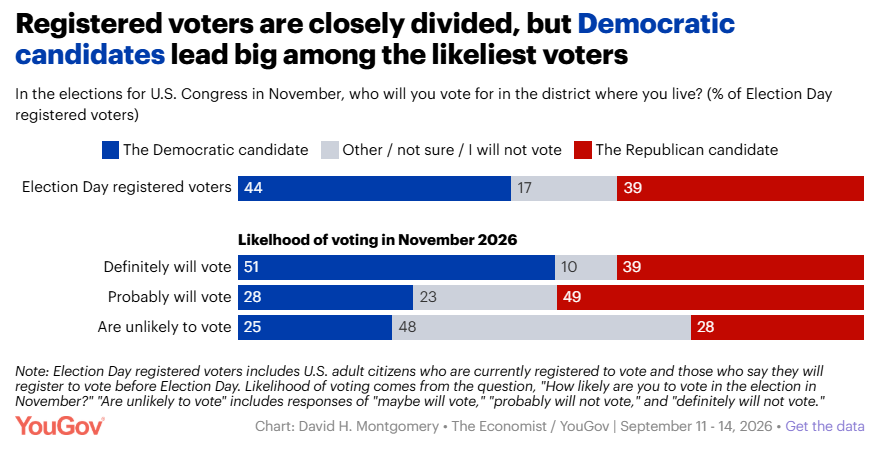
“Probably” does not carry the same certainty as “definitely,” and with good reason. But it’s also fair to suspect that most people interpret it as meaning “more likely than not.”
It is, of course, possible that likely-voter models are accurately capturing who will show up to vote in November; several signs suggest that a blue wave is a highly probable outcome. Friend of TLV Patrick Ruffini recently analyzed past pre-election polling trends from the Trump era and found that Senate polls, specifically, tended to become considerably more accurate by Election Day in midterm years than in presidential years. If that pattern holds this year, the Democrats stand a good chance of flipping the Senate—and flipping the House would likely be a foregone conclusion.
However, YouGov’s data may hint at a more complicated—and more competitive—landscape than many of us have expected up to now.
"How does a child with two educated, affluent, involved parents...." First of all, educated used to mean learned, now it just means you bought a diploma. Second, as far as 'involved parents," she had lunch with her daughter IN THE 3RD grade, witnessed first-hand the failures, then kept her daughter in that school district for another six years?? And third, this school spends $50,000 per pupil and her take-away is that the school just needs more money??
It is worth noting that Hannah-Jones made the opposite decision that the Clintons and Obamas did when they moved into the White House. Each of the Presidential families prioritized their own children. Both caught a good deal of criticism from Left and Right for doing that. From the Left, it was the same sort of argument that Hannah-Jones made. From the Right, it was for opposition to school choice for the non-affluent. Given the resentment that Hannah-Jones has caught from her daughter, I would have to say that the Clintons and Obamas made the right choice. As an aside, in my time in the C-Suite of an urban school district, it was obvious that the energy behind the charter school movement came from black parents seeking the best for their children.