



Dear readers,
We are launching a new recurring segment today called the Friday Five. The premise is simple: many of you likely have a surfeit of content to consume on a daily basis, and we want to help you weed through it by showcasing some of our favorite work from others. In each edition of the Friday Five, we will highlight two pieces from the past week, two pieces from further back, and one piece of data that we found interesting and worth sharing—something you can take into the weekend.
Additionally, we want to thank all of you who have joined us at The Long View. We are thrilled to have a new home for our writing and appreciate that you have chosen to be a part of this new endeavor. As we have mentioned, we know all too well that this work truly cannot happen without your support. If you like our work and are willing to do a little more than simply read, we’d greatly appreciate your becoming a paid subscriber today.
Paid subscriptions are what will allow us to keep investing the time and effort required to do this work well—to dig into the data, follow arguments and trends beyond the daily news cycle, and build something that can last.
And even if you’re not ready to pay, please keep reading and sharing the free posts. We’re grateful to have you with us either way.
-Ruy & Michael
2 things from this week
Bill Galston: Josh Shapiro Shows Democrats How to Win
The persuaders’ flag is being carried by Gov. Josh Shapiro of Pennsylvania, the largest and most important swing state. Except for George W. Bush, every winning presidential candidate since 1972 has carried the Keystone State, and in the past 10 presidential elections the winning candidate’s share of the state’s vote has deviated from his national share by an average of only 1.6 points. With its mix of bright blue big cities, purple suburbs and dark red rural towns, Pennsylvania has become a microcosm of the country.
Mr. Shapiro’s standing in his race for re-election is remarkable. According to polls conducted in the past two months, he leads his Republican challenger by more than 20 points. His job approval stands at 60%, including 56% of white voters without college degrees. Along with near-unanimous support from Democrats and from 58% of independents, 31% percent of Republicans approve of his performance in office, as do 30% of Trump supporters. Seventeen percent of Republicans say that they will vote for him.
In our polarized times, these results are unusual. But they are explicable. Fifty percent of Pennsylvania’s electorate sees the Democratic Party as having moved too far left, compared with only 33% who think that the party hasn’t moved too far in either direction. For Mr. Shapiro, it’s the reverse: Just 29% see him as having moved too far left, while twice as many—58%—see him as neither too far left nor too far right. Only 11% of Republicans think that the Democratic Party has found this sweet spot on the ideological spectrum, but 37% think Mr. Shapiro has. This is a good operational definition of moderation, and he is reaping its rewards. […]
…if Mr. Shapiro wins the smashing victory that current polls project, backed by a unified Democratic Party, a majority of independents and a substantial crossover vote from Republicans, his strategy of persuasion through moderation will be vindicated in a state that serves as a dry run for the 2028 election.
Congressman Tom Suozzi (NY-03): Democrats Must Reject the DSA
Millions of Americans are losing faith in their government, their institutions, and an economic system that no longer seems to reward hard work. They struggle to afford housing, healthcare, and education while watching wealth become increasingly concentrated at the top. They’re mad as hell, in other words, and they’re not going to take it anymore.
But if Democrats are going to earn the confidence of these Americans this November and beyond, the answer will not be found in the Democratic Socialists of America’s (DSA) platform. Although relatively small in number—the organization counts 120,000 members in a country of some 330 million people—the DSA is aggressive and disciplined. Candidates affiliated with the group are winning Democratic primaries. But we cannot allow them to drag our party to the far left. […]
Capitalism and democracy helped make America prosperous, innovative, and powerful, but neither is self-correcting. Unchecked capitalism can concentrate wealth and crush market competition. A hostile and paralyzed government can destroy confidence in democracy. We must repair both systems, not abandon one or surrender the other.
The DSA is not proposing that we become more like Denmark or Norway, two liberal democracies with universal healthcare and a more robust social safety net. Instead, they propose something much more radical.
2 things from the archive
Tyler Austin Harper: Confessions of a Token Black Professor
I had spent my entire adult life at college, in grad school, and now working as a professor, and I had never before been self-conscious about being a beneficiary of affirmative action. I had always assumed that if I simply worked harder than the people around me—if I read more, went to more conferences, published more and in better venues—then nobody would question whether I deserved to be there. My experience on that search committee, though, disabused me of the notion that any of this mattered at Bates. The school’s culture encouraged us to see professors of color as vehicles for achieving the college’s diversity goals. The inescapable conclusion I arrived at was that I had been hired to be visibly Black first and a scholar second, if at all. […]
I never stopped believing in affirmative action in principle, but I slowly stopped believing in it in practice. I’d understood the spirit of affirmative action to be about recognizing that people from historically underrepresented groups often face additional barriers, about affirming that talented minorities who may be less connected and superficially less refined can nonetheless rise to the occasion if given the opportunity. It seemed to me that the Bates administration’s push to diversify at all costs had led some of my colleagues on the faculty to internalize the opposite idea: that it is not especially important to find minority candidates who are capable of being held to traditional academic norms. Justice and anti-racism required a two-tiered system, a sort of woke Jim Crow, in which radically separate standards were applied to white and nonwhite candidates. In short, I came to see Bates College, self-styled beacon of progress, as an institution that was deeply, incorrigibly racist.
Aaron Renn: The End of the Interregnum
What comes next after the Trump era in American politics? And will it be a durable governing majority, or just another oscillation in a deeply polarized, nearly 50/50 nation?
The durability question is an important one. We are in a period of transition in America. The old arrangements of the 80s and 90s no longer seem fit for purpose to many. We have a long list of challenges to address: demographic transitions, China competition, social atomization and associated dysfunctions, etc. for which the old answers no longer seem as relevant.
Part of how that transition has manifested is in our political instability, and the gradual decline of our old political order. That decline is shown, for example, in the progressive rejection of old political norms and arrangements, such as how the filibuster has been weakened over successive administrations and the growth of party line voting on Senate confirmations for presidential appointments.
One part of moving beyond the transition period is the development of a governing majority that can implement the institutional changes needed to get America fit for the challenges of both today and tomorrow. I would define a durable governing majority as one that is able to hold the presidency for 12 years, have enough support in Congress to pass more than one or two significant pieces of legislation, and in which the minority party accommodates itself to a significant part of the new agenda.
I would define the Reagan-Bush era as a durable governing coalition. It wasn’t Republican hegemony and didn’t get everything it wanted, but it did get things done - and set the tone for another decade or more of similar approaches. The Democratic Leadership Council and Bill Clinton largely kept the economic playbook, and even embraced Reaganesque ideas like welfare reform and tough on crime measures. We haven’t had another period like this in about 35 years. (I should not, however, that various parts of Trumpism like China skepticism are being more broadly absorbed even by people who don’t like him generally).
So what are the possible 2028 outcomes, and are they potentially durable ones? If we use the standard left-right spectrum as one axis, and a populist-institutionalist as the other, this produces a 2x2 matrix of basic outcomes. We will examine each in turn.
1 data visualization
Matt Yglesias: The Great Awokening started in 2014, not 2020
The whole “Woke 1” discourse is a good joke, but it obviously lacks a certain kind of precision.
I wrote a big feature for Vox about what I called the Great Awokening back in March of 2019, which obviously was before Covid and before George Floyd. So while the social phenomenon I was talking about clearly reached its apogee 12 or 24 months after I published the piece, the underlying shifts were visible before that. There are a bunch of different ways to characterize what these shifts were, but I think if you want a single clear data point to focus on, I would look at the share of the non-Black population that says “yes” to the question “On the average Black people have worse jobs, income, and housing than white people. Do you think these differences are mainly due to discrimination?”
While 2014 feels like a long time ago now, when I wrote my Great Awokening piece in 2019, it was only five years in the past. And you can see that as recently as 2014, a majority of non-Black Democrats said “no” to this question. The numbers then surged among non-Black Democrats and non-Black independents in the 2016, 2018, and 2022 surveys while Republicans had small increases in 2016 and 2018.
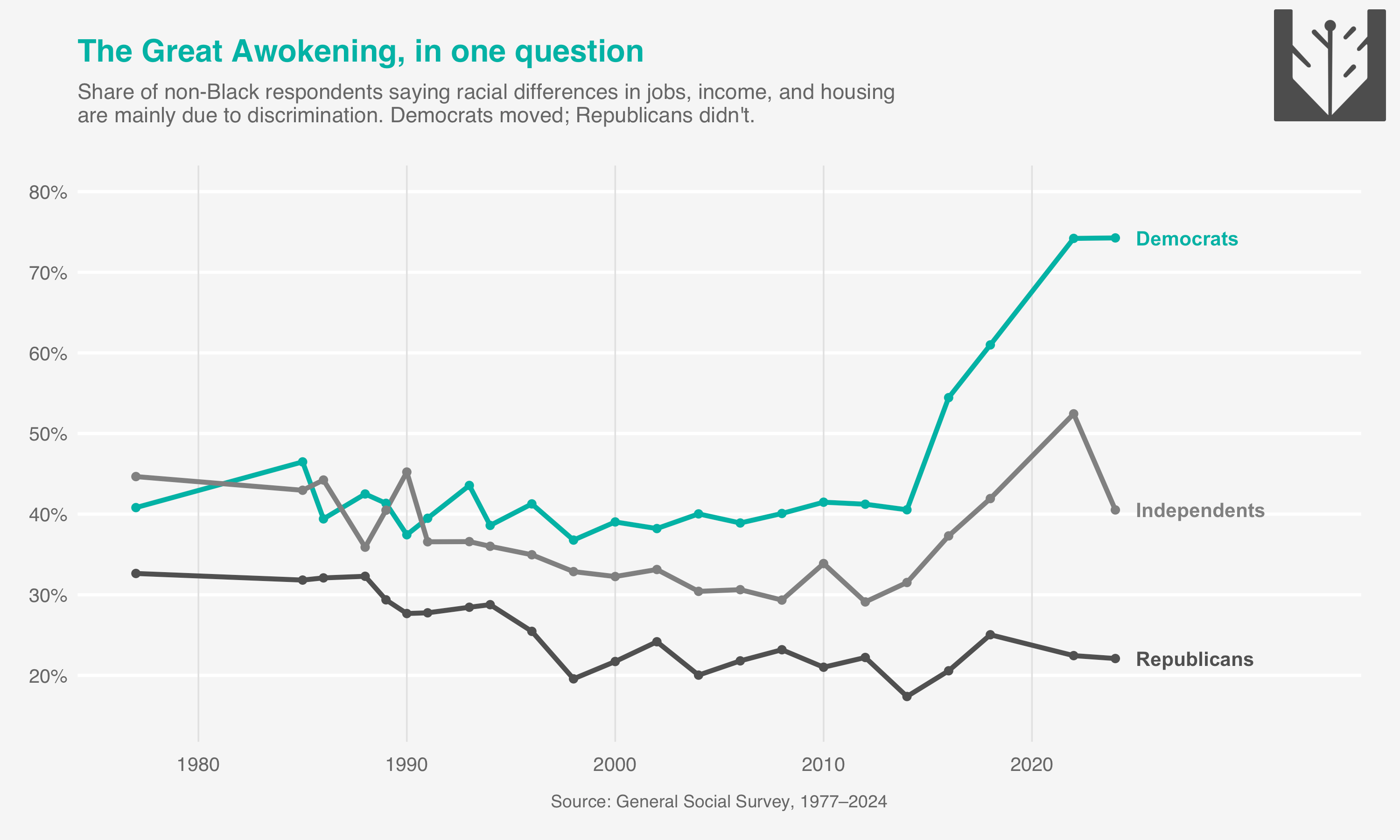
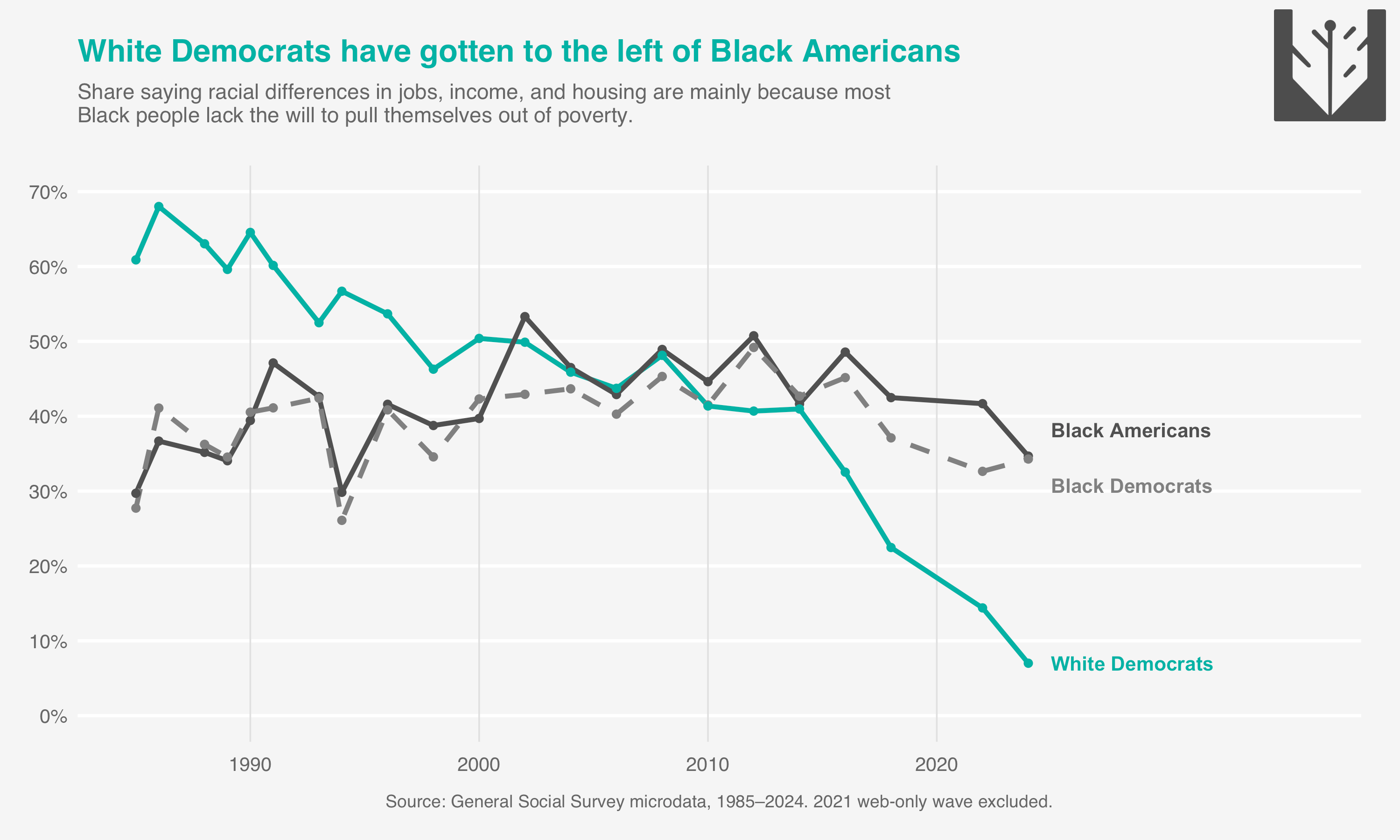
[…] I think the Great Awokening is almost by definition about shifts outside the African American community. You can, though, see that Black opinion has not really moved all that much — the key thing is that white Democrats’ views have shifted considerably.
I like the idea of the Friday Five. There is definitely too much to read, and it's interesting to see what you pick out of the pack. Still not convinced the Shapiro strategy is persuasion through "moderation," but his strategy is certainly worth watching, no matter how it is characterized. I like what I'm seeing with Rob Sand, in Iowa, too.
I am betting on another oscillation. Trump (and AOC) are symptoms not the cause of the deep divisions. The cause is the utter failure of the Establishment in politics and everything else. You can't create a stable coalition on this foundation.