


I don't know what to say really. Three minutes to the biggest battle of our professional lives all comes down to today. Either we heal as a team or we crumble. Inch by inch, play by play, til we're finished. We are in hell right now, gentlemen and we can stay here and get the shit kicked out of us or we can fight our way back into the light. We can climb out of hell. One inch, at a time.
There’s a comforting story Democrats tell themselves about Trump voters. It goes like this: they’re all in a cult. Brainwashed. Irredeemable. Beyond reach. This story is useful because it absolves Democrats of responsibility. You can’t reason with cultists, so why bother trying? Just energize your base and wait for demographics to save you.
A few days ago, Politico reported a new DNC outreach campaign to win over 2024 non-voters with a “listening first approach,” featuring this quote from the DNC’s Deputy Executive Director: “We didn’t lose to Donald Trump. We lost to the couch.”
New research from More in Common should shatter this delusion. After interviewing more than 10,000 Trump voters across ten months, they arrived at a conclusion that ought to reframe Democratic strategy entirely:
President Trump has built a coalition, not a cult.
Democrats need to understand that to understand how to win.
Only 38 percent of Trump’s 77 million voters say that being MAGA is important to them. More than 6 in 10 Trump voters don’t identify with the movement named after him.
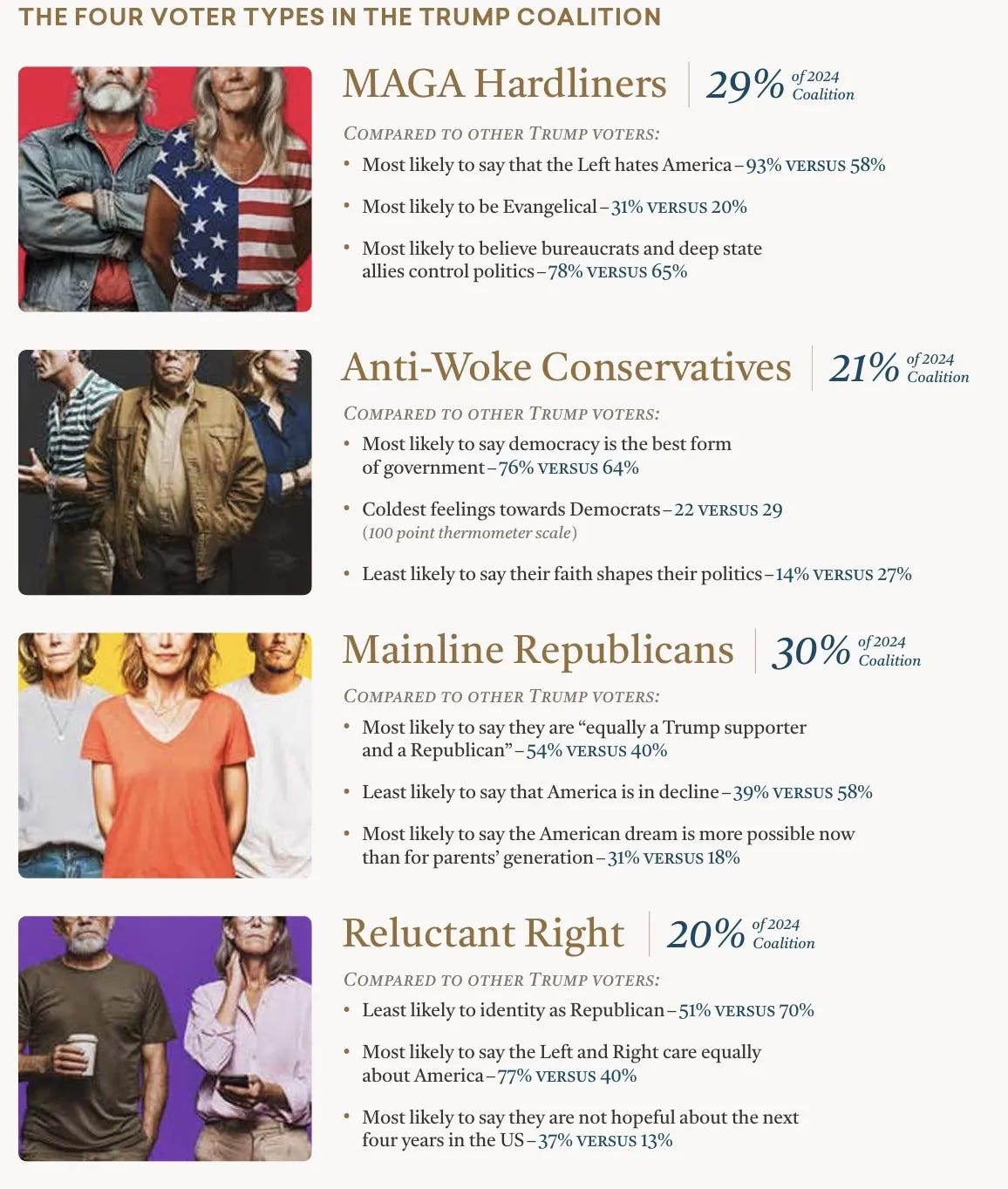
The Four Flavors of Trump Voter
More in Common identifies four distinct segments within the coalition. MAGA Hardliners represent about a third of Trump voters:
MAGA Hardliners represent the fiery core of Trump’s base. They are fiercely loyal, deeply religious, and animated by a sense that America is in an existential struggle between good and evil, with God firmly on their side.
9 in 10 agree Trump is “the best leader the Republican Party has had in my lifetime,” and 6 in 10 believe he should “punish his opponents for the damage they’ve done.”
OK, so these voters aren’t flipping.
Anti-Woke Conservatives make up roughly a fifth of the coalition:
Anti-Woke Conservatives are relatively well-off, politically engaged, and deeply frustrated by the perceived takeover of schools, culture, and institutions by the progressive left.
These voters aren’t driven primarily by economics, healthcare or affordability. They are motivated by the perception that progressives have captured every institution that touches their lives. Every time a Democratic candidate is forced to answer to “the groups”, these voters get further away.
Mainline Republicans comprise another quarter:
Mainline Republicans are middle-of-the-road conservatives who play by the rules and expect others to do the same. Most do not follow politics closely. For them, Trump’s strength is that he advances familiar conservative priorities: securing the border, keeping the economy strong, and preserving cultural stability.
These are your parents’ Republicans, the Phil Scott or Charlie Baker Republicans. They’d vote for Mitt Romney in a heartbeat if he were on the ballot. Trump is their vehicle, not their religion. They want normalcy, and right now neither party is giving it to them. These voters are potentially gettable.
The Reluctant Right is a key story, with roughly 22 percent of Trump voters:
The Reluctant Right are the most ambivalent cohort of Trump’s coalition... most likely to have voted for Trump transactionally: the businessman who was ‘less bad’ than the alternative.
Only 9 percent of the Reluctant Right view Trump as the best Republican leader. Only 8 percent support punishing opponents. These voters chose Trump despite finding him distasteful because Democrats seemed worse. For roughly 17 million Americans, the chaos agent they don’t much like was still preferable to us.
The Numbers That Should Haunt You
The More in Common data reveals a gradient that should be tattooed on the forehead of every Democratic strategist:
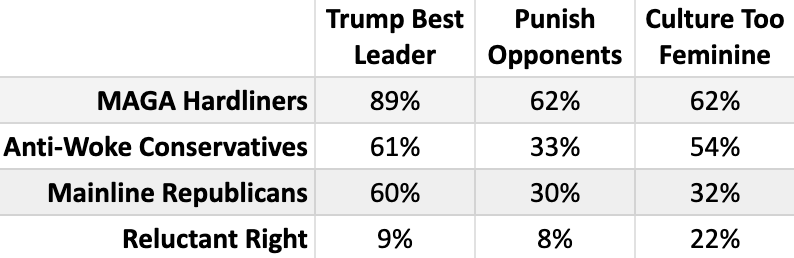
Look at that spread. You’re telling me there’s no strategic daylight between voters who 89% agree Trump is the greatest Republican ever and voters who only 9% agree? You’re telling me the 62% who want to punish opponents and the 8% who reject that idea are equally unreachable?
What Would Mary Do?
Mary Peltola understands. In Alaska, she won voters who pulled the lever for Trump by double digits. She did it by being vocally pro-gun, pro-drilling, and pro-choice, a combination that progressive gatekeepers insist is impossible.
Peltola didn’t treat every Republican voter as a MAGA cultist. She treated them as Alaskans who wanted practical representation. The Mainline Republicans? She spoke their language on energy and the economy. The Reluctant Right? She gave them permission to split their ticket.
Democrats don’t need to flip all Trump voters. The Reluctant Right is 22% of Trump’s coalition, roughly 17 million voters. If you peel off even 10% of them, that’s 1.7 million votes. Shift 5% of the Mainline Republicans and you’re looking at another million.
But these voters have conditions. They’re not coming over because you think Trump is bad. They’re coming over if the Democratic alternative doesn’t scare them more.
That means candidates who can credibly distance themselves from progressive cultural politics. Candidates who talk about the border like it’s a real issue and not a right-wing fever dream.
All We Got
Here’s what makes Trump’s coalition sticky despite its internal contradictions:
Yet these divisions exist alongside striking agreement: America is in crisis, the political establishment has failed, and the other side holds them in contempt. Whether the coalition endures may depend on whether these shared frustrations remain strong enough to override differences about deeply-held identities and about what lines should not be crossed.
Democrats have focused a lot on the first two beliefs. America is in crisis, and the establishment has failed. That’s what the “affordability” messages are about.
But that third belief? That “the other side holds them in contempt”?
That one too many Democrats keep confirming every day. Persuadable Trump voters are all around us, and winning them over is how to climb back to the light.
Read the full report in the More in Common US Newsletter below:

Yep it’s driving me nuts that some of my fellow Dems think we should drive further left because Trump voters are completely ungettable.
In order to convince my fellow Dems I continue to seek a telling sports analogy for the approach (wanting to win without conceding on any policy positions regardless of their appeal). Your team hasn't played great with their risky high variance deep passing offense but you garner a slight lead at halftime as a result of opponent ineptness. Yet you play the 2nd half the same way because you want your star receiver to be happy rather than a more conservative ground game to burn the clock and amplify your likelihood of winning. Open to better suggestions.