


Twice in eight days, pollsters1 mistook nail-biters for progressive blowouts in a Midwestern Democratic primary. They may have missed something obvious: independent voters in open primary states.
In Michigan, the final five public Senate polls showed Abdul El-Sayed with leads of 10, 13, 14, 15, and 16 points over Haley Stevens. He won by less than a point.
In Wisconsin, the final five gubernatorial polls had Democratic Socialist Fran Hong with leads of 11, 13, 18, 20, and 22 points over David Crowley. She lost.
Debates rage over the implications of these primaries for the intra-party factions in the 2028 Democratic presidential primary. Naturally, most focus on Democrats. But voters are increasingly not registered with either party. Including those who vote in primary elections. In Massachusetts, which has an upcoming primary, independents made up 41% of Democratic primary turnout in 2018 and 45% in 2022.
In 2019, Welcome began by engaging independent voters ahead of the 2020 presidential primary. Our first report, an analysis of the New Hampshire voter file titled 50/50 in 2020: Trends Point to Half of Democratic Voters Being Independents, identified the basic drivers:
Share of voters registered as independent was going up
Share of primary-voting independents choosing a Democratic ballot would go up
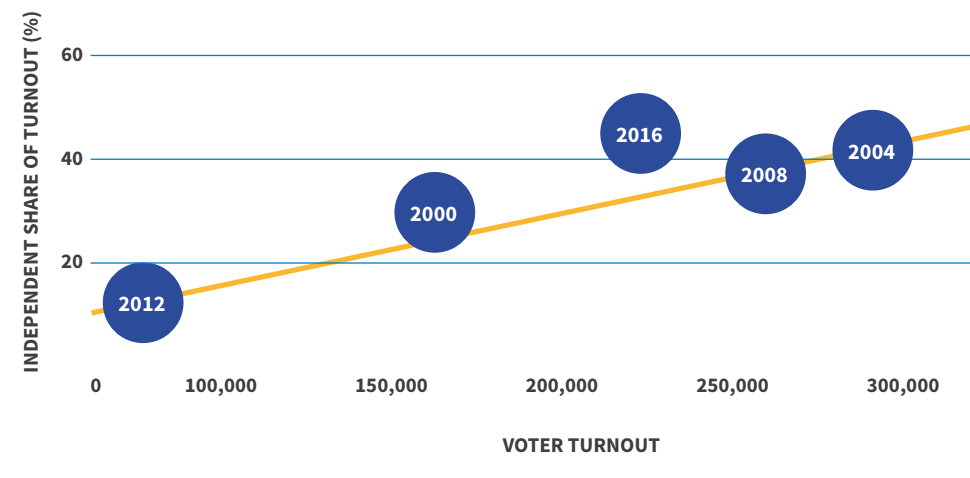
As in Massachusetts primary elections, increases in New Hampshire presidential primary turnout are strongly correlated with increases in the share of Democratic primary voters who are registered as Independent:
On Wisconsin
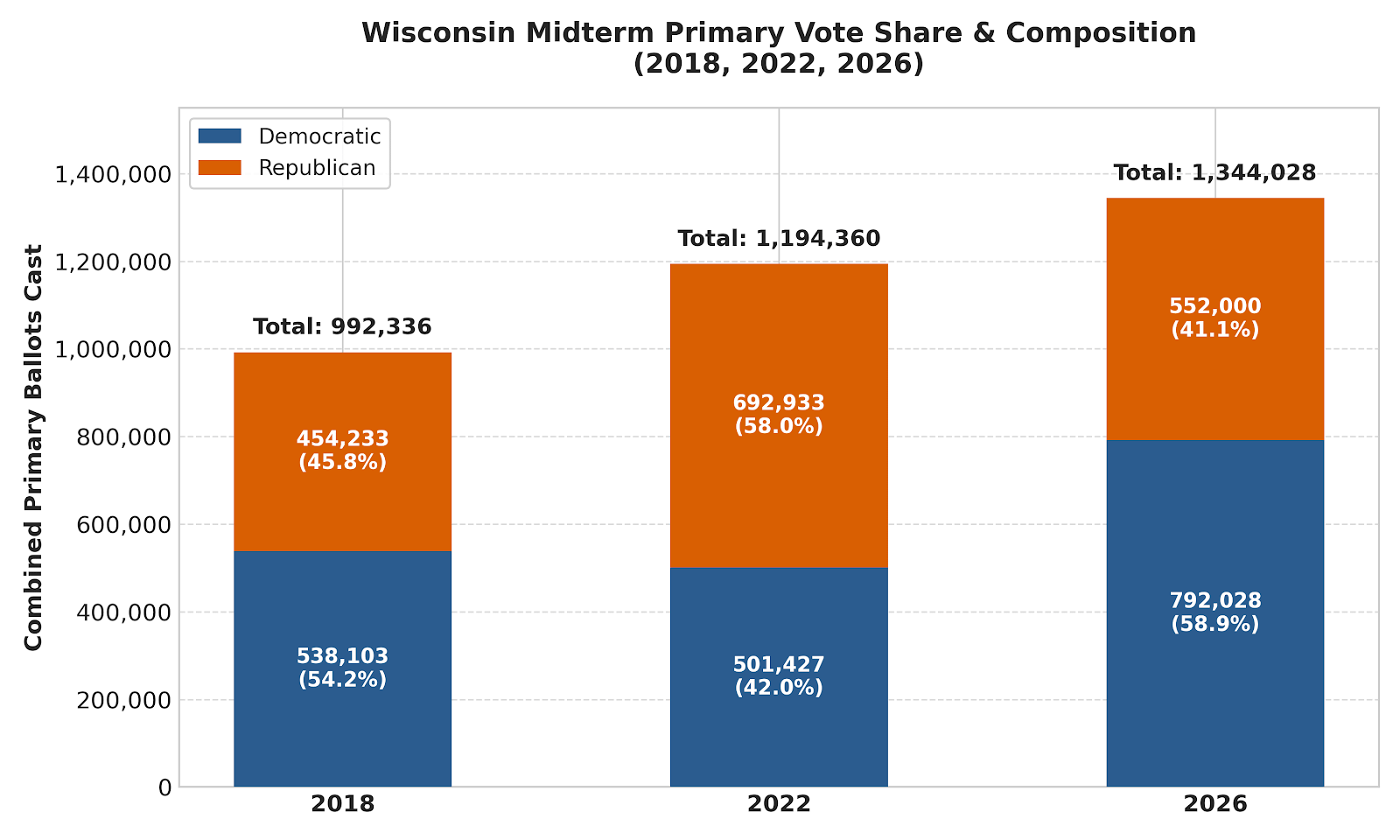
Back to the Midwest. In Wisconsin, turnout surged in the Democratic primary - from less than 540,000 in each of the last two gubernatorial primaries to nearly 800,000 in 2026. That’s an increase of 47% from 2018 and 58% from 2022. At the same time, turnout in the Republican primary (orange bar) decreased by 20%.
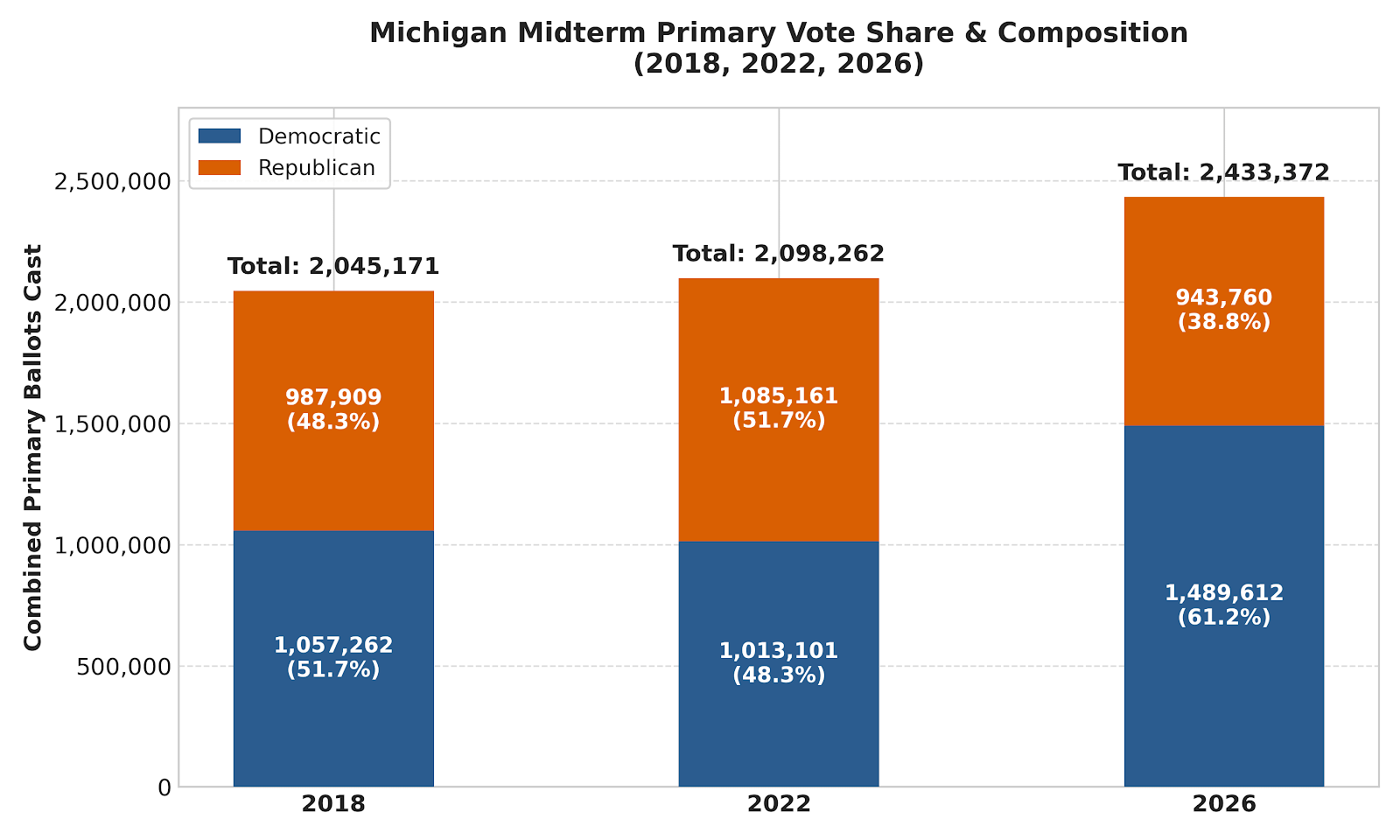
The story in the last three Michigan midterms is similar: increasing turnout, increasing share in the Democratic primary (blue bar), and Trump-era lows in GOP turnout (orange bar) in 2026.
All the punditry this week was about Democrats. But it is a safe bet that the difference-makers were Independents, many of whom pulled a mix of Democratic and Republican ballots in past elections or were simply roused by the fear of extremism.
After Michigan, the surge story was partially about Democrats (and partially about interest group SuperPAC spending). But Wisconsin - like South Carolina in the 2020 presidential primary - looks more like a quiet revolt from Independents.
Recall 2020
Back to New Hampshire, and the 2020 presidential primary. In the final polling average, Bernie Sanders and Elizabeth Warren combined for 39% of the vote while Pete Buttigieg and Amy Klobuchar combined for 33%.
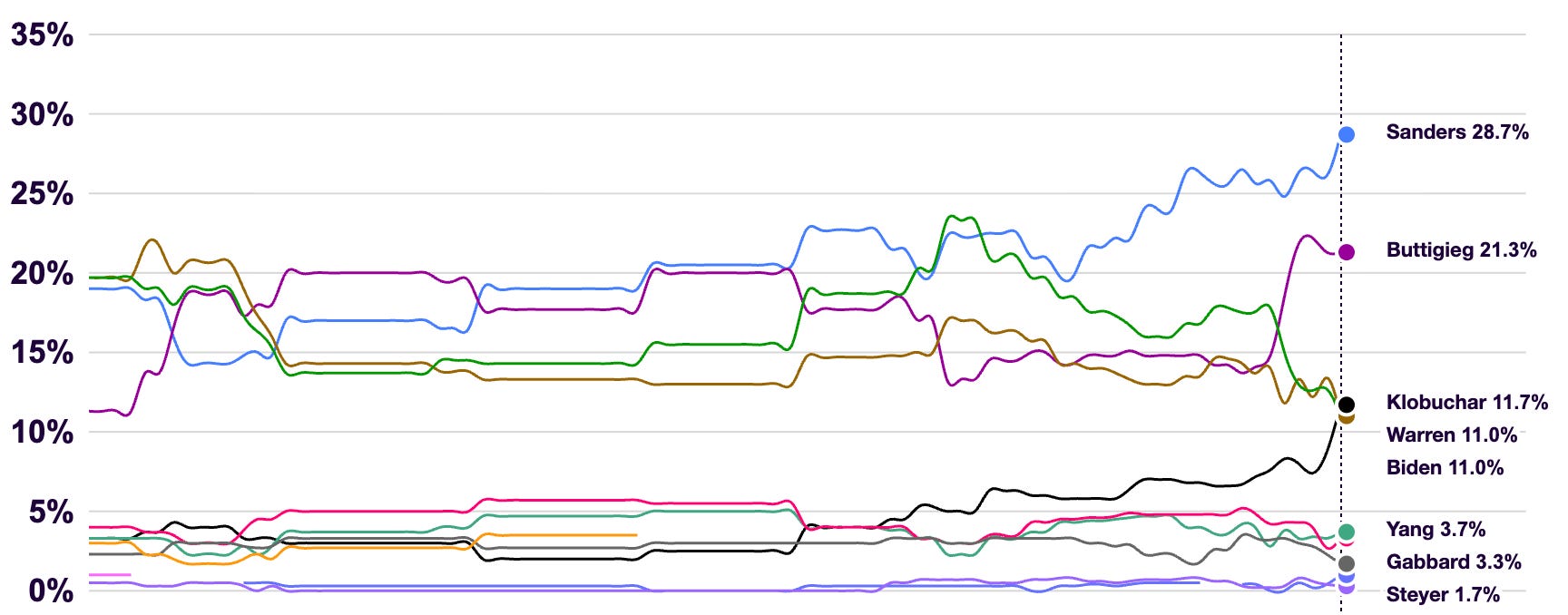
The result was flipped from the polling averages: Pete+Amy at 44% and Bernie+Warren at 35%.
In South Carolina a few days later, Bernie again performed well below his polling average as Biden ran 9 points ahead of his polling average.
New Hampshire and South Carolina had similar dynamics in the 2020 presidential primary that Wisconsin and Michigan had last week:
Primary laws allowing Independents to participate
Little competition for attention and ballot-casting from the GOP primary
A surge of attention on leftwing momentum in the week leading up to voting
2028 (Weak) Tea Leaves
Discussion on the 2028 presidential primary calendar, has focused on racial dynamics, with snow white Iowa and New Hampshire getting bumped.

But the real news is that the activist-dominated caucuses are gone, replaced by early voting states where primaries are open to independent voters.
That is a huge difference!
Check out the share of the Citizen Voting Age Population that participated in the 2020 nominating process, where higher on the chart indicates a higher participation share, with states moving chronologically from left to right:
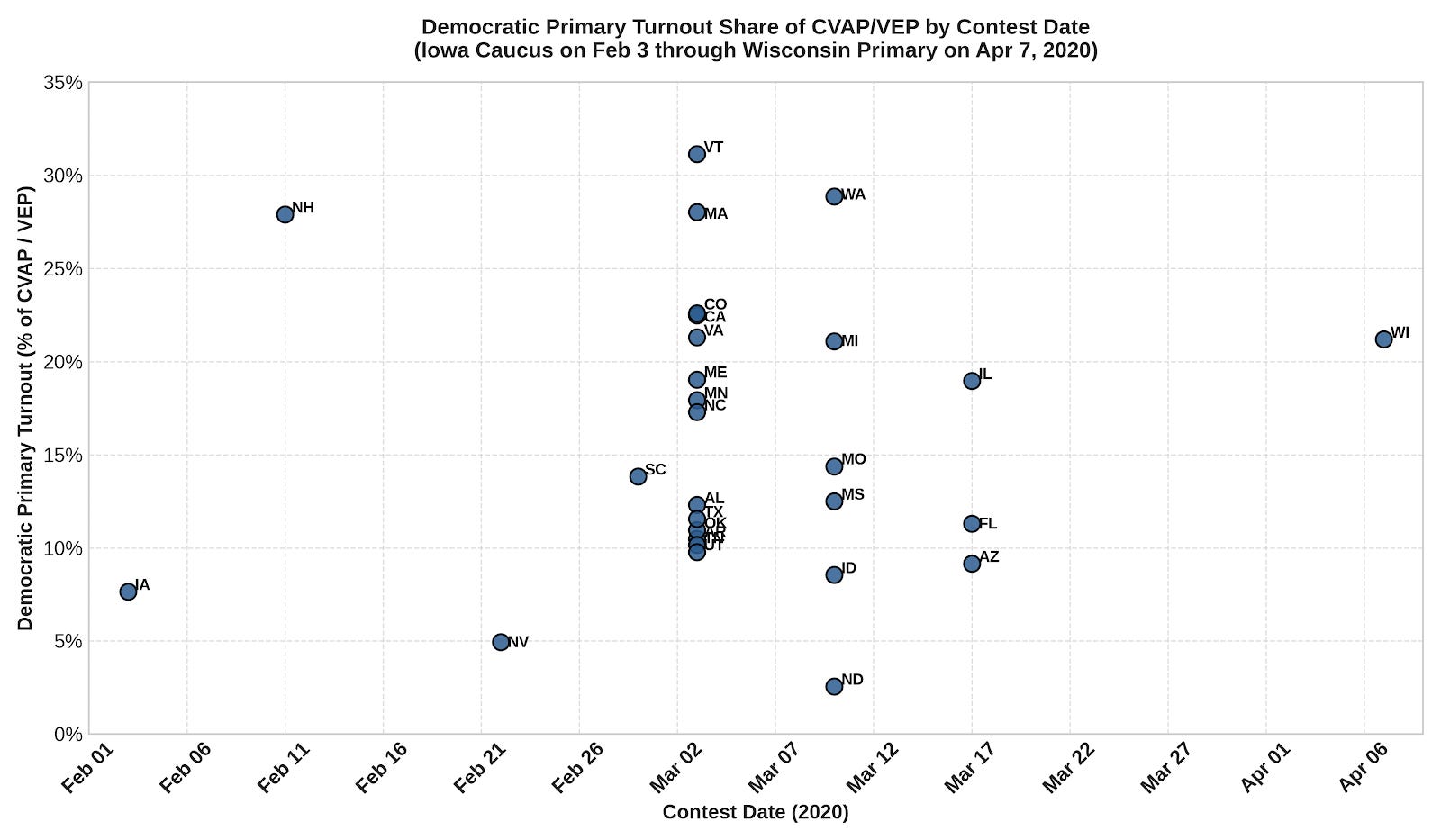
This had clear ideological implications: Bernie’s highest vote shares were in the bottom states, where voter participation was lowest. Leaving aside his home state of VT and neighboring NH, Bernie won Iowa (<8% participation), then cracked 40% vote share in Nevada (<5% participation), Idaho (<9%), and North Dakota (<3%).2
Each of those states had less than one-third the participation of New Hampshire voters.
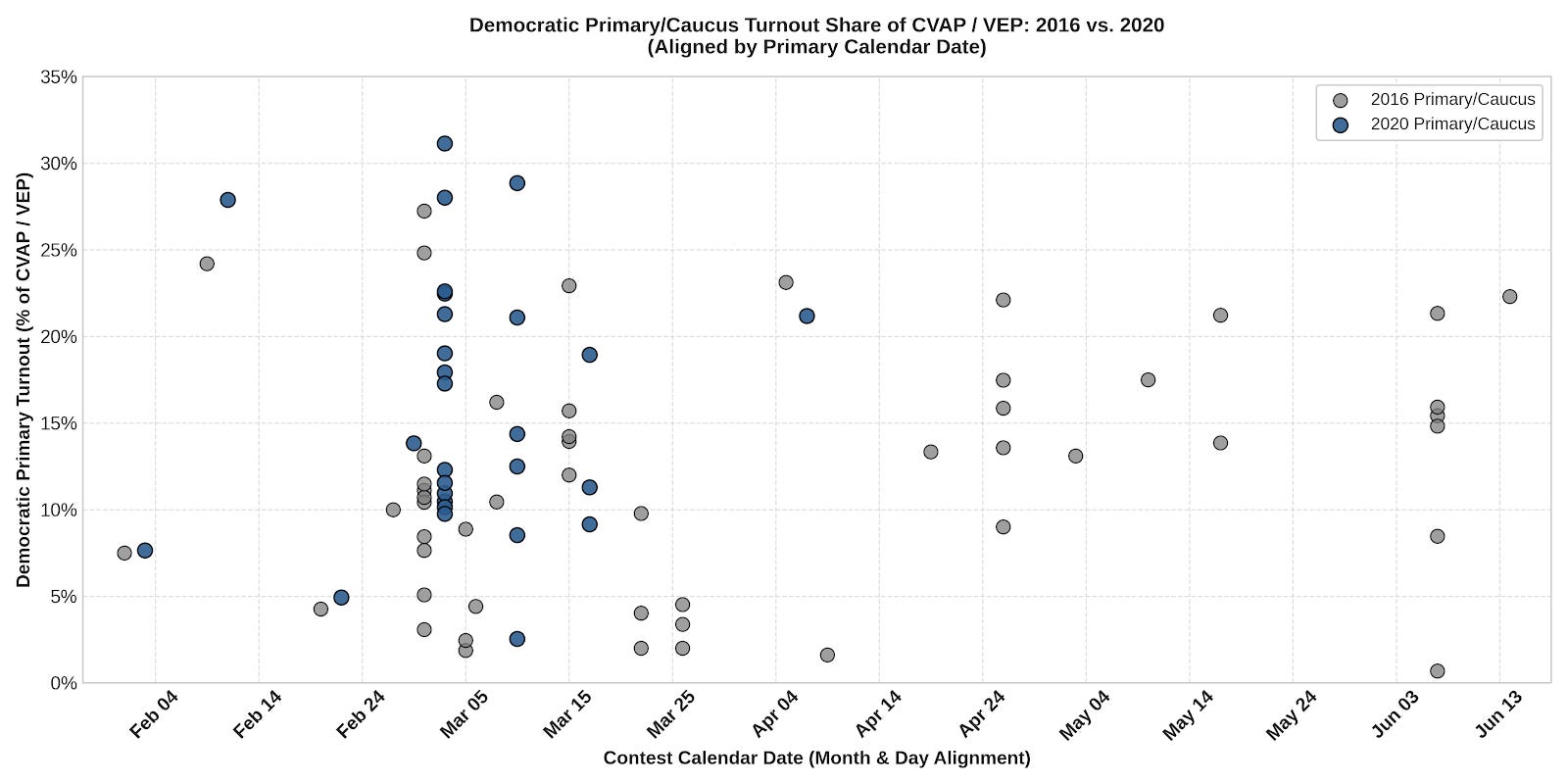
Such low-participation states were far more common in 2016, when more states held caucuses (14, vs just 3 in 2020) and there was also a competitive Republican primary to attract independent voters.
Bad News for Progressives & Pollsters
Progressive pollster Adam Carlson wrote a nice reflection3 on why his results were so off in Michigan. It begins with “Michigan has open primaries, so it is very difficult to gauge the electorate.”
Look at the 2028 presidential primary calendar. Independent voters are banned from the Democratic primary in exactly zero. The number of caucuses is also zero.
That is good news for democracy, and good news for the Democratic Party selecting the strongest nominee.
But it is likely bad news for pollsters - and for the type of progressive who prefers low-turnout elections favoring extreme nominees.
Prediction markets somehow fared even worse, giving Stevens less than a 1% chance of winning shortly after polls closed, before surging past 22%, and giving Crowley just a 5% chance when polls closed.
Bernie also topped 40% with Democrats Abroad and the Northern Mariana Islands, earning delegates in presumably low-participation affairs.
Carlson also wrote a nice reflection on his miss with Graham Platner. Hot DSA Summer has also frequently been Cool Leftist Reflection Summer!
Interesting. Third from last paragraph. Is there something missing? "Independent voters are banned from the Democratic primary in exactly zero."