


When the DNC set the 2028 primary calendar, Chair Ken Martin emphasized the importance of choosing states that represented “every region, race, generation and economic circumstance.”
Left unsaid - by the DNC and the media - is that the changes may drastically change the ideological and partisan composition of the primary electorate. Caucuses are out, and independent voters are allowed in everywhere.
We just released Party Crashers, a report analyzing this new presidential primary lineup.
READ THE FULL REPORT, first seen in this POLITICO story by Lisa Kashinsky.
I. New Calendar
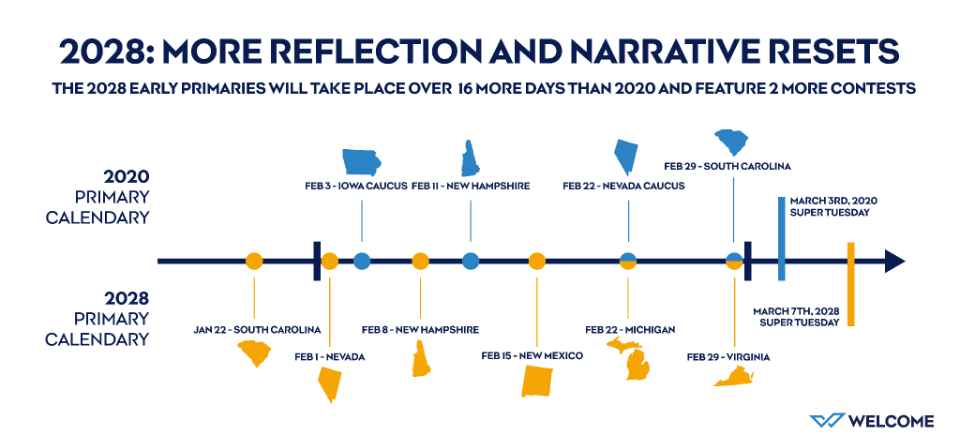
Iowa is out, Nevada is swapping the caucus out for a primary, and three newbies (Michigan, New Mexico, Virginia) join South Carolina and New Hampshire. All six allow independents to vote in primaries, and none hold a caucus.
The cadence will be much different, with a week between each primary. Imagine the nation watching Survivor: Democratic Presidential Candidates in primetime nearly every Tuesday evening for nearly two months. This replaces the mad-dash three days between South Carolina and Super Tuesday, and the goofy vote-counting marathons in Iowa that reduced the 2020 primary to just a pair of major momentum-changing moments.
II. 100 Friends, 0 Caucuses
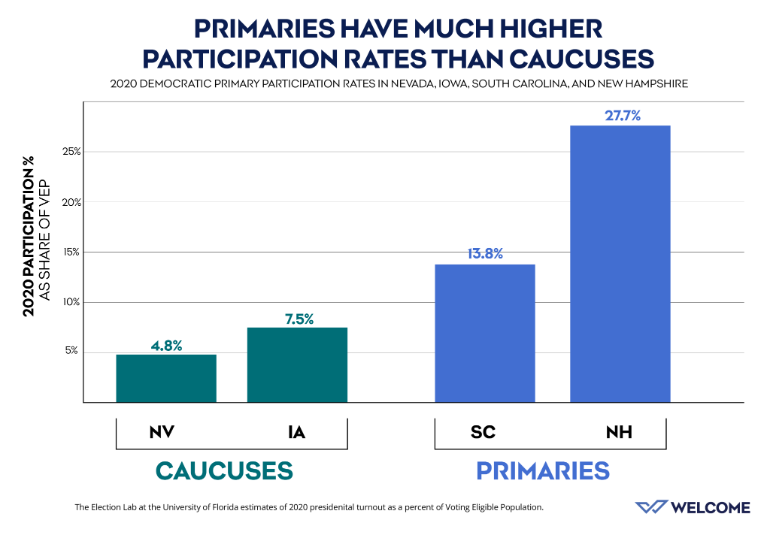
How much did the old caucus system skew towards activists?
Here’s a useful mental model: picture 100 representative eligible voters. Picture them in your mind. And then think of the 5 or 7 of those people most likely to spend hours participating in a Democratic caucus. That matches the ~5% of eligible voters in Nevada and ~7% in Iowa who participated in 2020. Meanwhile, 28% of eligible voters participated in the New Hampshire primary that featured a late surge in support for moderate candidates who had previously lagged in the polls.
III. Unpredictable
Campaigns have become clinically efficient in recent decades, and the predictability of caucus turnout allowed campaigns to fine-tune outreach to an insane degree. Obama and Sanders ran vaunted Iowa operations. Both forecast ~170,000 caucusgoers in a state of 3 million people.
That sort of early-state inundation won’t work quite as well with 23 million eligible voters across six early states that vote in a primary system.
Remember Michigan & Wisconsin this summer? Twice in eight days, pollsters mistook nail-biters for progressive blowouts in a Midwestern Democratic primary. They may have missed something obvious: independent voters in open primary states.
In Michigan, the final five public Senate polls showed Abdul El-Sayed with leads of 10, 13, 14, 15, and 16 points over Haley Stevens. He won by less than a point. We analyzed the voter file and found that 29% of Democratic primary voters hadn’t voted in either the 2022 or 2024 primary.
In Wisconsin, the final five gubernatorial polls had Democratic Socialist Fran Hong with leads of 11, 13, 18, 20, and 22 points over David Crowley. She lost.
Expect more volatility in the six early primary states, all of which allow independents to vote and offer mail or absentee voting. Five of the six also offer early in-person voting.
IV. Good for Dems & Democracy
More is better!
Welcome was founded in 2020 to focus on independent voters in the presidential primaries: the voters everyone was talking about but not talking with.
It is good for democracy when campaigns bring more people into the process. But the incentives and the narrative still point towards campaigns saturating the most-likely primary voters.
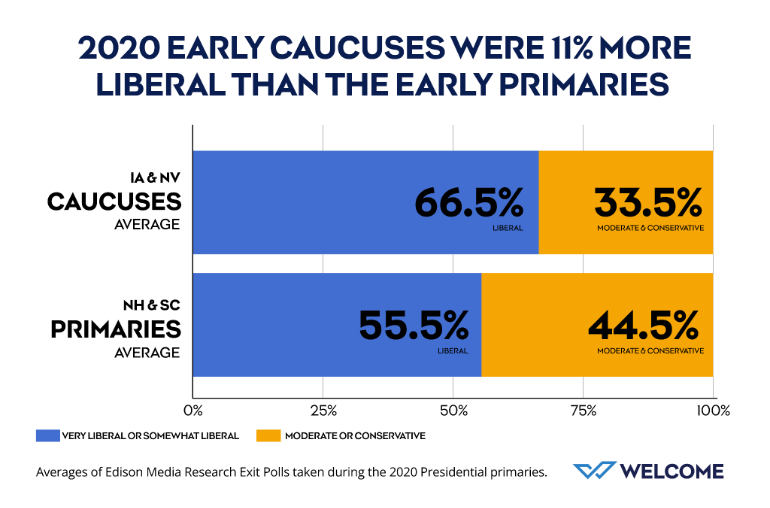
It’s also good for the Democratic Party. A nominating electorate that looks more like a general election strengthens the party. A nominee will likely engage more with independents and swing voters for whom party politics is not part of their identity. And enter the general election stronger for it.
An electorate which look much more like South Carolina and New Hampshire, where moderate voters boosted moderate candidates:
For Welcome, it’s an opportunity for us to return to our 2020 roots, engaging with independent voters in early primary states.
More on that to come! The party crashers are coming.