


At the Rural Urban Bridge Initiative (RUBI), one of our core activities is traveling around the country—and through the Zoomosphere—giving presentations on the causes of the rural-urban/red-blue divide and discussing how America can overcome it. We talk about how deindustrialization and agricultural consolidation shattered factory towns and farming communities. We show how Trump spun rural despair into electoral gold and caution progressives against rubbing salt in the wound by disparaging “flyover country.” And we demonstrate the inflexibility of electoral math—how deficits with rural voters have resulted in virtual one-party rule across many parts of the country, and how flipping as little as three percent of rural voters could reshape the political map.
At the end of our workshops, someone often raises their hand to say that while we may have made a worthwhile point or two, they weren’t eager to “be nice” to Trump voters. But being “nice” wasn’t exactly our prescription. Rather, we tried to drive home the importance of understanding their grievances and working together to rebuild trust, cultivate mutual respect, and find common ground. Most of our participants are willing to try, but for a few, respecting the humanity of Trump supporters remains too bitter a pill to swallow. Trump voters infuriate them, scare them, even disgust them, and they’re not about to let their defenses down.
Stubborn animosity toward Trump voters is the default attitude among the “resistance” rank-and-file in liberal politics today. This stance raises important strategic as well as ethical considerations—and, in my view, fails on both fronts. From an electoral strategy perspective, it repels potential defectors. And as a moral posture, it contradicts bedrock democratic principles and values that most on the left hold sacred.
Most liberals likely do not hold Obama voters responsible for the killing of hundreds of civilians by the drone strikes he ordered. Nor, presumably, do they blame Bill Clinton voters for the loss of blue-collar jobs when factories were offshored in the wake of NAFTA. But because of the contempt Trump’s obnoxious persona inspires, his voters are not extended the same grace.
Holding individual voters accountable for the egregious things Trump has done might feel like an act of justice, but it’s a strategic pitfall. Whether the goal is to vanquish MAGA or “save democracy” (an oft-heard resistance refrain), shunning, shaming, or ridiculing Trump voters is counterproductive.
Expressing contempt or hostility toward Trump voters ratifies their perception of liberals as self-righteous hypocrites. Rather from shaming them into withdrawing support for Trump, they are more likely to look to him for safety: he will bully the bullies. Round and round it goes, contempt volleyed and returned in an endless cycle that helped send Trump back to the White House. Beth Macy, a Democrat trying to flip a rural Virginia congressional district this year, cautioned against her party meeting Trump voters who have recently become jaded with the president with scorn and ridicule. “We should be welcoming them into the tent and making the tent larger.”
Ostracizing or lashing out at those whose opinions make us uncomfortable or angry offers fleeting gratification. But when venting personal feelings takes precedence over strategic exigencies, the result is an impotent coalition of one.
Rich Logis, a disillusioned MAGA operative who founded the group Leaving MAGA, says that epithets like “neo-Nazi” or “deplorable” don’t accurately describe most MAGA adherents and warns that insults push them deeper into that world. Logis encourages Trump opponents to give his fans a reason to leave by welcoming them into a big tent and providing a sense of belonging and camaraderie like they experienced inside the MAGA movement.
Logis’s advice is reinforced by the Columbia World Project, a consortium of one hundred thought leaders and organizers who identify the dearth of left-leaning community-building organizations as one of the principal causes of the crisis of democratic participation: “On the right: evangelical networks, conservative media, and organizations such as Turning Point USA that often meet people where they are, offer genuine community, and make members feel like they matter. On the left: not much.” The project calls for fostering civic participation that makes people feel “connected, valued, and part of something larger than themselves.” That’s not just being “nice”—it’s creating institutions that respect and engage local wisdom and values.
Electoral coalition-building and democratic participation aside, what about the ethical dimensions of the question, “Should we be nice to Trump voters?”
The skeptic is likely thinking one or both of the following:
I’m better than them and, to preserve my superiority, I must maintain a firewall between myself and the bad people. If I stoop to their level to extend kindness, I’m compromising my own righteousness and scruples; and/or
They deserve to be punished for the moral transgression of voting for Trump. If they are now suffering, they have only themselves to blame.
Someone who answers “yes” is thinking very differently:
Who I voted for doesn’t make me a better person. Adjudicating who is “better” would require knowing everything each of us has ever done, an impossible and futile exercise with no referee;
Voters are not personally responsible for everything their leaders do. More generally, most people who do bad things still deserve human kindness. Maybe a rapist or murderer or Nazi forfeits this right, but vote choice doesn’t come anywhere close to those things; and/or
My moral code favors reconciliation over retribution. If I can stay in community with people whose views I abhor, we can make common cause on the things we do agree on. And there’s always an outside chance they’ll change their minds about the other things, not because I enlightened them, but because they realize something for themselves once the obstacle of seeing me as the enemy is removed.
The desire for retribution is, in other contexts, anathema to liberals. Opposition to harsh prison sentences and a willingness to consider a convicted criminal’s life circumstances are what separates liberal from conservative criminal justice frameworks. So, why extend mercy and second chances to even violent offenders but reserve severe condemnation for the crime of voting for Trump?
For those of us who live in small towns and are surrounded by conservative family, friends, coworkers, and acquaintances, this more antagonistic mindset is something of a head-scratcher. In these places, it’s easier to see how demonstrating contempt for ideological opponents would disrupt the ties that hold our communities together. The guy who gravels our driveway has a Trump sign on his truck and no shortage of customers. Picking a fight with him would leave me and my driveway in a bad spot. The same goes for the farmers who feed me, the line workers who keep the lights on, and the drivers who deliver my packages, most of whom I assume voted for Trump.
My local Rotary club is politically mixed, but there we are, side by side, picking up trash and filling backpacks of food for hungry students. RUBI runs a Community Works program that operates on the same principle: bringing people together to solve problems, instead of arguing about politics, builds trust across lines of difference. Working together for the betterment of their communities opens people’s eyes to each other’s fundamental decency. Trust and respect operate in a reciprocal cycle, with each small act inspiring more of the same until, eventually, distrust and loathing fade away and “being nice” comes naturally.
With the help of Colby College political scientist Nicholas Jacobs, we’ve actually been able to document the depolarizing impact of our strictly apolitical program. Republicans who live in counties with Community Works chapters did not grow colder toward Democrats the way Republicans in neighboring counties did. Anecdotally, Democrats who volunteer for Community Works projects tell us that working shoulder to shoulder with local Republicans changes the way they view their communities for the better. Being “nice,” it seems, makes it easier to see that we’re all in the same boat, our destinies intertwined.
That shared-fate ethos is beautifully exemplified by Daryl Davis. A black musician in Maryland, Davis took it upon himself to initiate conversations with members of the Ku Klux Klan. After years of effort, his closet is now filled with the robes of dozens of Klan members, including top leaders, who found it impossible to sustain their hatred in the face of Davis’s signature question: “How can you hate me if you don’t even know me?”
Hailed by many as a civil rights hero, Davis came under fire from three Baltimore Black Lives Matter activists who were so outraged by his efforts to befriend white racists that they all but threatened (Klan-like) to run him out of town. They chastised him for wasting his time, insisting, contra the evidence right in front of them, that white supremacists are incapable of changing their minds. (One of the men later reconciled with Davis.)
At a screening of a documentary film about him, Davis said, “I consider everyone in this room my people, the Klan, neo-Nazis, whatever, they’re all my people. And granted, some of our people are deplorable, as Hillary Clinton might put it…and some of them will never change. But we have an obligation to make this a better society.” He has also emphasized that finding common ground with even our worst enemies is the key to defusing fear and hate.
Davis’s commitment to finding the thread of humanity that connects us all stands in stark contrast to the ethos of shunning and canceling that is so prevalent online and in many progressive spaces, and that gives rise to the “deplore the deplorables” reflex. The deplorables mindset manifests in ugly and hypocritical ways: it rationalizes dancing on the graves of Lindsey Graham and Charlie Kirk while denouncing Trump for spitting on Rob Reiner’s. It blinds partisans to how their own side contributes to the erosion of democratic norms and principles. They embrace conditional principles like “free speech for me but not for thee.” They endorse academic freedom, except for “wrong” opinions on topics like Israel, and decry gerrymandering as a threat to democracy, except when their party does it.
In a contest of good against evil, many partisans come to see principles such as free speech, due process, viewpoint diversity, and basic fairness and respect as instruments of harm. Extending these values to the bad guys is considered too risky. The dehumanization of our enemies is justified as the means to a noble end (destroying or disempowering them).
But this reductive view misses a messier reality in which we Americans live together on a chunk of land. Some of us do terrible things, to be sure, but such people are not Star Wars stormtroopers who can simply be eliminated by “resistance” fighters. They are complex human beings, many of whom are raising children and have strong ties to their communities. Trump and his supporters don’t inhabit a Death Star that can be blown up; they’re right here, living alongside us. And unless Trump’s opponents plan to launch a civil war that would carve the country up into hostile red and blue territories, we are stuck here together for the long haul. Like it or not, we are interconnected, our fates intertwined.
A nation that hangs together must rest on a bedrock of shared principles. Democratic virtues like free speech and due process are crucial, but the most important of all is, I believe, kindness.
I see kindness as an antidote to the poison that has seeped into our culture, from the social media cesspool to the manosphere to the hate-filled sludge seeping out of the Oval Office. Even as keyboard warriors and narcissists wreak havoc, our society holds together thanks to a stable core of decent-hearted people who quietly help and support each other, extending everyday kindnesses, large and small, without asking the beneficiary to fill out an ideological questionnaire.
While some relish the misfortune of Trump voters reaping what they sowed, they are but a small number of misanthropes, far outnumbered by ordinary Americans who treat everyone with courtesy and respect without a second thought. Still, the vindictive minority is pumping poison into the country’s veins.
In response to a story about Arkansas farmers on the brink of bankruptcy and suicide, for example, reactions like these were typical:
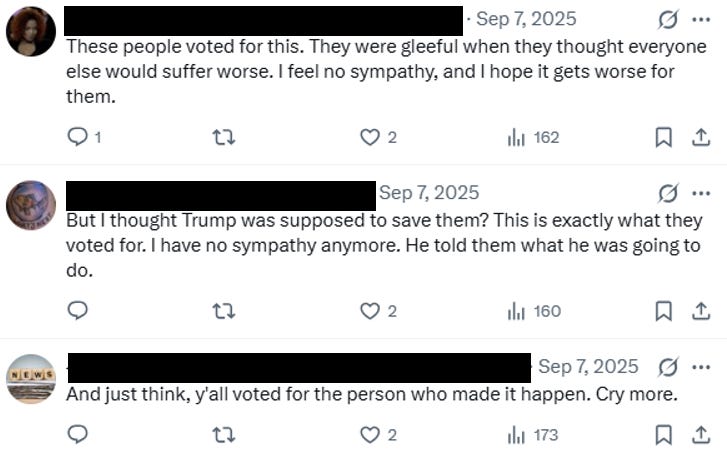
It’s not just social media warriors, either. Even professional journalists have been vindictive.
“Humiliation,” writes social psychologist Evelin Lindner, “is the nuclear bomb of the emotions.” Anyone on the receiving end of headlines and tweets like those above is bound to have a negative reaction. Some will turn the other cheek, but many will respond in kind. Still others will feel bitterly alienated, impotent to do anything other than vote for the guy who promises to put the jerks in their place. There is no upside to shaming and humiliating.
Are compassion, fairness, inclusivity, leniency, and open-mindedness core liberal values? I used to think so. It’s not for nothing we’re often disparaged as “bleeding-heart liberals,” a label most of us wear with pride.
But this litany of values is now cluttered with enough asterisks to make them sound like slogans from Orwell’s Ministry of Truth: tolerance, except toward perceived intolerance; fairness, but not toward those who play dirty; concern for people’s health, unless they refuse to get vaccinated, in which case their deaths are worthy of mockery.
Other behaviors most liberals would normally consider objectionable become okay in the midst of partisan conflict. Prejudice and “othering” are wrong, except when aimed at people with the wrong opinions or values. Stereotypes are verboten, unless they’re stereotypes of rednecks and hillbillies, which are fine—even hilarious.
In carving out so many exceptions to these values, liberals become doppelgängers of the people we claim to oppose, our (supposed) superiority entitling us to mimic what we detest. I reckon many conservatives are no more principled and are similarly willing to discard core tenets of conservatism when politically expedient. (I leave it to conservatives to examine their own contradictions). But withholding empathy from political foes is an asymmetrically liberal vice.
My husband is part of our county’s volunteer search-and-rescue team that goes out looking for hikers gone missing in the woods and elders and children who have wandered off. The team includes quite a few former military members and police officers, most of whom we assume voted for Trump. But it would be absurd to suggest that my husband is morally compromised by working alongside men and women who give up their free time to trudge for miles in heat and rain looking for people of every race and creed. It would be destructive for him to be anything other than collegial toward them—and they would not dream of conditioning their services on Republican Party allegiance.
If being “nice” to Trump supporters is a bridge too far for some liberals, another option is to simply refrain from being mean. Deriding, ridiculing, or turning our backs on them is an act of self-sabotage. It violates values liberals hold dear, costs us elections, and contributes to the fraying of our social fabric. Most of all, it turns us into versions of ourselves we probably never consciously chose. It chains us to an anvil of negativity we drag around to the point of exhaustion. By contrast, being nice can feel amazingly liberating.
Political movements and figureheads come and go, but society endures. What that society looks like largely depends on how we treat each other. Trump shouldn’t be allowed to take that power away from us.
Editor’s note: this piece first appeared on the author’s personal Substack.
Erica Etelson is president of the Rural Urban Bridge Initiative and author of Beyond Contempt: How Liberals Can Communicate Across the Great Divide.

I think key takeaway from this excellent article is “Stop the madness.” This is how. Don’t miss the point. Excellent piece and a hopeful take on the possible future of our country.
A lot of people (including me) have voted for Trump because the alternative--machine Democrats with very left-wing ideas--is worse. Even now.
1) Trump had a few good ideas, most importantly energy freedom/security. Also blocking Iran's nuclear program and ballistic missiles, even though that program wasn't well-enough thought through. 2) Mean or offensive tweets are better than bad votes. 3) Trump and Republicans are always split on their ideas and don't get much "done." Democrats vote like a machine--talk moderate, vote hardline.