


There’s no doubt vote-switching played a big role in the 2026 election. That is, many, many voters who supported Trump in 2024 wound up supporting Democrats for the House and/or Senate in 2026. The shifts were too big for that factor not to have played a central role.
But what of turnout—not so much by demographic group but by Trump vs. Harris 2024 supporters and through new voters? Democrats prefer to focus on the undeniable fact that they won over an amazing number of Trump supporters to their side in 2026. The evidence is strong though that 2024 Harris supporters were far more likely to show up in 2026 than 2024 Trump supporters. Logically, that must have also played a role in the big swing toward the Democrats.
But how big? Estimates vary but it appears that that role was quite large indeed; accounts of the 2026 pro-Democratic swing that downplay or leave out this factor are missing something of potentially great political consequence as we move into the 2028 cycle.
Jason Corley of Quantus Insights summarizes some of the relevant findings:
J.L. Partners ran an Election Day poll alongside more than 30,000 campaign interviews. They found the national swing from 2024 was about 15 points, and that 10 of those points came from turnout and 5 from switching. Lenny Bronner, a data scientist formerly with the Washington Post, worked from actual precinct results in 11 states and puts it at about 75% turnout and 20% switching. The exit polls imply a bit more switching, around 35%, and still have turnout in front.
Bronner’s version is the easiest to understand. If we take 100 people who voted for Trump in 2024, about 63 voted Republican this year, 4 voted Democratic, and 33 stayed home or went third party. If we take 100 Harris voters, about 85 voted Democratic, 2 voted Republican, and 13 sat out.
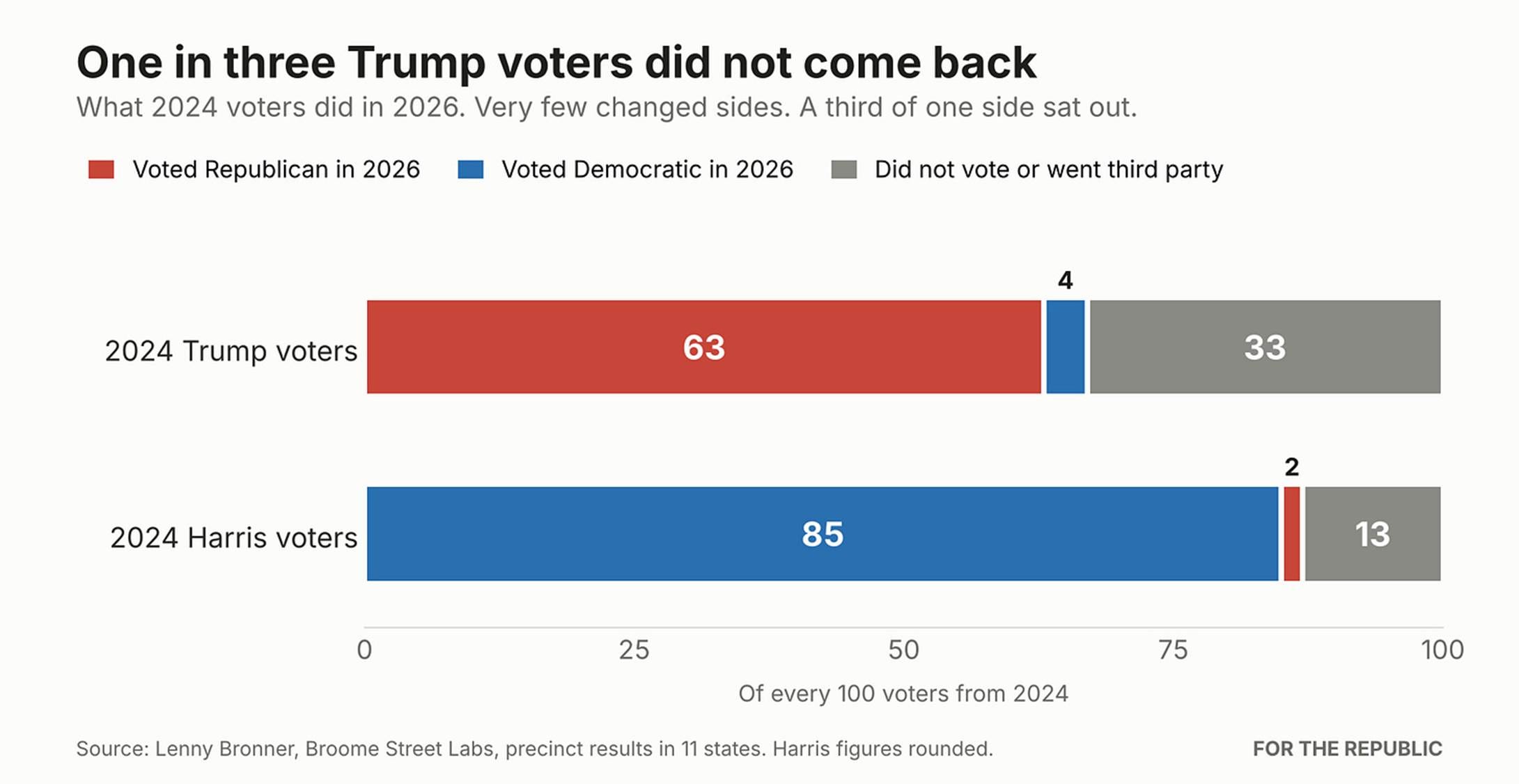
The crossover vote is tiny in both directions. The gray area in the char[t] is where the election was decided. By Bronner’s count, eight of every nine Trump voters who did not vote Republican simply did not vote.
That fact changes the shape of the electorate considerably. The country voted for Trump by a point and a half in 2024. The people who cast ballots in 2026 had voted for Harris by somewhere close to 7 points. It was a different set of voters, and, therefore, a different electorate and would have produced a Democratic year even if no one had changed their mind. J.L. Partners ran that counterfactual and found Republicans lose both chambers with zero switching.
Patrick Ruffini has a deeper dive into the evidence, including breaking down turnout factors into differential dropoff of Trump voters and new voters, who loomed especially large in some key Senate races:
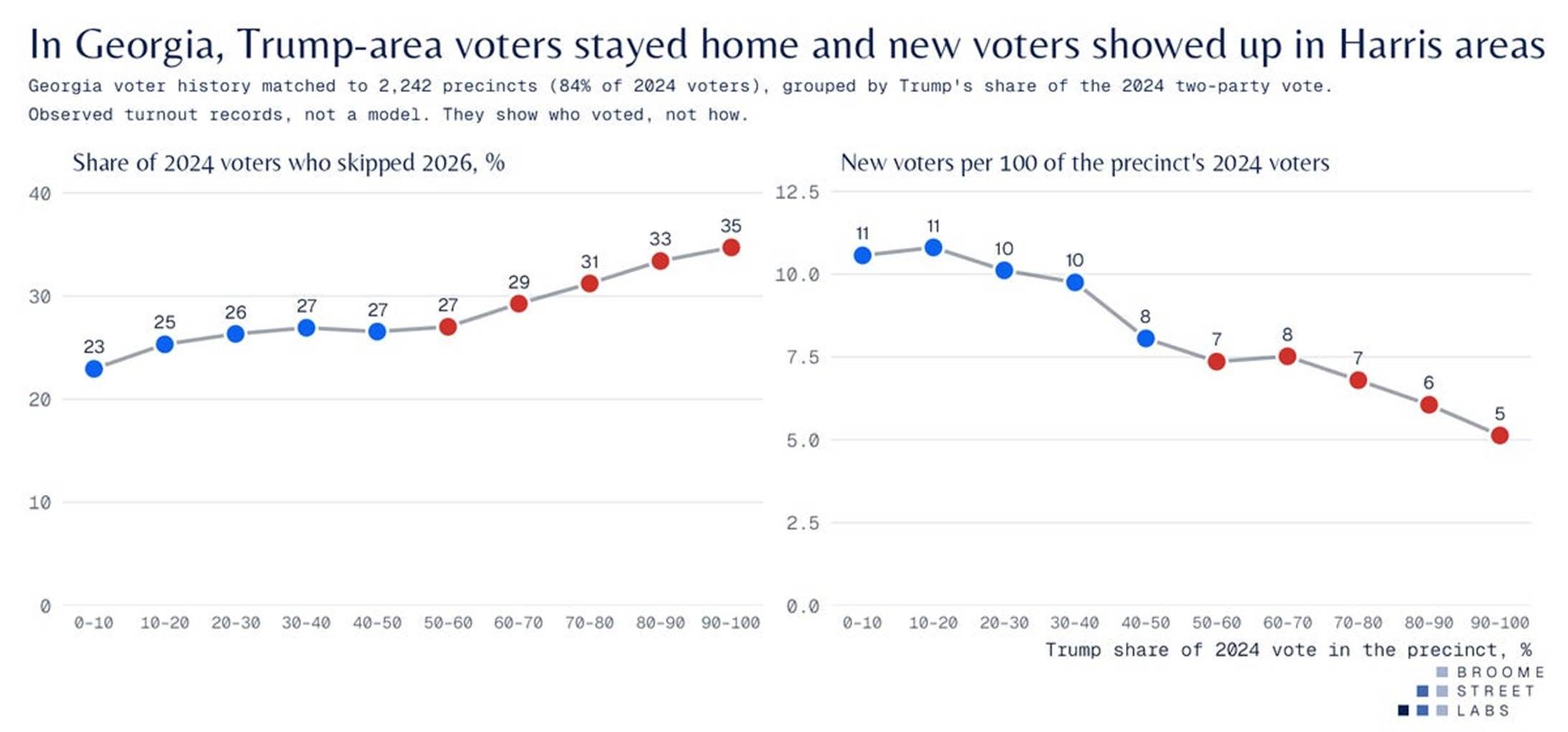
The turnout gap was massive. Across the Senate battlegrounds, Harris-voting counties turned out at much higher rates than Trump voting counties…. Lenny Bronner’s Georgia voter-file analysis adds evidence beyond early voting. About a third of 2024 voters in heavily Trump precincts sat out, compared with a quarter in overwhelmingly Harris precincts. Another 420,000 people who skipped 2024 voted this year, disproportionately in Democratic areas. Bronner estimates that switching still accounted for roughly 40% of Democrats’ Georgia gains, though that depends on assumptions about how the new voters voted.
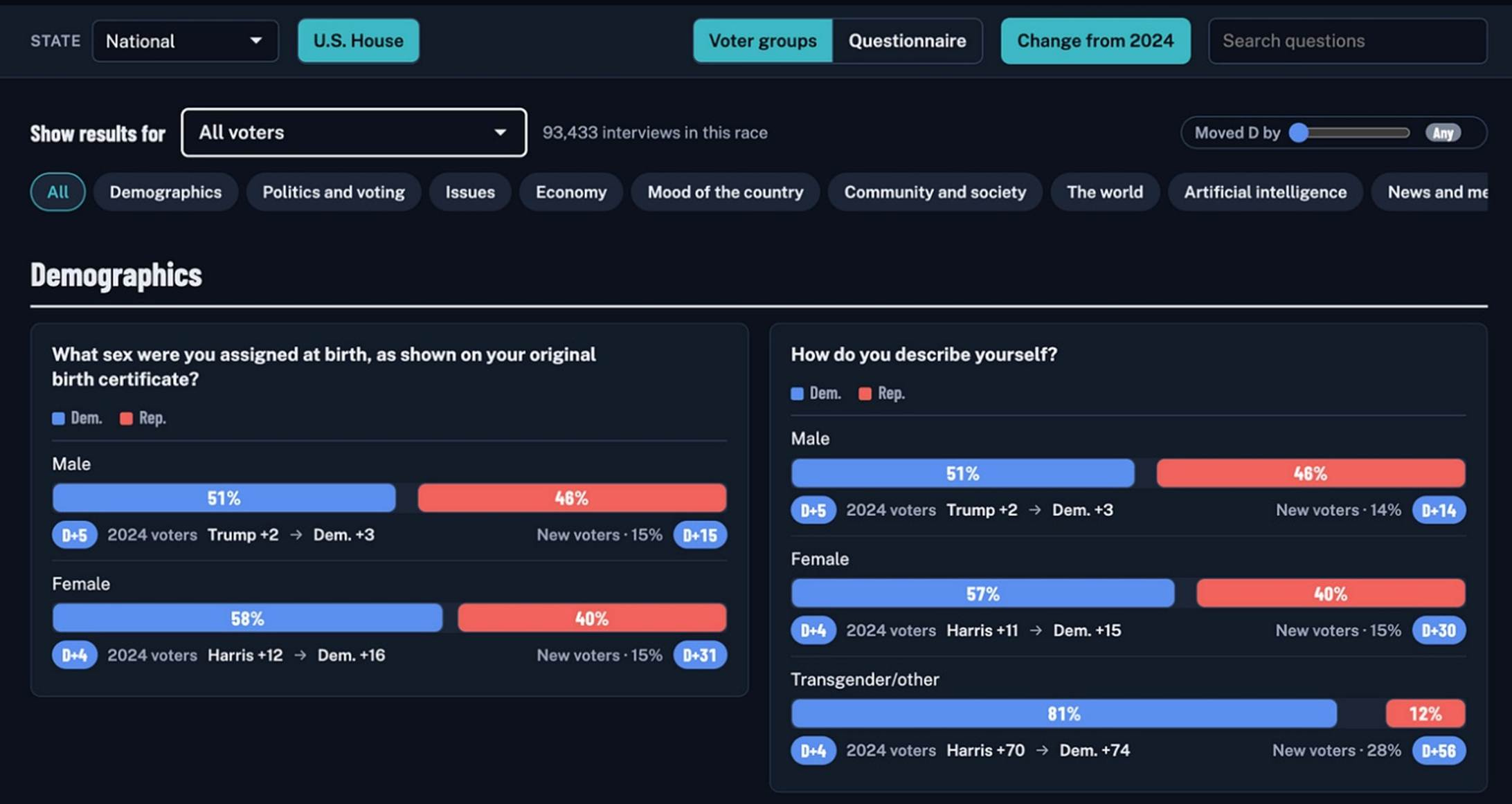
By some measures the gap between Trump and Harris stands at around ten points in voter turnout, while other metrics I’ve posted suggest closer to 20. That’s because a fuller county-level metric also must include new voters, which I estimate added around 3 points to the Democratic House margin nationally.
To do this, I looked at the NORC voter poll data and broke down the reported shift among 2024 presidential voters (adjusted using Chaz Nuttycombe’s recall bias work), the margins among new voters, and what this said about which 2024 voters dropped out of the electorate. In the House, around 40 percent was due to vote switching, 40 percent due to turnout, and 20 percent due to the contribution of new voters. Together, turnout-related factors account for around 60 percent of the shift. You can see this in the exit poll-like dashboard I built to explore the data, including a “turnout or switching?” view.
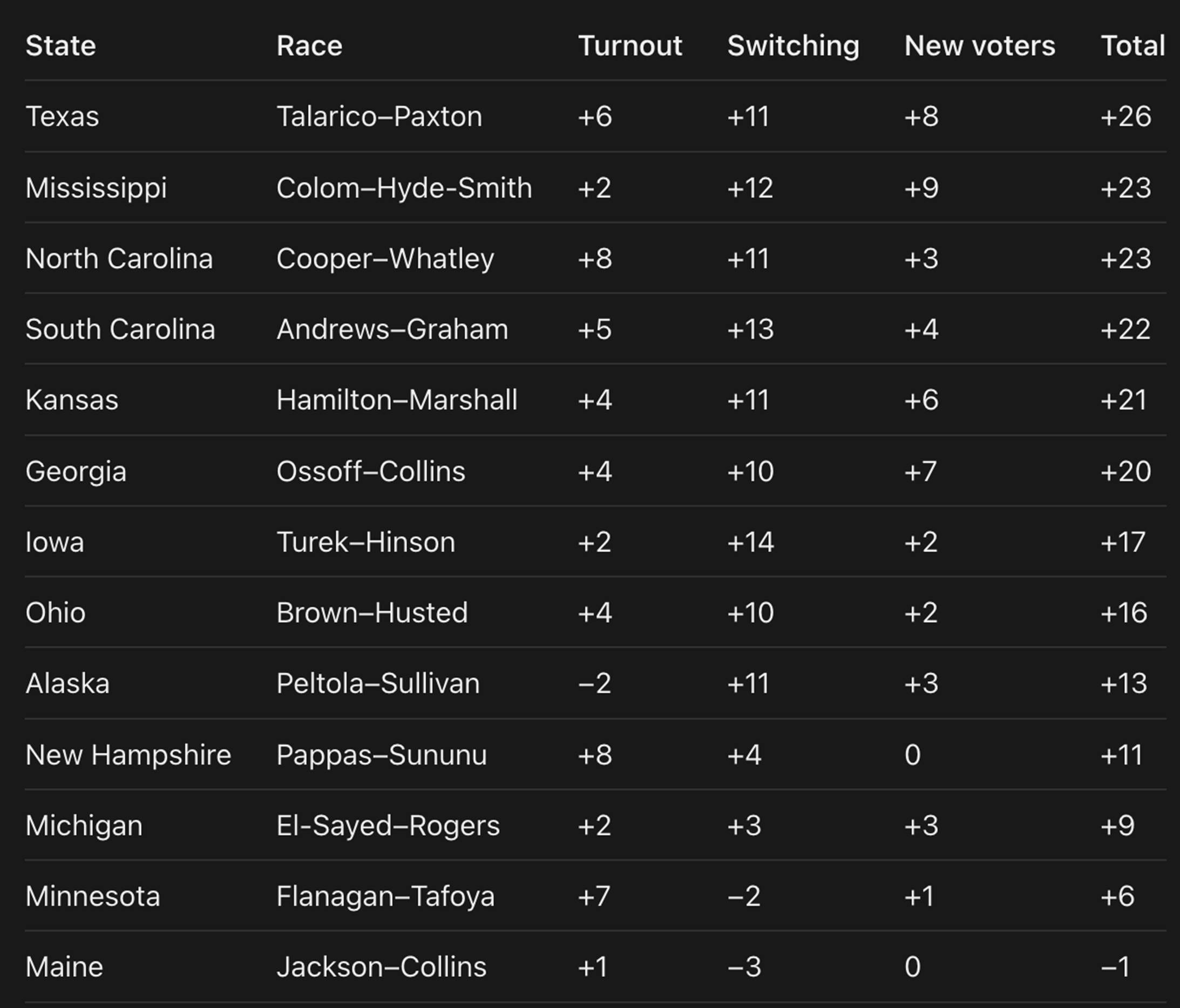
This data is noisier in key state races, with the difference that more of the turnout difference was loaded on voters who skipped the 2024 election, specifically in favor of Democrats. Because these were higher-salience races, you didn’t see above-average partisan turnout gaps among 2024 voters, but Democrats were possibly able to add around 8 points of margin in Texas, 9 points in Mississippi, 7 points in Georgia, and 6 points in Kansas based on voters who skipped 2024. In many [states], non-2024 voters entirely covered or nearly covered the spread, having outsized impact in previously uncompetitive states where they made up 15 to 20 percent of the electorate and voted 20 to 30 points (or more) to the left of the 2024 margin.”
There’s a lot to digest here and I should stress that we are in early days of figuring out the relative contributions of differential dropoff, new voters and switching. Nothing is definitive yet. But it does appear that, among other factors, there was a very substantial pool of 2024 Trump voters who sat out this one to the great advantage of the Democrats. These voters are unlikely to sit out 2028 as well so a realistic Democratic strategy should take that into account.
Note: this post expands on #3 in my Democratic overreach list. More coming from that list!
The Democrats did not win this election as much as the Republicans lost it. The D's are on trial. A screwup can reverse this.
I never had any doubts that this election had a lot to do with turnout. The only person driving votes on a national level was Trump driving the "against" vote. When voters switch parties on a major scale it shows up in small cohorts when you drill down, like at the precinct level.
The lack of enthusiasm amongst Republicans however is a bid deal going forward. Trump had better do something more relevant than saving Jensen Huang. On his signature issue, immigration Trump has only been half assed. Trump closed the border but his headline grabbing deportations have satisfied no one except the red meat racists. Trump has done nothing legislatively or cracked down on employers which is where real change would need occur.
Cost of living gets slightly worse every day as it has for thousands of days.