


Democrats appear poised to have a fantastic election this November. Major forecasters project they will easily take the House with a solid margin, and see them as more likely than not to recapture the Senate. This will not surprise anyone who has been following the polls, seeing the Democrats’ lead on the generic congressional ballot continue to grow, and observing their consistent Senate leads in states like Ohio and Texas.
Many Democrats are giddy about the likely thumping of Trump and the GOP. The 2024 debacle is fast fading from memory. Between the adoption of the “affordability” campaign trope, a ratcheting up of populist rhetoric, and a carefully curated dose of “heterodoxy” in key races, they are convinced they have found the winning formula to take down the unpopular Trump and his party. The necessary reforms and repositioning have taken place; a “wave” election awaits. Problem solved!
I beg to differ. Here are three reasons they’re deluding themselves.
1. The election aftermath problem. Right now, all wings of the party seem pretty happy to, as it were, cash in their winnings in November and stare into a future so bright they gotta wear shades. On the progressive left, whether socialist-identified or not, they feel they have all the momentum and, with their projected victories in the 2026 election, will be the rising force in the party. Their politics have been legitimated; it is the party’s establishment that has had to accommodate them rather than the other way round. The party’s future is secure, they will assure us, provided it follows the progressive path.
On the moderate wing of the party, they are happy that many candidates have seen the dangers of going all-in with the progressive left and appear poised for success this November. If candidates like Josh Turek and James Talarico help capture the Senate, they will feel vindicated. Democrats’ problems are solved, they will argue, provided they follow the moderate (or, at least, non-left) formula.
Of course, the reality is that Trump and his administration are extraordinarily unpopular, especially on cost-of-living issues. And without that factor, the party, regardless of candidate strategy, would not be succeeding as it is. That means it will be hard in the election’s aftermath to sort out who can legitimately claim to have solved the Democrats’ problems. But claim they will.
It is predictable that the current kumbaya moment, with all happily ensconced in the “big tent,” will dissolve very quickly in the election’s aftermath. While the fighting ramps up, it will serve to obscure the depth of the Democrats’ real problem: they are not well-liked as a party, and their national brand is still terrible. The party just has not changed that much since its drubbing in 2024. Consider these recent ratings from an NBC poll:
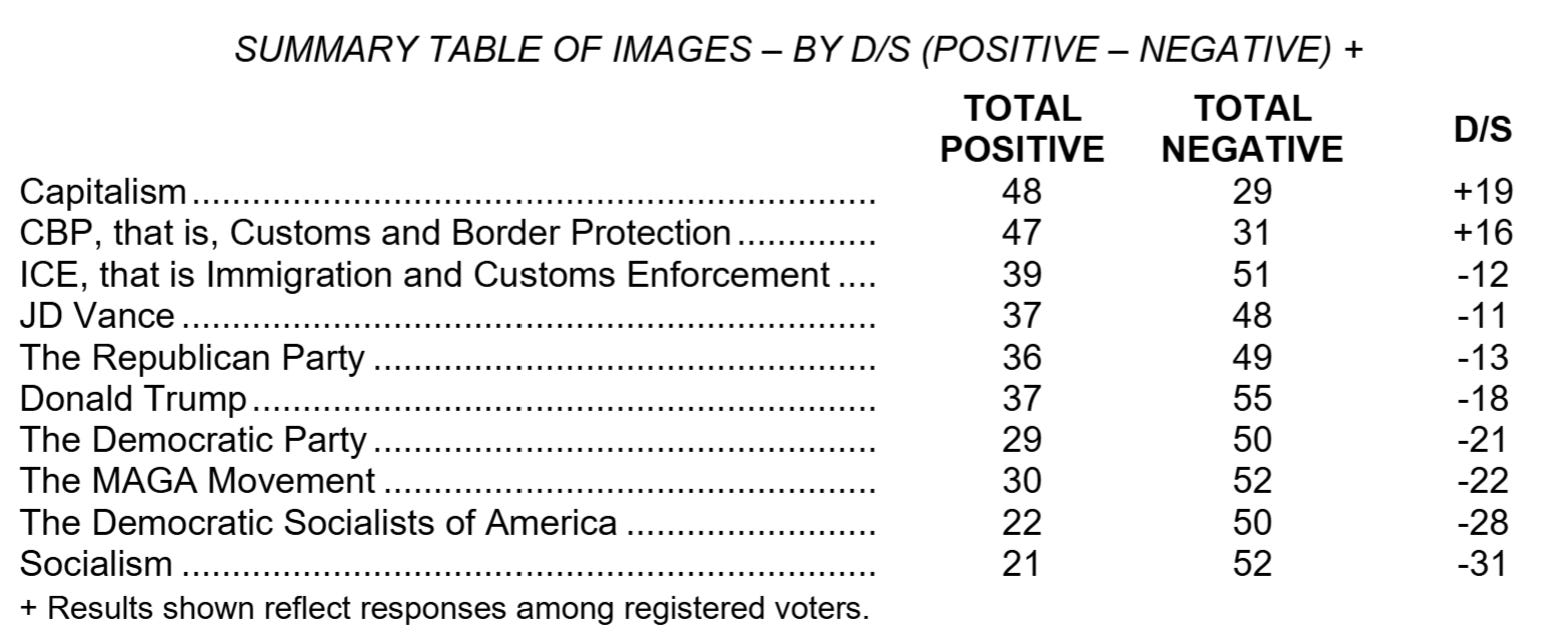
The Democratic Party’s image is highly negative and actually worse than that of the Republican Party (and even ICE!). The Democrats’ rating is about on a par with that of the MAGA movement and only significantly better than that of the DSA and of socialism—both of which, of course, are becoming more and more associated with the Democrats. Manifestly, the unpopularity of Trump is failing to generate warm feelings for the Democrats.
2. The “minimum necessary heterodoxy” problem. Assuming the Democrats do as well as the polls suggest, some credit will be apportioned to a willingness of candidates in key races to slightly dissent from party orthodoxy to achieve sufficient marketability with swing voters—what I have dubbed the “minimum necessary heterodoxy” (MNH). MNH positions are clearly not the primary sell these candidates are making to voters; they are more about convincing voters who might otherwise vote against them if they cleaved to party orthodoxy.
Inspection of the actual “heterodox” positions of these candidates makes clear their MNH nature. Consider James Talarico, perhaps the most stunning example of a Democrat running way ahead of a state’s partisan lean (Trump carried Texas by 14 points). He has been blessed with an opponent who is an unbelievably terrible (and lazy!) candidate. But he has wisely realized that, despite his low-quality opponent and the highly unfavorable national environment for the GOP, he needs to compensate for his extremely liberal background and statements with countersignals to reassure more conservative voters—it’s still Texas, after all!
But the substantive limitations of these countersignals are not hard to detect. Take energy/climate. In 2022, Talarico was saying, “Fossil fuels are destroying the planet,” and, “It’s time to transition.” The previous year, he had introduced the Texas Climate Action bill in the Texas legislature (HB2206), which included extremely aggressive emissions reduction targets (50 percent of 1990 levels by 2030; 90 percent by 2050).
Now, Talarico says that “too many people in our party talk about eliminating oil and gas,” and, “I support our oil and gas industry.” Yet his commitment to aggressive climate action remains, including to his Texas Climate Action bill, and he offers no real dissent from his party’s high prioritization of renewables development and emissions reductions.
So, he somewhat incoherently (and ostentatiously) backs the Texas oil and gas industry while simultaneously supporting policies that would undercut that industry’s long-term prospects. The latter is presumably reflective of his underlying (and certainly his party’s) views on climate/energy while the former provides some reassurance to the many Texans who don’t share his party’s animus toward the fossil fuel industry. And, importantly, the former is guaranteed to get the media coverage he needs to craft his image, even if his underlying philosophy has changed very little. Call it “headline heterodoxy.”
This can also be seen in his positioning on transgender issues. Talarico has opposed a simple prohibition on trans-identified boys/men participating in girls/women’s sports—the overwhelmingly preferred position of voters. Instead, he has said that he favors dealing with this issue locally on an athlete-by-athlete, case-by-case basis where issues of safety or fairness may arise. This could result in some trans athletes being unable to play on teams that match their gender identity. This is a very squishy position, but it reliably yields headlines about how Talarico breaks with his party on trans sports.
Similarly, on “gender-affirming care,” Talarico does not appear to question the Democratic Party’s embrace of the importance—sometimes overriding importance—of gender identity. He supports medicalizing minors where necessary (e.g., puberty blockers and cross-sex hormones) to align their bodies with their gender identity and opposes bans on these treatments.
However, he has stated his opposition to gender-affirming surgical treatment for minors, even to the point of suggesting he would support a national ban on such procedures. Interestingly, though, when he had the opportunity in the Texas legislature to support a bill (SB 14) that would have prohibited these procedures, he voted against it because it also prohibited use of puberty blockers, cross-sex hormones, etc. But, as noted, he still gets the headline.
Talarico has also taken great pains to portray himself as a “border security Democrat.” He pairs this rhetorical positioning with criticism of the Biden administration for letting the border situation get out of hand. He has also declared his support for the “framework” of the bipartisan Dignity Act, currently languishing in Congress, which includes support for physical barriers along the border, faster processing of asylum claims, and even some form of E-Verify.
In terms of interior enforcement, however, Talarico is only comfortable talking about deportation for “criminals, gang members and human traffickers,” not those who are here illegally but are “our neighbors.” And, despite his criticism of the Biden administration’s record, he has little to say about alternatives like “Remain in Mexico,” reforming the criteria for asylum, and ending the abuse of irregular immigration pathways that contributed to the Biden-era wave, such as Temporary Protected Status (TPS) and parole. But the headline “border security Democrat” still garners attention.
These mildly heterodox positions are not the positive sell, though; rather, they are aimed at preventing more conservative voters from automatically opposing him. The positive sell builds on widespread voter discontent with the economic record of the Trump administration. Talarico advocates a decidedly non-heterodox progressive economic approach embedded in the affordability/anti-corruption/economic populism template adopted by many Democrats this cycle. He supports higher taxes on corporations and the wealthy, a higher minimum wage, universal child care and pre-K, and a public option for Medicare (“Medicare for y’all”), among many other progressive economic ideas.
These ideas are typically linked to a strenuous economic populism. He frequently asserts that “the only minority destroying America is the billionaires”, says that “trickle-down economics isn’t a theory, it’s theft”, claims that “while we’re here serving our neighbors, billionaire mega donors and their puppet politicians are clinking their champagne glasses,” and, taking off the gloves, promises to “tax trillionaires out of existence.”
Talarico’s basic playbook of mild heterodoxy on some issues combined with progressive economics and populist messaging is quite similar to that adopted by Josh Turek in Iowa, another red state where Democrats have a good shot of flipping a Republican Senate seat. Mary Peltola in Alaska is also similar, but she concentrates on issues particular to her state, especially on energy. Sherrod Brown in Ohio is overall less heterodox but even more focused on economic populism.
Given that these candidates could all win their races, is MNH plus economic populism the Democrats’ “problem solved” formula? No, but it may be adequate to leverage thermostatic reaction against Trump and his administration in a terrible year for the GOP. The longer-term problems, though, will remain.
Consider the continuing and very wide class gap in Democratic support. No doubt Democrats are hoping that their economic populism, affordability rhetoric, and carefully calibrated heterodoxy will bring working-class voters flooding back into their camp and remedy their ongoing problems with this historic Democratic constituency. And they are, indeed, enjoying a significant increase in working-class support this cycle. But the same is true among the college-educated. The end result is that the class gap has remained roughly the same.
For example, the class gap in 2024, based on an average of the four key election data sources (Catalist, Pew, exits, and AP VoteCast), was 26 points—that is, the Democratic margin among college-educated voters was 26 points better than among working-class (non-college) voters. By comparison, in the latest national New York Times/Siena poll, the Democratic margin in the generic congressional ballot was 30 points better among the college-educated than among the working class.
This fits the idea of a sharp thermostatic swing across demographics against the incumbent GOP rather than a break in the overall trend of class voting. And why should there be such a break? As longtime election analyst Charlie Cook notes:
While many have long predicted that Democrats will enjoy a “blue wave” election, I think of it more as a “red undertow,” which will pull many Republicans under and significantly trim the margins for many others.
A blue wave implies an endorsement or affirmation of Democrats and their policies. But Democrats’ brand is still in tatters from 2021–2025, particularly 2021 and 2022, when they not only had President Biden in the White House but also majorities in the Senate and House. Fortunately for Democrats, this election will in most cases not be about them.
On a deeper level, Dustin Guastella, a political commentator who is also a Teamsters Union official, clarifies that, despite the Democrats’ current emphasis on how their party is a “big tent,” it is still very clear who is running the tent:
It’s no secret that the Democratic Party increasingly represents high-earning voters. Democrats control 9 of the 10 richest congressional districts in the country and hold governorships in 9 of the 10 richest states by median household income. A majority of upper-income voters now identify as Democrats.
This influx of affluent voters into the Democratic Party has significant implications for the party’s agenda. Consider recent research by Jared Abbott and Joan Williams that asked working-class and liberal professional-class respondents to rank their top political priorities. For working-class respondents, 11 of their top 12 concerns were economic, and the only extra-economic concern listed, the desire to lower the crime rate, would hardly be considered immaterial. For progressive professionals, however, the story was very different. Of their top 12 concerns, only half were economic priorities. Worse, abstract cultural and symbolic issues trumped concrete material ones: “Resisting authoritarianism” was rated above “Protecting Social Security,” and “Ending racism” ranked higher than “Protecting Medicaid.” Whatever else one might read into these results, it’s clear that it isn’t the working class that is clamoring for the culture war.
The MNH exhibited by some Democrats on some issues in some races cannot change these realities and the party image they evoke. It will take far more than this to get working class voters to embrace the Democrats as their party once again. It’s hard to see how anyone with a clear-eyed view of today’s actually existing Democratic Party—not some mythical tribune of the working class—could possibly disagree.
Of course, many Democrats will argue that, heterodoxy aside, it is their great economic ideas that are not only bringing back the working class but will keep them in the party. That brings us to the third problem.
3. The economic populism problem. Democrats have not stinted on the economic populism this cycle. One can scarcely hear oneself think over the incessant denunciations of “billionaires” and “the Epstein class.”
But that’s not an economic program; it’s just rhetoric. Presumably, if Democrats were serious about remedying the ills implied by their populist messaging, they would have a program in hand to improve economic outcomes for the working class. They do not.
Instead, they have a confusing smorgasbord of measures intended to address “affordability,” their mantra of the 2026 campaign. (A Democratic candidate would no doubt be rung up on charges if they didn’t refer to it constantly.) These include a grab bag of price caps and controls, subsidies, and new regulations that may or may not make everyday life more affordable. Then there is a wide array of ideas for new social welfare programs and expansions of old ones—expensive and extremely difficult, if not impossible, to implement in today’s fiscal climate. And, of course, there are traditional favorites like taxing the rich and raising the minimum wage.
There is nothing particularly new about this affordability program, supposedly the substantive content of economic populism. Indeed, it seems suspiciously similar to the laundry list of progressive economic priorities that defined the Biden administration. But that didn’t work so well, so perhaps proposing a do-over is neither wise nor likely to convince working-class voters that Democrats have things figured out.
The fact of the matter is that essentially none of Democrats’ economic ideas have a clear connection to achieving higher economic growth. Redistribution, yes, but not growth. This is remarkably short-sighted. The key to substantially raising living standards for the working class—which should be the goal—is precisely more economic growth, especially higher productivity growth. You cannot make up for that by redistribution, nor by simply spending more money on government programs. A fast-growth economy provides more opportunities for upward mobility, generates better-paying jobs, creates fiscal space for non-inflationary government spending, and, as Benjamin Friedman has argued, has positive “moral consequences” by orienting citizens toward generosity, tolerance, and collective advance. Slow growth, by contrast, has the opposite effects.
It is therefore completely unrealistic for Democrats to think they can accomplish their goals (or even afford them!) and build support without centering the goal of economic growth. Attempts to elide this problem have resulted in heavy reliance on chimerical projects like a rapid green transition—which have not and cannot deliver the benefits of overall growth—or, as in the Biden administration, just spending money on various party priorities and hoping for the best. (“Make Spending Money Great Again” did not work.)
No doubt promoting economic growth is challenging and does not lend itself to economic populism. It depends above all on promoting sustainable, strong productivity growth. This in turn depends centrally on technological change and its incorporation into the economy, typically linked to the rise of new general-purpose technologies (GPTs). Think electricity, the internal combustion engine, semiconductors/computing, and so on.
Might such a GPT be on tap today? Of course there is: AI. AI boosters are not wrong to claim that it is, in fact, a new GPT. If so, the effects on productivity growth could be game-changing and era-defining.
Democrats, however, who have long had a streak of techno-pessimism, are not reacting terribly positively to this development and its enormous growth potential. Indeed, the evolving reaction seems to be downright negative. Senator Chris Murphy, a reliable barometer of party trends, had this to say:
The cultural and economic impact of AI is going to be the biggest issue in politics over the next decade…There is going to be a growing appetite from voters to support candidates that are going to help them manage the potential coming disaster as AI poisons our kids and destroys all of our jobs.
Murphy made this judgment on AI back in December. Democrats’ views on the topic have not improved since then. Indeed, they’ve become even more negative to take advantage of increasingly negative sentiment among voters. AI, data centers, tech companies, and the like have been eagerly and seamlessly integrated into the Democrats’ economic populism pitch.
The general approach is to bash data centers and call for regulatory measures ranging from a moratorium on new ones to insisting that data centers provide and pay for their own power to a slowdown in the development of AI frontier models. Other proposed regulations take aim at AI companies directly around issues of online safety, especially for minors.
The concerns behind these ideas are legitimate, and some of the proposed regulations may indeed be necessary. But, pretty much by definition, they have nothing to do with maximizing productivity growth from AI and channeling the benefits as widely as possible. They are, instead, measures designed to take advantage of public fears about AI, which are now considerable. Blue Rose Research found that a fire-breathing AI-specific populism maximizes political benefits for Democrats. An example from their research of such an approach:
Within 5 years, AI is projected to eliminate 75 percent of our jobs. The biggest change in human history is here. Your job, my job...they’re on the line. What happens next is a choice. Their choice? Let mega-corporations fire everyone, keep all the profits, and leave you with nothing. A future of mass unemployment, foreclosures, and chaos.
I don’t doubt that such an approach will be politically effective in the short run, especially as we approach the 2026 election. But it is woefully inadequate as an approach to AI as a new GPT that could make the country and its workers richer.
Steven Rattner put it well in a recent op-ed in the New York Times:
The walls are closing in on artificial intelligence: moratoriums on new data center construction, job-loss concerns and rising alarm over safety.
All valid worries. But none are sufficient to turn away from one of the greatest technological innovations in history, one with the potential to reinvigorate our slow-growth economy and make it easier to address the country’s increasingly challenging problems. For all the concern about the technology, we need A.I. to deliver….
Growth — and the increases in incomes and living standards that come with it — is a function of just two things, a larger labor force and how much each worker produces. More workers increase the overall size of the pie. But individuals don’t get a larger share unless each worker produces more.
Greater national income, particularly if it comes from higher productivity, gives the nation more legroom to redistribute wealth fairly among citizens and reduce inequality. It also provides resources to hold down the national debt and fund public services such as health care and education….
In the early 1970s, productivity growth slowed and has remained depressed for most of the past half-century, with notable exceptions such as the internet boom. Ending the productivity sluggishness should be a top national priority, and using A.I. is the most promising way.
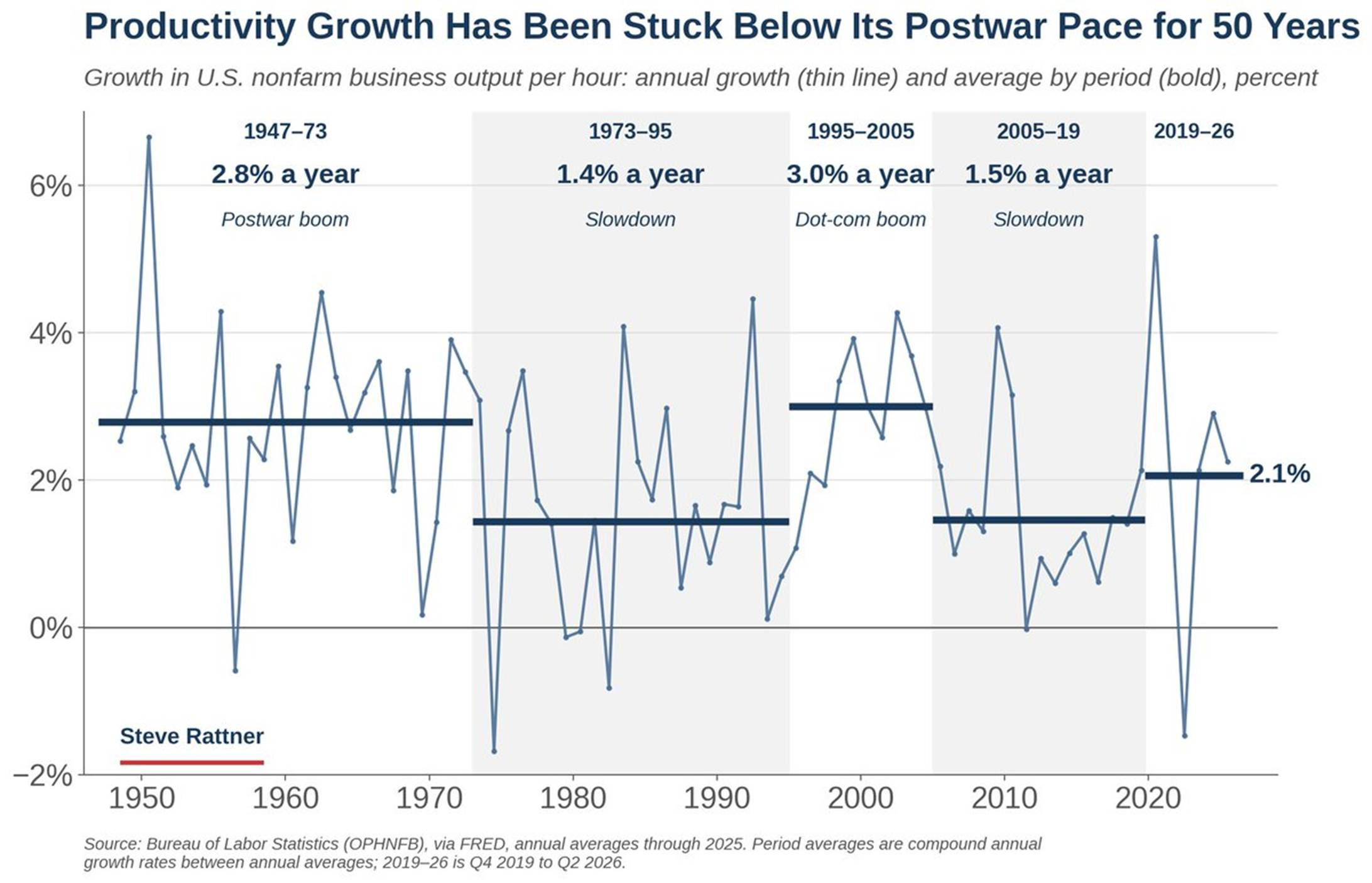
Of course, many Democrats may believe that AI cannot or will not deliver a big productivity growth dividend, or that it is too dangerous to try. OK, but then what’s the alternative growth program? The Green New Deal/Inflation Reduction Act 2.0? Please. They just don’t have a plausible or compelling alternative right now. Once this campaign’s over, they will have to take AI seriously rather than using it as a punching bag.
Ruy, I’m almost as old as you, so I can remember the days when it was cool to be a Democrat - peace, love, tolerance of all were hallmarks of the Dems in the 60’s and 70’s. During the decades following that era, the Democratic Party gradually became less tolerant, less loving and far less cool for normal people. Today, the party is unrecognizable for people of our age - it requires strict conformance to the party line, it requires support of open borders, boys playing girls’ sports, discrimination dressed up as DEI, belief in climate catastrophe fairy tales, etc.
The left even supports the Iran sponsored terrorists in Hamas and Palestine along with the radical Islamists in the US who refuse to live in accordance with US laws. In short, the party has become repulsive 🤮 and effectively unAmerican. While there are still some normal people left in the Democratic Party, most have left the party. It would be best for the US if the Democratic Party splintered, forcing the radicals to become an irrelevant minority party. Good luck! 🍀
is there a market yet on how many times the democrats will impeach Trump this congress? Cause that is all that will happen for the next two years.