


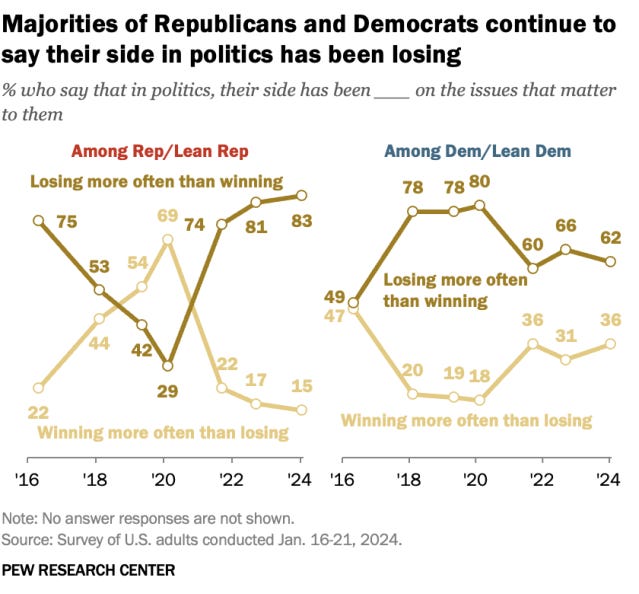
A remarkable feature of modern American politics is that large majorities of people in both political parties believe their side is the one losing. More strikingly: Republicans tend to believe this when they don’t control Washington, while Democrats in recent years have come to believe it regardless of which party holds power.
Indeed, it is not uncommon to hear Democrats today argue that the country’s political and electoral institutions are structurally biased against them, and that this is the reason they have had such a difficult time consistently winning elections in recent years. Many believe that they represent a majority of the country, and before 2024, they often pointed to the fact that they had won the national popular vote in six of the previous seven elections as evidence of this. And in two of those elections, they lost the Electoral College, allowing conservatives to build a durable majority on the Supreme Court that included five justices who were appointed by Republican presidents who lost the popular vote. Democrats also lament that Republicans successfully gerrymandered themselves into an eight-year majority in the House of Representatives during the 2010s, and that their advantage in the Senate is growing.
Viewed through this lens, it’s easy to see why Democrats believe there needs to be major change. Where the party may be getting itself into some trouble, though, is on the question of what, exactly, should change. Throughout American history, parties that have lost elections—especially over a long period of time—have eventually acknowledged that winning back power required reforming themselves. For Democrats today, this might mean making the party more palatable to working-class and rural voters, who are overrepresented in states that often determine control of the Senate and White House, and at least some of whom supported Democrats not long ago.
But repairing their coalition will likely take time—and because many Democrats think Trump poses an existential threat to the republic, they have become less willing to wait. Rather than taking the long view and working to rebuild a coalition capable of regularly winning under the existing rules, they have become convinced that what needs changing is the system itself.
Of course, reform isn’t always a bad thing. Moreover, some of Democrats’ proposed reforms are more nonpartisan in nature and would not give either party a clear edge, such as banning partisan gerrymandering, expanding the size of the House of Representatives, and reducing barriers to voting. However, several of them appear designed to boost their political power and make it easier for them to enact their agenda, such as making DC a state, scrapping the Senate filibuster, and abolishing the Electoral College.
Perhaps the most controversial—and revealing—proposal targets the institution Democrats increasingly see as the biggest obstacle to their policy goals: the Supreme Court. Recent polling shows just 12 percent of Democrats approve of the Court, while 67% say justices decide cases based on their political views (rather than the law) and 77% believe they regularly side with Trump. Many Democrats simply see the Court as a biased political actor and fear that it could take a generation or more before it has a liberal majority that will more consistently uphold the party’s preferred policies.
Because of this, a growing chorus of voices in the party, including prominent figures, is now openly advocating for expanding (or “packing”) the Court. Calls for this kind of change are particularly noteworthy because they represent a marked shift in thinking from the last time Democrats won a majority in Congress. In 2019, they introduced as their very first bill the “For the People Act,” which included a litany of reforms to the nation’s political system but conspicuously left out expanding the Court. When Joe Biden later controlled the presidency, the furthest he went was to establish a commission to study court reforms and eventually endorse term limits—but not expansion.
However, Democrats’ appetite for a more combative approach to the Court has become much stronger, as many now believe that their leaders have been played for fools by Republicans and that this has cost them dearly. One of the most common expansion proposals would add four more seats, bringing the total to 13. Some Democrats have argued that this is a commonsense measure designed to align the number of seats on the Court with the number of federal appellate courts. Of course, the four additional seats could then be filled while Democrats still controlled the White House and Congress, creating a 7–6 liberal majority.
Whatever the stated rationale, proposals like court-packing would do more than just remove existing biases from the political system. And even if Democrats are convinced that this effort is merely aimed at righting past wrongs, the public overwhelmingly views the proposal as a raw power grab and opposes it.
There’s a reason why the parties have viewed court expansion as such a risky endeavor that they have historically been reluctant to pursue it. In fact, it has been nearly 90 years since the last time a party seriously attempted to expand the court for partisan purposes, and that’s because it ended extremely poorly for that party—the Democrats.
In 1937, President Franklin Roosevelt, having just won re-election in a landslide, attempted a court-packing scheme of his own to overpower a conservative bloc that had helped strike down a series of his New Deal initiatives. Despite FDR’s broad popularity, his plan proved politically disastrous. By summer 1938, the public had begun souring on his economic plans, with a Gallup poll showing that two-thirds of Americans wanted him to pursue more conservative policies. In the midterms that fall, Republicans made gains in both the House and Senate for the first time in a decade, and many historians point to Roosevelt’s overreach as a key factor.
But the pitfalls of court-packing go beyond imperiling Democrats’ political standing. Hardball tactics like this are guaranteed to perpetuate America’s endless cycle of escalating polarization: one party makes a play for more power, and the other responds in kind—or worse—the next time they hold the reins. In fact, Democrats have been down this road before with the Supreme Court. After they scrapped the Senate filibuster for lower-court appointments in 2013, Republicans finished the job four years later, ending the filibuster for Supreme Court nominees to confirm Neil Gorsuch.
In this case, there’s no reason to think that Democrats could expand the court to 13 and that would be the end of the fight. What is to stop Republicans from adding an additional four seats and reclaiming a conservative majority the next time they have power?
This is the problem at the heart of reforms that are motivated by the pursuit of a partisan advantage: they almost always provoke an equal and opposite reaction and erode Americans’ trust in their government even further. What the country desperately needs is to have its faith restored in important institutions, which includes the Supreme Court. Confirmation hearings for new justices carry extremely high stakes and aggravate tensions between the parties. The increasingly political nature of Court appointments also makes it harder for partisans to regard decisions they dislike as legitimate.
But reforming the Court in a way that doesn’t give either side a clear advantage could help repair its image. One idea is to institute 18-year term limits, which would give every president the chance to appoint two justices in their term. This is one of the more straightforward proposed changes and has substantial backing from the public, though it still keeps control of the confirmation process in the political realm, which is less ideal. More ambitious proposals would seek to significantly depoliticize the Court, such as a “lottery” system that would randomly elevate appellate judges to help decide cases. Both ideas carry trade-offs as well, but they maintain the more constructive goals of trying to reduce the stakes of appointments to the Court and remove partisan influence over it.
The other option for Democrats is to simply do the hard work of persuading more voters to support them and building a large, durable coalition that can eventually reform the court through the current process. Unlike court-packing, this does not offer a shortcut to winning back power. It takes time and isn’t always easy, especially in the current political environment. But it would allow Democrats to pursue their policy goals through Congress with some consistency rather than turning the courts into another arena for partisan combat—as it should be.
We have had the same rules since the dawn of the country. When Democrats lose - they think the rules should be changed so they can win. Literally, alter EVERYTHING so they can win. They are delusional, poor losers. The problem is not the system- the problem is the their message and ideology. They are getting rejected, and can't deal with the reality of why.
So Democrats' proposed solution to their perception of the politicization of the SC is to further politicize the SC. Their endless "the sky is falling" rhetoric makes it impossible for them to see more than one step ahead.
"Confirmation hearings for new justices carry extremely high stakes and only serve to worsen tensions between the parties..." And if we go with term limits, we'll be treated to these tensions endlessly. It was the Democrats' blatant weaponization of an objectively substanceless and unverifiable sexual assault alegation against Kavanaugh that began my turn away from the Left in 2018. They've only gone further and further off the deep end since then.