


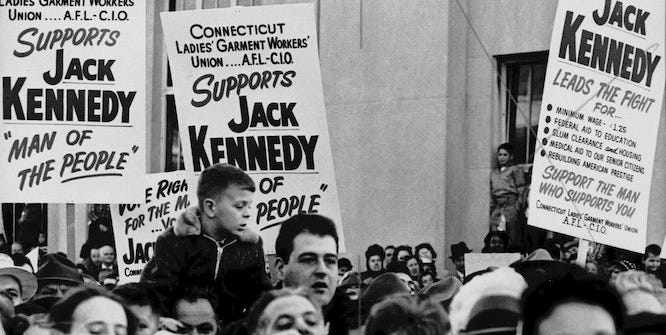
Editor’s note: this is a significantly updated and expanded version of a piece that first appeared in Commonplace.
What was social democracy?
Social democracy was the most successful product of a working-class movement that had long contained both revolutionary and reformist elements. Two world wars, an interwar period of political chaos and economic meltdown, and the authoritarian degeneration of the Soviet Union decisively tilted the working-class movement toward the political management of capitalism to deliver a better deal for workers. Social democrats came to believe it was both possible and necessary to harness the capitalism’s dynamic growth potential to raise workers’ wages, with unions helping them capture a larger share of the gains, and a wide array of social programs that could guard against sickness, old age, and unemployment—the so-called welfare state. Instead of a revolution, they put their sights on boosting working-class prosperity and security.
The social democrats were right about the potential of a politically managed capitalism to deliver these benefits for workers while avoiding serious economic crises and authoritarianism. And, while remaining anchored in the working class, especially unions, they successfully built cross-class coalitions that could support a managed capitalism and the welfare state. In this, they were helped immensely by the rise and decades-long hegemony of Keynesian economics, which provided a coherent economic philosophy for managing capitalism to achieve their goals.
As practiced by the labor and socialist parties of Europe—and, in a milder form, by the labor-backed mainstream of the American Democratic Party—the results were impressive. In the 30 years after World War II, growth was strong, crises were held in check, and living standards rocketed upwards, providing much of the working class with a middle-class lifestyle. In the United States, the GDP growth rate was 3.8 percent per year between 1946 and 1973, and the per capita GDP growth rate was 2.4 percent over the same period. Unemployment, though considered high compared to booming Europe, averaged 4.8 percent over these years. And the growth in living standards was phenomenal: real median family income rose at a rate of 2.8 percent per year, more than doubling over the period. What’s more, this growth was even stronger at the bottom and a little weaker at the top, so income inequality actually fell substantially.
For three decades, the Keynesian consensus in industrial democracies produced strong economic growth, low unemployment, rapidly rising living standards, and government actions to provide more protection and security for the average citizen. This produced a virtuous feedback loop between the political fortunes of social democrats and the economic fortunes of their countries.
Reflecting this feedback loop, until almost the very end of this period, the social democratic-oriented Democratic Party received high levels of electoral support. As far as voters were concerned, Democrats had delivered a better and ever-richer society and deserved their support. In the six elections between 1932 and 1948, Democratic presidential support averaged 55 percent. After the liberal Republican Dwight Eisenhower won two terms in 1952 and 1956, the Democrats again averaged 55 percent presidential support in 1960 and 1964. And during almost all of this period, the party also controlled both houses of Congress.
But as the 1970s dawned, three factors converged and reinforced one another to undermine social democracy. The social democratic economic model lost its effectiveness; the social democratic base got smaller; and the social democratic influence within the left got weaker.
Let’s start with the economic model. In the 1970s, the complications of a globalizing economy started to bite, undermining the stable international economic relationships of the postwar Bretton Woods system, including fixed exchange rates. The coup de grâce was administered by the OPEC oil price shock of 1973. Inflationary pressures that had been building up inside the U.S. and other advanced countries could no longer be contained, producing high inflation rates that could not be brought down even by high unemployment. This toxic combination of high unemployment and high inflation was termed “stagflation.” Social democrats at that time did not have an alternative to the postwar Keynesian system to fix this problem, nor a plan for extending the life of the system, which led to the end of the Keynesian consensus.
A conservative counter-revolution in economic thinking filled the vacuum left by the collapse of the Keynesian consensus. Conservatives, of course, had never been happy with the Keynesian consensus. They were ideologically opposed to the idea that the unregulated market had intrinsic flaws that only government could correct, and many conservatives had economic interests that predisposed them to resist and resent government. So, when the Keynesian system appeared to break down, they seized the opportunity to reinstate their views and discredit government’s role. They succeeded beyond their wildest dreams.
Leading the charge was conservative economist Milton Friedman. In his academic work he showed how inflationary expectations could derail the Phillips curve favored by Keynesian economists. With his wife, Rose, he published the enormously influential Free to Choose, a no-holds-barred polemic in favor of self-interested individuals making “rational,” unregulated decisions and against anything that interfered with this process—especially government action. As far as Friedman was concerned, government’s economic role should be limited to little more than controlling the growth of the money supply.
This economic philosophy was obviously no mere reform or adjustment of the Keynesian system but a complete turnaround—a true counter-revolution. In short order, it came to dominate economic policymaking in the U.S. and other advanced countries. Deregulation, privatization, and rapid globalization of economic activity became the order of the day, while Keynesian fiscal policy, especially the central role of public investment, was shunted aside. In the U.S., this led to significant deregulation of the transportation, energy, telecommunications, and financial sectors.
This return to market-driven economy policy and the downgrading of the political management of capitalism came to be termed “neoliberalism.” While initially promulgated by the right, it came to be accepted on the left, including in the ranks of social democrats. They more or less accepted this turn in policymaking as inevitable and sought to focus their economic policy on defending welfare state programs and, where possible, extending them. The social democratic model of economic management was mothballed in favor of a softer form of neoliberalism, while the right promoted a harder variant.
Whether accepting neoliberalism was truly as necessary as social democrats came to believe—and whether they had more degrees of freedom to dissent from that approach than they thought—can be debated. But for purposes of understanding the long, slow death of social democracy, that is not terribly relevant. The point is that they assented to this economic regime change, thereby undercutting a key pillar of the social democratic project.
The second key factor in social democracy’s demise was the shrinking of the social democratic base. For perhaps 150 years—and most robustly in the century between 1870 and 1970—the left coalition was primarily based in the industrial working class, though additional support, especially for the non-socialist left, came from reformist elements of the white-collar middle class and the agrarian sector). This coalition ebbed and flowed in this period but reached its peak of power and influence in the 30 years after World War II—the social democratic moment.
But the industrial working class had typically peaked in size by 1970 (in some countries, even somewhat earlier), and after 1970 it experienced a precipitous decline. The general pattern has been a decline from 40 to 50 percent of the workforce to less than a quarter in a very short historical time span.
To put these changes in perspective, consider the United States. After rising for around 150 years, industrial employment is now roughly back to its 1820 level, when 70 percent of employment was in agriculture. Today, services account for well over three-quarters of employment. Agriculture and services have essentially swapped places since 1820, while industry’s share of employment has ended up roughly where it started nearly two centuries ago.
Other changes deepen the significance of this shift. Union membership, crucial to the social democratic formula, has dropped steadily across countries and, notably, its composition has shifted toward public-sector employees. In the United States, union membership peaked at 35 percent of the non-agricultural workforce in the mid-1950s and is now down to about ten percent (and an even lower six percent in the private sector).
Finally, as the industrial working class has shrunk, it has also become less supportive of the mainstream left parties that had promoted social democracy. Most of this support went to parties of the right and, especially lately, to right-populist parties.
So, in addition to a sharp decline in the viability of the Keynesian social democratic model of economic management, the very constituency that provided the bulwark of support for that model was declining in size and moving on politically. This brings us to the closely related third factor in the long, slow death of social democracy: the dramatic weakening of the influence of social democracy within the broad left.
This was the inevitable consequence of the replacement of traditional working-class voters—who reliably supported social democratic aims—within the left by other constituencies with other priorities. The key change here is the rise of educated and professional voters and the movement of these voters into the left.
The U.S. provides a particularly compelling example of rapidly rising educational levels. Incredible as it may seem today, in 1940, three-quarters of American adults aged 25 and over were high school dropouts (or never made it as far as high school), and just five percent had a four-year college degree or higher. But education credentials exploded in the postwar period. By 1960, the proportion of adults lacking a high school diploma was down to 59 percent; by 1980, it was less than a third; and by 2024, it was just six percent. Concomitantly, the proportion with a bachelor’s degree or higher rose steadily and reached 39 percent in 2024. This is quite a change: from a country where only one in twenty adults had a college degree to one where nearly two in five do.
As the educated class has become more numerous, it has realigned toward left parties, especially its professional segment. Indeed, in the United States of 60 years ago, professionals were actually the most conservative occupational group. Now, they overwhelmingly vote Democratic, and the college-educated more reliably support Democrats, while the broad working class (often defined as the non-college-educated) leans Republican.
Most strikingly, the working class—especially in former left strongholds—has swollen the ranks of right-populist parties, while the educated professionals have become increasingly loyal to the erstwhile social democratic parties (and, in some countries, parties even further left, like the Greens). And as they have become the foot soldiers and activists for these parties, their influence has grown apace, amplified by their vast influence in the commanding heights of cultural production, such as the media, the arts, academia, and NGOs. This has dramatically reduced the influence of the working class, formerly the beating heart of left parties.
Put these three factors together—the declining effectiveness of the social democratic economic model, the diminution of the social democratic base, and the profound weakening of social democratic influence within the left—and you have the recipe for the long, slow death of social democracy. If social democracy has been on a long journey to oblivion, what has taken its place, given that the parties of the left continue to exist?
The best term for this transformation is the “Brahmin Left,” a concept coined by economist Thomas Piketty and colleagues to characterize Western left parties increasingly bereft of working-class voters and dominated by highly educated voters and social elites. The Brahmin Left character of these parties developed over many decades but accelerated in the 21st century. The chart below illustrates this trend for the United States.
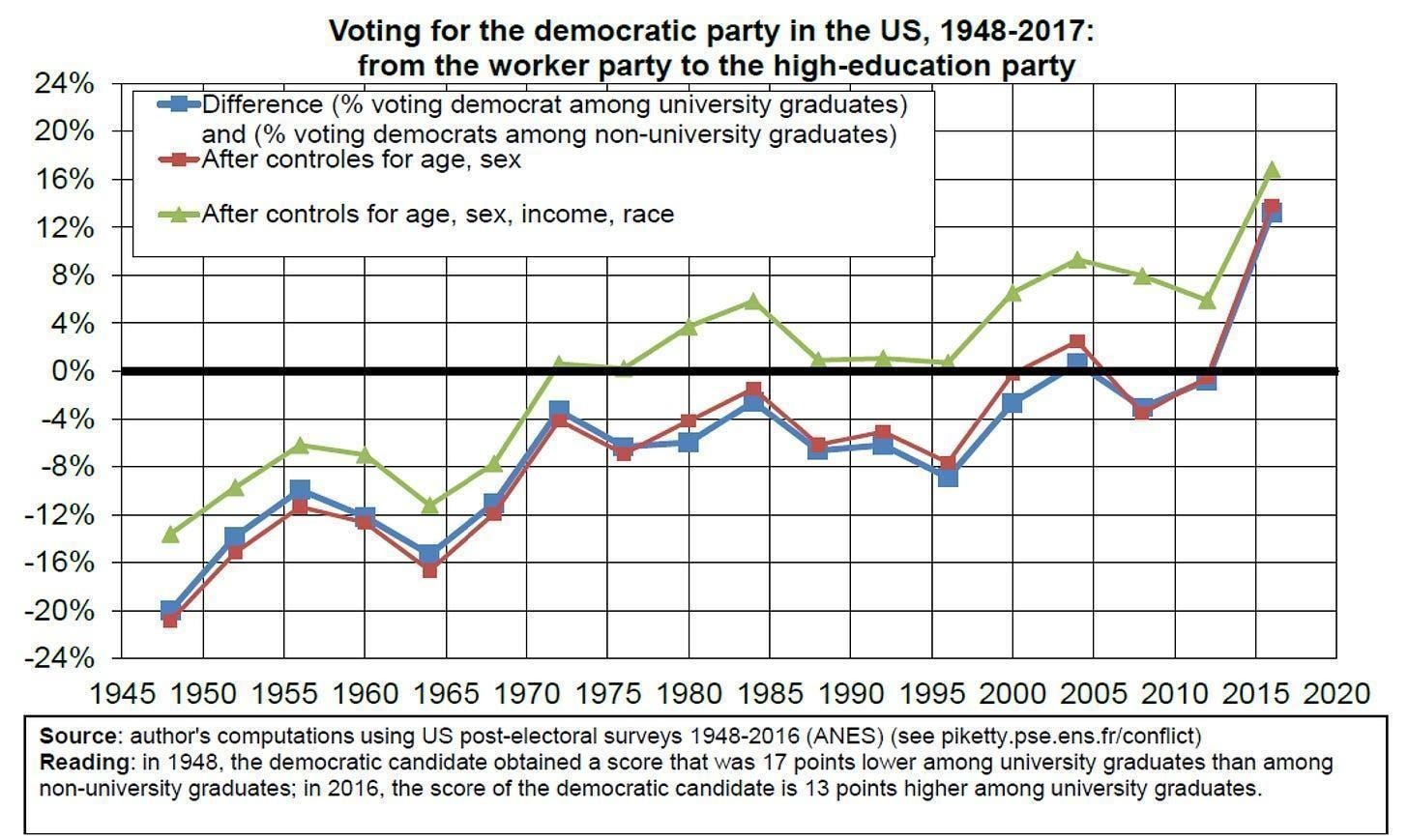
The chart does not show the most recent election results, but survey studies agree that education polarization intensified further in both 2020 and 2024. Including those data would thus make the pattern in the chart even more striking.
Brahmin Left parties continue to favor redistribution more than the right, even as they have lost their working-class character and overriding commitment to a model of capitalism that could produce better market outcomes for workers (sometimes termed “predistribution”). An influential paper by economists Ilyana Kuziemko, Nicolas Longuet-Marx, and Suresh Naidu terms the redistributionist approach “compensate the losers.”
But what really defines the Brahmin Left parties and marks their decisive break with social democracy is the shift in priorities toward sociocultural issues of primary concern to their educated constituencies. These issues generally hark back to the movements of the sixties around racial and gender equality, the environment, and cultural tolerance. They increasingly came to define the core commitments of the Brahmin Left parties, thereby undercutting their ties to working-class voters who were generally far less interested in these issues.
The focus on sociocultural issues did two things that intensified the Brahminization of these parties. First, there were opportunity costs to such a focus, as the expenditure of energy and political capital on these issues necessarily reduced efforts to reach working-class voters and respond to their economic concerns. It was a much more zero-sum game than social democratic leaders were initially willing to admit, even if over time this fundamental fact became glaringly obvious.
The second—and most critical—effect of the sociocultural focus was that catering to professional class priorities bred ever more reliance on these voters, forcing left parties to accommodate them as their preferences changed and potentially became more extreme. And that is exactly what happened.
Consider the four biggest changes in left priorities in the 21st century, all of which were eagerly embraced by Brahmin Left parties: (1) neo-racialism; (2) mass immigration; (3) gender ideology and transgender “rights”; and (4) climate catastrophism and the rapid green transition. None of these were of, for, or supported by the working class, but rather they reflected the increasingly left-wing priorities of professional class voters.
Neo-racialism
Start with neo-racialism. A key moral commitment of the 20th-century left was to make societies colorblind. It was unfair that racial discrimination could limit the life chances of racial minorities. Therefore, the left strenuously advocated for ending discrimination and unequal opportunity. They won the argument, in the process pulling social democrats and social democratic-oriented parties in their direction.
In America, not only did the government pass legislation to make such discrimination illegal, but anti-discrimination and equal opportunity became close to consensus beliefs in the country.
Americans today believe, with Martin Luther King Jr., that people should “not be judged by the color of their skin but by the content of their character.” In a 2022 University of Southern California Dornsife survey, this classic statement of colorblind equality was posed to respondents: “Our goal as a society should be to treat all people the same without regard to the color of their skin.” That view elicited sky-high (92 percent) agreement from the public.
Similarly, a 2023 Public Agenda Hidden Common Ground survey found 91 percent agreement with the statement, “All people deserve an equal opportunity to succeed, no matter their race or ethnicity.” This is what Americans deeply believe in: equal opportunity—not, it should be noted, equal outcomes.
These broad sentiments were what social democratic parties initially endorsed, consistent with their historic commitment to social fairness. But a funny thing happened on the way to the 21st century: instead of treating a colorblind society as a noble ideal worth pursuing—even if perfect attainment was impossible—these increasingly Brahminized parties lost faith in the ideal because racial disparities did not immediately disappear. Instead, prodded by increasingly radical professional class activists, they began to favor color-conscious remedies like affirmative action that went far beyond anti-discrimination and equal opportunity and oppose colorblind policies if they did not produce desired outcomes by race.
Even worse, huge swaths of these parties, egged on by the professional class left, have become infected with an overarching ideology that judges actions or arguments not by their content but rather by the identity of those engaging in them. Those identities in turn are defined by an intersectional hierarchy of oppressed and oppressors, powerful and powerless, dominant and marginalized. With this “intersectional” approach, one judges an action not by whether it’s effective, or an argument by whether it’s true, but rather by whether the people involved are in the oppressed/powerless/marginalized category or not. If they are, the actions or arguments should be supported; if not, they should at minimum be viewed as suspect—or simply opposed.
This approach is in obvious contradiction to logic and common sense. It has also led Brahmin Left parties to take positions that have little purchase in social or political reality and are often offensive to the basic values most voters, especially working-class voters, hold.
Take the vogue for “anti-racist” posturing in America, which has had massive influence throughout the Western world. It emerged in the mid-2010s and gathered overwhelming force in 2020 with the killing of George Floyd by police in Minneapolis and subsequent nationwide protests, which were echoed in many other countries. It became de rigueur in Brahmin Left circles to solemnly declare their societies to be systemically racist and shot through with white supremacy from top to bottom.
Nothing exemplifies this better in America than the lionization of Ibram X. Kendi, whose thoroughly ridiculous claims were treated as revealed truth by tens of millions of good Democrats, with professional class enforcers at the ready to make sure they stuck to the catechism. Kendi wrote, for instance:
There is no such thing as a nonracist or race-neutral policy. Every policy in every institution in every community in every nation is producing or sustaining either racial inequity or equity between racial groups…The only remedy to racist discrimination is antiracist discrimination…The only remedy to past discrimination is present discrimination. The only remedy to present discrimination is future discrimination.
Only those who had checked their capacity for critical thinking at the door could possibly have taken such arguments seriously. But millions of Democrats insisted these absurdities must be taken on board.
Bad ideas and arguments are bad ideas and arguments to most voters, especially working-class voters. It doesn’t matter who makes them. Working-class voters generally embrace universal principles of fairness, but they also believe that racial preferences—or any other preference based on identity characteristics—in rewards and decision-making are not fair and fairness is a fundamental part of their world outlook.
This inversion of consensual values of anti-discrimination and equal opportunity is still with us today, as the Brahmin Left tenaciously defends racial preferences and DEI programs that contradict these values. Indeed, the very use of the term “colorblind” has become right-coded, evidence of supporting racism rather than opposing it. This is very strange indeed. To grasp how strange this is, we must dig a little deeper to the revolutionary concept of merit.
The traditional theory of the case on the pre-Brahmin left ran like this: discrimination should be opposed and dismantled and resources provided to the disadvantaged so that everyone can fairly compete and achieve. Rewards—job opportunities, promotions, commissions, appointments, publications, school slots, and much else—would then be allocated on the basis of which person or persons deserved these rewards on the basis of merit. Those who were meritorious would be rewarded; those who weren’t would not be. No more would people be rewarded because of who they were or where they stood in some hierarchy rather than what they accomplished.
This is something many of us take for granted today as an enlightened idea, but it is truly one of the most revolutionary concepts in human history. It simultaneously liberated individuals to achieve regardless of their position in the social structure and powered overall social advance because it allowed for the replacement of the incompetent and unimaginative with the competent and creative. This was a great thing!
But shockingly, many in the Brahmin Left have lost interest in the whole idea of merit. Merit and objective measures of achievement are now viewed with suspicion as the outcomes of a hopelessly corrupt system. Therefore, the thinking continues, rewards, positions, etc. should be allocated based on various criteria purportedly related to “social justice.” Instead of dismantling discrimination and providing assistance so that more people have the opportunity to acquire merit, the solution is to worry less about merit and more about equal outcomes—or “equity,” in parlance of our times.
This is deeply misguided. Arguments can be made in defense of the anti-merit approach—consult your local postmodern or critical theorist—but they are all specious, and egregiously so. You’re either good at something or you’re not. You either know things or you don’t. You’re either competent or you’re not. These things can be assessed with a reasonable degree of objectivity, and those assessments typically reveal differentials in skills, achievements, capabilities, knowledge, and so on—in short, merit. This is what should determine the allocation of positions, promotions, and rewards in a fair system.
And this is what ordinary people—ordinary working-class voters—believe in. They believe in the idea of merit and in their individual ability to acquire merit and attendant rewards if given the opportunity to do so. To believe otherwise is insulting to them and contravenes their common sense about the central role of merit in fair decisions. As George Orwell put it, “One has to belong to the intelligentsia to believe things like that: no ordinary man could be such a fool.”
It is difficult to overestimate the damage that was done to social democratic and social democratic-oriented parties by their radical downgrading of the importance of merit. The original idea was to remove barriers so that people could accomplish what they are capable of, not to disregard the importance of accomplishment. That original idea was fully realistic and accorded with how societies function best and what ordinary working-class voters believe is fair and facilitates their upward mobility. Departing from this beautiful idea, driven by neo-racialism and intersectionalism, was a tragic mistake that has contributed immensely to the long, slow death of social democracy.
Mass migration
Social democratic and social democratic-oriented parties were generally suspicious of uncontrolled immigration, even as they opposed xenophobia and supported moderate levels of legal immigration. But in the 21st century, immigration surges, abetted by the erstwhile social democratic parties, have contributed to results like these:
At the end of Milan’s M1 metro line you’ll find Sesto San Giovanni, a sizable blue-collar city. It was once called “Italy’s Stalingrad,” not only for its Brutalist concrete block apartment buildings and hulking steelworks, but also because Sesto San Giovanni was consistently one of the most left-wing towns in Italy…
That’s all over. In 2017 Sesto elected a right-wing mayor for the first time in 71 years. And in 2022, Sesto voted for Giorgia Meloni’s right-populist alliance by double-digit margins. Over the same period, Milan, rich as ever, has drifted to the left.
Immigration was the issue at the heart of these elections.
Such trends have been repeated in working-class areas in the rest of Italy and all over Europe. And, of course, we have witnessed many such equivalents in our own country, as working-class areas have moved to the right—with the immigration issue playing a starring role. But, as with the Brahmin Left parties in Europe, Democrats repeatedly refused to see anything wrong with a de facto policy of mass immigration, which is considered an unalloyed good contributing to a more diverse society. Therefore, to oppose mass immigration is to oppose diversity, which can only mean that you are racist and xenophobic. For many on the Brahmin Left, it’s that simple.
This attitude has been a huge mistake because there are in fact rational reasons for voters, especially working-class voters, to oppose mass immigration that cannot be reduced to racism or xenophobia. As Josh Barro writes about the American situation:
Democrats…need to get back in touch with the reasons that both uncontrolled migration and excessive volumes of migration really are problems—not just political problems, but substantive ones. That is, they need to get back in touch with the feeling that illegal and irregular migration reflect a failure of our civic institutions, a misuse of the social safety net, and a breakdown of the rule of law, and that all of that is actually bad…
Illegal immigration, and other forms of irregular migration that happen with the authorization of the executive branch, really do hurt Americans by putting strain on public resources, imposing costs on taxpayers, and undermining social cohesion. And this has been particularly noticeable because of the huge surge in three categories of migration over the last few years: old-fashioned illegal immigration; migrants abusing our asylum system to gain years of legal access to the U.S., even without claims that are likely to be judged valid in the end; and the Biden administration’s large-scale use of the Temporary Protected Status designation to admit about a million mostly low-skill, mostly non-English-speaking migrants into our communities, especially from Haiti and Venezuela.
The immigration issue has been a disaster for the erstwhile social democratic parties. They encouraged mass immigration through lax border and interior enforcement and porous asylum systems that effectively legalized illegal immigration and made a mockery of controlled, legal immigration. Over time, the intense unpopularity of these policies has contributed hugely to tanking these parties’ working-class support. But to this day, few Brahmin Left politicians have been willing to unapologetically proclaim the following fundamentals of a realistic immigration policy:
Many more people want to come to rich countries than an orderly immigration system can allow.
Therefore, many people are willing to break the laws of these countries to gain entry.
If you do not enforce the law, you will get more lawbreakers and therefore more illegal immigrants.
If you provide procedural loopholes to gain entry into these countries (for example, by claiming asylum), many people will abuse these loopholes.
Once these illegal and irregular immigrants gain entry to these countries, they will seek to stay indefinitely regardless of their immigration status.
If interior immigration enforcement is lax, such that these illegal and irregular immigrants do mostly get to stay forever, that provides a tremendous incentive for others to try to gain entry to these countries via the same means.
If you provide benefits and dispensations to all immigrants in a country, regardless of their immigration status, this further incentivizes aspiring immigrants to gain entry to that country by any means necessary.
Tolerance of flagrant law-breaking on a mass scale contributes to a sense of social disorder and loss of control among a country’s citizens, who believe a nation’s borders are meaningful and that the welfare of a nation’s citizens should come first.
There is, in fact, such a thing as too much immigration, particularly low-skill immigration, and negative effects on communities and workers are real, not just in the imaginations of xenophobes.
If more immigration is desired by parties or policymakers, from whichever countries and at whatever skill levels, that immigration should be regular, legal immigration and approved by voters—including working-class voters—through the democratic process. Backdooring mass immigration over the wishes of voters because it is “kind” or “reflects our values” or is deemed “economically necessary” inevitably creates backlash.
These are the realities of the immigration issue, and each and every one of them has been ignored by the Brahmin Left parties during the first quarter of the 21st century. The working class of these countries has duly punished these parties. The contribution of mass immigration to the long slow death of social democracy is difficult to overestimate. The wounds have been grievous and deep.
Gender ideology and transgender “rights”
Social democratic and social democratic-oriented parties were able to absorb basic conceptions of women’s rights and sexual equality that came out of the 1960s. The idea was that women and men should have equal rights and that there is no “right” way to be a man or woman—gender-nonconforming behavior is just a different way of being a man or woman. Therefore, no one is “born in the wrong body,” whatever their behavior or affect.
This was a realistic approach to the problems of both discrimination against women and the stereotyping of gender roles that limited men’s and women’s life choices. It required no heroic assumptions about human biology or an unobservable “internal sex,” or the need for medical interventions. It was also consistent with basic conceptions of equality and fairness that these parties had historically identified with.
But then things changed. Perhaps nothing would surprise a time traveler from the 20th-century left as much as the adoption of transgender “rights” as a defining issue by the mass parties of the 21st-century left. Going far beyond basic civil rights in housing, employment, and marriage, Brahmin Left parties in Europe and very much here in the United States have uncritically embraced the ideological agenda of trans activists who believe “gender identity” trumps biological sex. Many therefore believe, for example, that trans women—trans-identified males—are literally women and must be able to access all women’s spaces and opportunities: sports, changing rooms, bathrooms, jails, crisis centers, institutions, etc.
The same logic is applied to children who exhibit gender-nonconforming behavior and profess discomfort with their bodies. Their revealed “gender identity” is taken to be a determinative indicator that they were “born in the wrong body” and that, therefore, they should be encouraged to “transition.” This is done first socially and then through medical procedures (such as puberty blockers, hormones, and even surgery) to align their bodies with their “true” sex.
Notoriously, the rise of gender ideology and “gender-affirming care” has also led to an explosion of new language and pronoun use to paper over the obvious contradiction between biological sex and the dictates of gender identity. This has been enforced informally and through formal regulations in many institutional settings.
Gender ideology now thoroughly dominates Brahmin Left parties. In these parties, certainly including the Democratic Party, it is de rigueur to believe that being born in the wrong body happens all the time and that such individuals should seek to change their body to match their internal gender identity. Biological sex is merely a technicality that can be overridden by self-identification and medical treatment to turn men into women and women into men (and back again!).
In reality, sex is binary; males cannot become females and females cannot become males. Transwomen are not women. They are males who choose to identify as women and may dress, act, and be medically treated so they resemble their biological sex less. But that does not literally make them women. It makes them males who choose a different lifestyle.
As noted, the remarkably radical approach of many trans activists and gender ideologues has until very recently been met with little resistance within Brahmin Left parties. But as evidence mounts that the medicalization of children is not a benign and life-saving approach, but rather a life-changing treatment with many negative effects, the Brahmin Left’s association with gender ideology has become a massive political liability. Voters have stubbornly refused to endorse the idea that biological sex is just a technicality and more and more strongly oppose activists’ agenda.
Indeed, for many, many working-class voters, the Brahmin Left’s embrace of gender ideology and its associated policy agenda has become the most potent exemplar of these parties’ lack of connection to their real-world concerns. For these voters, Brahmin Left parties have strayed into “who are you going to believe, me or your own eyes” territory. And, importantly, if they’re not realistic about something as fundamental as human biology, why should they be trusted about anything else?
The 2024 American presidential election illustrated this dynamic. In that election, the top reason among swing voters not to vote for Democrat Kamala Harris was the perception that she was “focused more on cultural issues like transgender issues…than on helping the middle class.” This, of course, was the theme of the Trump campaign’s most effective ad.
Additional polling found that almost three-quarters (72 percent) of swing voters who chose Trump thought it was extremely or very accurate to say that Democrats “want to promote transgender ideology.” These same voters believed Harris supported using taxpayer dollars to pay for transgender surgeries for undocumented immigrants (83 percent) and allowing children under 18 to transition genders without informing their parents (77 percent).
The contribution of gender ideology and trans “rights” to the long, slow death of social democracy is undeniable. And nowhere has it been clearer that the priorities of radical professional class activists and NGOs take precedence over those of the working class.
Climate catastrophism and the rapid green transition
At the end of the 20th century, climate change was an issue in historically social democratic and social democratic-oriented parties but generally a peripheral one. Our time-traveler from the year 2000 would be shocked to discover how the status of the issue evolved in the intervening decades. Far from peripheral, it became a core part of the Brahmin Left’s political identity in country after country, including the United States.
This was despite a thunderous lack of interest from these countries’ working classes. But for these parties’ burgeoning Brahmin Left constituencies, it became a non-negotiable commitment—after all, they were saving the world! As the 21st century unfolded, more and more of these parties’ economic policy plans centered around combating climate change and promoting a rapid clean energy transition. The claim was that this transition was not only a virtuous thing to do but would actually drive economies forward. Hence, the Democrats’ Green New Deal, a version of which was implemented by the Biden administration, and similar schemes in other countries.
The working class has not been impressed. In the United States, these voters view climate change as a third-tier issue and vastly prioritize the cost and reliability of energy over its effect on the climate. If action on climate change is to be taken, they are primarily concerned with the effect of such actions on consumer costs and economic growth. Making fast progress toward net-zero carbon emissions barely registers. The Democrats’ assurance that the clean energy transition will deliver prosperity has fallen on deaf ears. The working class just doesn’t believe it will. And it hasn’t.
Tom Fairless and Max Colchester in the Wall Street Journal summarized the European situation:
European politicians pitched the continent’s green transition to voters as a win-win: Citizens would benefit from green jobs and cheap, abundant solar and wind energy alongside a sharp reduction in carbon emissions.
Nearly two decades on, the promise has largely proved costly for consumers and damaging for the economy.
Europe has succeeded in slashing carbon emissions more than any other region—by 30 percent from 2005 levels, compared with a 17 percent drop for the U.S. But along the way, the rush to renewables has helped drive up electricity prices in much of the continent.
Germany now has the highest domestic electricity prices in the developed world, while the U.K. has the highest industrial electricity rates, according to a basket of 28 major economies analyzed by the International Energy Agency. Italy isn’t far behind. Average electricity prices for heavy industries in the European Union remain roughly twice those in the U.S. and 50 percent above China. Energy prices have also grown more volatile as the share of renewables increased.
It is crippling industry and hobbling Europe’s ability to attract key economic drivers like artificial intelligence, which requires cheap and abundant electricity. The shift is also adding to a cost-of-living shock for consumers that is fueling support for antiestablishment parties, which portray the green transition as an elite project that harms workers, most consumers and regions.
The working class—rightly—does not believe the green transition is delivering or will deliver prosperity or that the end of the world is nigh if the green transition doesn’t proceed really fast. Even Bill Gates thinks they’re right!
Although climate change will have serious consequences—particularly for people in the poorest countries—it will not lead to humanity’s demise. People will be able to live and thrive in most places on Earth for the foreseeable future…Although climate change will hurt poor people more than anyone else, for the vast majority of them it will not be the only or even the biggest threat to their lives and welfare. The biggest problems are poverty and disease, just as they always have been.
When Bill Gates starts sounding like Bjorn Lomborg, you know things are really changing. Putting further nails in the climate catastrophism coffin, the IPCC scenarios committee just recently admitted that the notorious RCP8.5 climate change scenario—always implausible—is now officially dead. As in: no more. “Passed on…no more…ceased to be! Expired and gone to meet [its] maker!...Bereft of life…rests in peace!…kicked the bucket…shuffled off [its] mortal coil, run down the curtain and joined the bleedin’ choir invisible!” You get the idea: it is now an ex-scenario.
This is huge. This scenario had been treated as the “business as usual” trajectory of climate change and underpinned all the doom-laden predictions of our climate future without a radical and radically fast green energy transition. As Roger Pielke, Jr. observes:
[T]he group with official responsibility for developing climate scenarios for the IPCC and broader research community has now admitted that the scenarios that have dominated climate research, assessment, and policy during the past two cycles of the IPCC assessment process are implausible: They describe impossible futures.
Tens of thousands of research papers have been—and continue to be—published using these scenarios, a similar number of media headlines have amplified their findings, and governments and international organizations have built these implausible scenarios into policy and regulation.
We now know that all of this is built on a foundation of sand.
Indeed. Yet the Brahmin Left parties have bet the farm on this catastrophism and built their economic plans around it in obeisance to professional class priorities—and without buy-in from the working class. The contribution to the long, slow death of social democracy has been immense.
Could social democracy be resuscitated—rise Lazarus-like from its currently terminal condition? Is a working-class-oriented politics that aims to both promote a dynamic capitalism and channel the benefits of the growth it produces still possible?
In theory, perhaps. But current evidence suggests this is unlikely anytime soon. The Brahmin Left parties show no signs of giving up on the priorities of their professional class supporters, which define these parties today. They are still living off their historic reputations as advocates for the working class and make sure to talk endlessly about “working families” and “kitchen table issues.” The working class is not impressed, either in Europe or here in America.
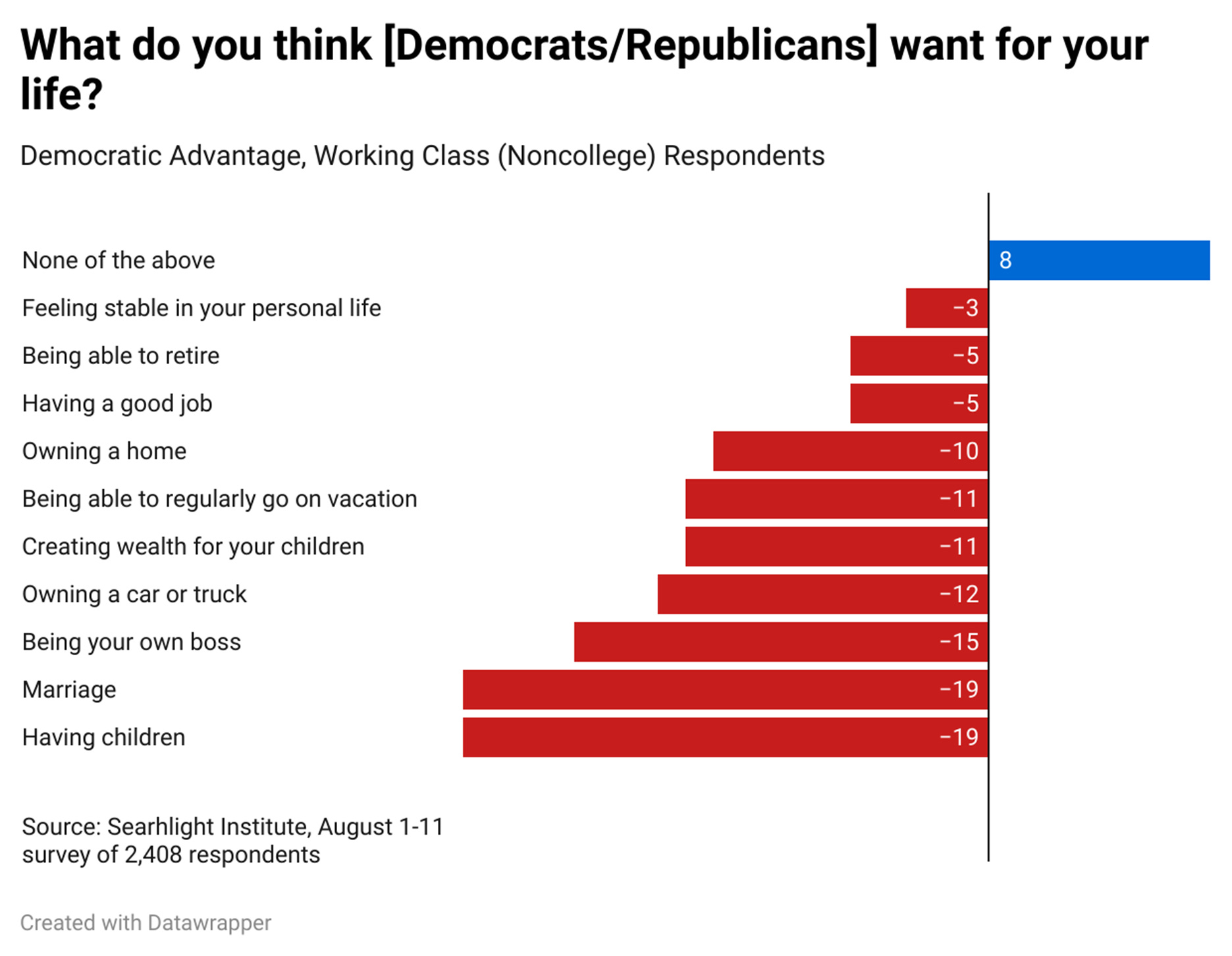
These data are not surprising. Democrats’ big economic policy idea for the last decade has been some version of the clean energy transition, about which voters have demonstrated their lack of interest. Democrats remain committed to that vision, even as they seek to cover it up by “affordability-washing” their green economic plans.
And speaking of affordability, Democrats are clearly hoping that their new party line about the issue will overwhelm suspicions and related uneasiness about a return to the Biden-era economy. But affordability is just a slogan, and so far the meager policy substance behind the slogan are a grab bag of price caps and controls, subsidies, and new regulations that may or may not do much to make everyday life more affordable. Their purpose is mostly, if not solely, to signal that Democrats want to do something about the problem. Even the most partisan Democrats, however, likely realize that as an economic program all this doesn’t amount to much.
It is interesting that affordability, as thin as it is, has mostly drowned out Democratic interest in “abundance,” which had a moment in the Democratic discourse. The concept was always somewhat compromised by its tight linkage to policy projects beloved by liberal professionals like a clean energy transition and urban infill housing, but at least there was a “there” there. However, the intrinsic deregulatory and anti-bureaucratic character of the abundance approach is just not that popular with the many Democratic professionals whose ox would be gored by that approach. So, affordability it is to keep peace within the coalition.
Rounding out the hit parade of Democratic economic policy ideas is that old favorite, “tax the rich.” There are now several versions in circulation whose policy defects are glaringly obvious. But, shockingly, this is what now passes for an innovative Democratic economic policy idea.
A good part of the problem here is that Democrats, broadly speaking, have lost interest in the general goal of economic growth and a richer country. That goal has taken a back seat to others deemed more important, like fighting climate change, reducing inequality, pursuing procedural justice, and advocating for migrants and identity groups. The invaluable “Deciding to Win” report analyzed word frequency in Democratic Party platforms since 2012 and found a 32 percent decline in the appearance of the word “growth.” By contrast, there was a 150 percent increase in the word “climate,” a 1,044 percent increase in “LGBT/LGBTQI+,” a 766 percent increase in “equity,” an 828 percent increase in “white/black/Latino/Latina,” and a 333 percent increase in “environmental justice.”
Getting from these priorities to a revival of social democracy will be very, very difficult. Of course, there is no law that says a working-class-oriented politics that aims to both promote a dynamic capitalism and channel the benefits of that growth to ordinary workers can only come from the left. But that’s a story for another day.
Great stuff. I wish that most voters on any point of the political spectrum, especially younger voters, had the patience and attention span to read this.
The working class long ago discovered that the objectives of social democracy, fairness in a merit based system that preserves the middle class and freedom, has not disappeared. It's home is the Republican Party under Donald Trump. If the Democrat Party is the party of the Brahmin Left...let them go form their own country and watch it collapse like academia is.