


Intro
Last month, the 2025 Census Population Estimates were released, which showed new population data and trends between the official Census counts.
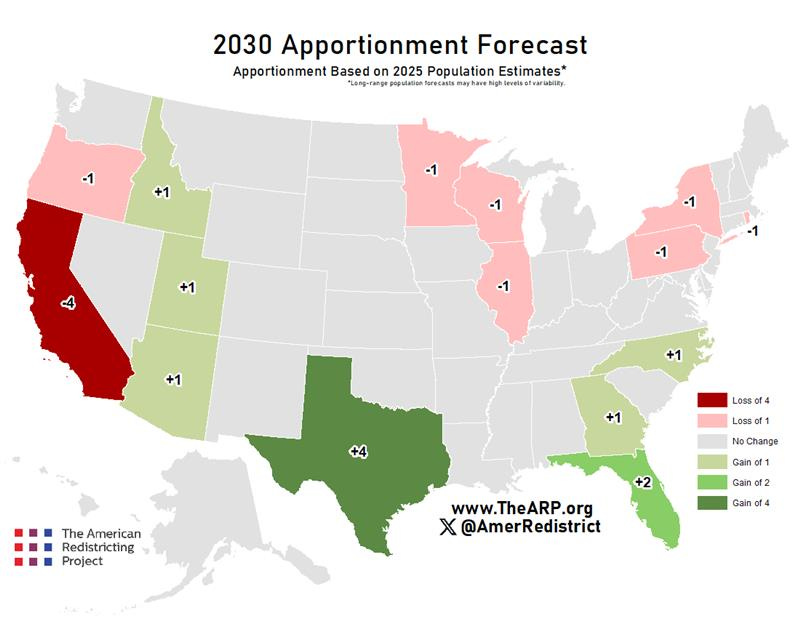
The mid-decade estimates also can help provide insights into what the congressional and Electoral College maps will look like starting in 2032. Based on these new numbers, The American Redistricting Project forecasts the following:
Gaining seats
+4: Texas
+2: Florida
+1: Arizona, Georgia, Idaho, North Carolina, Utah
Losing seats
-4: California
-1: Illinois, Minnesota, New York, Oregon, Pennsylvania, Rhode Island, Wisconsin
This is the decennial equivalent of an earthquake, and the political aftershocks will be with us for years.
Electoral Impact
Every ten years, seats in the House and Electoral College votes are redistributed based on population changes. Some states grow and gain power. Others shrink and lose it. But this cycle looks different.
Instead of small gains and losses around the margins, what we’re seeing is a clear pattern: the political map of the United States is moving south and west toward states that typically vote Republican, while several traditional Democratic strongholds are losing ground.
Because House seats convert directly into Electoral College votes, states gaining seats also gain votes. That means:
Texas and Florida, both reliably Republican, get more influence.
Two other reliable Republican states (Idaho and Utah) add votes.
Swing states of Arizona, Georgia, and North Carolina add votes.
Meanwhile, California, a solidly Democratic state, loses four.
Other Democratic states (New York, Illinois, Oregon, etc.) also shed votes.
Put plainly: the states that are growing are not the ones Democrats rely on most.
What This Would Have Meant in 2024
Let’s put this into perspective from the most recent election:
Trump won the Electoral College in 2024 312-226 over Harris. Under the newly forecasted map, that would become 321-217 without changing a single vote.
Even more telling is the “blue wall” scenario. In 2024, there was significant discussion about whether Democrats could hold Pennsylvania, Wisconsin, and Michigan, even if they lost Georgia, Arizona, and Nevada.
Under the new apportionment forecast, a map where Democrats hold all the traditionally “safe” blue states plus Pennsylvania, Wisconsin, Michigan, and Nevada would still result in a 273-265 Trump victory.
In other words: the blue wall would no longer be enough.
This has major strategic implications. Democrats can no longer treat the Electoral College as a system they can survive by playing defense. Expanding the map isn’t optional, it’s required. That means competing in places Democrats haven’t won consistently in years, and in some cases, decades.
Congressional Implications
On the House side, reapportionment creates additional opportunities for Republicans.
In states like Texas and Florida, not every new seat will automatically be red, but the overall direction is clear. A reliably Democratic seat lost in Rhode Island is almost certainly replaced by a new seat in a deep-red state like Idaho or Utah.
This isn’t about clever map-drawing or partisan gamesmanship. It’s math.
And it reflects broader economic, cultural, and social trends shaping where Americans choose to live.
Governing Implications
The story here isn’t just about electoral math. It’s about governance and demographic change.
For more than a decade, Americans have been leaving high-tax, high-cost blue states and moving to lower-cost, faster-growing red states. That trend shows up in tax receipts, labor participation, housing permits, and now in the Census data.
First it was the much-discussed California-to-Texas pipeline. Now the pattern is broader. Southern and western states continue to grow as people leave coastal metros for places with cheaper housing, lighter regulation, and more economic mobility.
This isn’t random migration. It’s governance-driven. People vote with their feet when they have the freedom to do so, especially in an era of remote work, cheap travel, and highly mobile capital.
As a result, the policy preferences of the electorate are shifting, because the population itself is shifting.
What does this mean for the 2030s?
Predicting politics five years out is risky. Predicting it ten years out is even harder. Hell, predicting politics five days out is nearly impossible. All that to say, these trends could slow, stall, or partially reverse.
But two conclusions are hard to avoid:
First, the structural advantages baked into the Electoral College and House are moving in a Republican-friendly direction, independent of messaging, candidates, or turnout operations.
Second, blue states can no longer assume population loss is politically cost-free. Fewer people means fewer seats, fewer electoral votes, and less leverage in Washington, regardless of how strong their margins remain at home.
The 2030 reapportionment won’t just redraw maps. It will redefine the playing field. And whichever party adapts fastest to that reality will shape the next decade of American politics.
Kamala wants to run again, and the only one challenging her in the polls is Newsom. The Hispanic voters (I hate that stereotypic term but have to use it.) are shifting away from the
Republicans because Trump overshot the immigration issue, but hate the wokies. If the Republicans produce a half-decent candidate who is better than Trump the Democrats will lose in 2028. I think concern over the 2030 census is a bit premature. The Welcome Party needs to get behind a viable alternative and hit the ground running after the midterms. If the Democrats lose in 2028, the moderates will need a new party, because what will be left will be non-viable.
The Blue Wall may be obsolete. If you take the 7 states with the narrowest Trump victory margin in 2024 starting with the closest you have in order WI. MI, PA, GA, NV, NC, AZ. So we continue with WI, MI, and PA, as the blue wall, but the fourth state could be GA, NV, NC, or AZ. NV would not get you there, correct, but GA, NC or AZ with the three Midwests would do it. Now the caveat here is that the biggest swing away from Trump recently is Hispanics, so maybe there is a better shot for NV and AZ, and GA and NC have been trending blue where the Midwests have not.