


Dear readers,
We believe there’s value in revisiting old ideas and arguments as circumstances change, so we are starting a new, semi-regular segment: TLP, Revisited. From time to time, we will reprint some of our favorite pieces from The Liberal Patriot and add a little commentary reflecting on them from the perspective of today.
As we note in this piece, a recurring theme of the 21st century has been instability: the dot-com crash, the 9/11 terrorist attacks, the wars in Iraq and Afghanistan (and subsequent fallout in the Middle East), the Great Recession, mass migration, rapid technological change, the COVID-19 pandemic, and the rise of populist movements on the left and right (to name just a few).
And over the past few years, artificial intelligence has emerged as a new and increasingly omnipresent force in daily life—one that many people are wary of and feel they have little control over. Consider:
63 percent of Americans say AI is advancing “too quickly,” while just 19 percent say it’s moving at about the right pace (and a mere two percent say it’s going too slowly);
59 percent expect AI to reduce the need for humans to perform important or creative tasks;
57 percent say they believe the risks of AI outweigh its benefits (compared with 34 percent who say the opposite);
Half (50 percent) of Americans are more concerned than excited about the growing use of AI in daily life, versus just ten percent who are more excited than concerned; and,
Three in five (59 percent) of Americans say they have little or no control over how AI is used in their lives.
In the face of all this, it’s not hard to understand why so many Americans feel that the world around them has become so unsettling. And any party that hopes to win and exercise political power would be wise to speak to this growing sense of instability.
Right now, the party that appears to be on the cusp of winning power is the Democrats. Their standing has dramatically improved since this piece was first published. But with any newly acquired power will come a great responsibility: they must rise to the occasion by showing strong, steady leadership and offering a path for navigating this new world that eases people’s fears as much as possible, rather than feeding on them.
Originally published on June 17, 2025.
As Donald Trump ran for a second term in 2024, a attack line he frequently leveled at Joe Biden and Kamala Harris was that they were both “weak.” He focused specifically on the porous southern border and conflicts abroad, problems he said never would have happened under his leadership. Enough voters ultimately bought this argument. In a post-election study from Third Way, among the top words they associated with Trump were “strong” and “leader.” The AP VoteCast survey similarly found voters were likelier to view Trump (56 to 43) than Harris (46 to 53) as a “strong leader.”
The efficacy of the “strong” versus “weak” framing likely stemmed from a deeper issue in American life: many people feel like the country is going through an uncertain and unstable time and are looking for strong leadership to navigate it. In a poll last month, YouGov asked respondents which periods in U.S. history they believed were the most and least politically stable. There were several contenders for most stable, but the top choice was the Reagan Era, which many seem to fondly recall as a time when the country succeeded under the leadership of a strong and confident president—especially coming out of the Vietnam War and economic stagnation of the 1970s.
But respondents were less divided when it came to identifying the least stable era: a decisive plurality (31 percent) picked the present, which appears to include everything that has happened since 2020. Tack on the decade or so just before that, including the Great Recession and tumult of the 2010s, and that figure rises to 36 percent. The next-closest era? The Civil War, which just 17 percent identified as the most unstable period in American history.

Some of this result is likely due to recency bias. Still, it’s telling, if understandable, that so many Americans view the present with such unease. Consider everything the U.S. (and several other countries, for that matter) has experienced over just the past couple of decades:
A monumental recession that created a prolonged period of hardship and an uneven recovery;
Post-war fatigue following Iraq and Afghanistan, the rise of ISIS and other terror groups that later wreaked havoc on western countries, and the start of two new foreign wars in which the U.S. has had a tremendous stake;
The advent of camera phones, which among other things became a vehicle for broadcasting police shootings, leading to subsequent unrest across the country;
Social movements on the left aimed at upending longstanding conventions and understandings surrounding everything from race to gender to relations between the sexes;
A populist uprising on the right that has fervently worked to dismantle (or at least seriously rethink the wisdom of) many post-World War II institutions and disrupt the longstanding global neoliberal order;
A pandemic that led to the deaths of over one million Americans, greater levels of isolation, and more antisocial behavior in public;
Mass migration that has rapidly changed the demographics of many western societies and engendered backlash, especially following a surge of border crossings during Biden’s presidency;
A declining devotion to organized religion, an institution some people may feel has long helped root American society in a shared ethos;
The exacerbation of political and cultural polarization coupled with growing levels of distrust among Americans of different political persuasions; and
The rapid development of new technologies and their subsequent disruption of daily life (such as social media and, most recently, AI).
In moments of vulnerability and precarity, people often turn to leaders who project strength—or whom they believe can at least deliver some sense of stability. In 2020, facing a global pandemic, that leader was Joe Biden, who pitched his steady hand and decades of experience as the antidote to four chaotic and unpredictable years of Trump and pledged a “return to normalcy.”
However, Biden’s term was marred by much of the post-Covid fallout detailed above, including growing inflation and a spike in border crossings that sharply reversed a previous uptick in favorability toward higher levels of immigration. According to the 2024 VoteCast survey, a large majority (60 percent) identified either inflation or immigration as the top issue facing the country—both issues dealing with matters of security and stability—and these voters broke heavily for Trump.
Since assuming office for the second time, though, Trump has overseen even more instability. His haphazard tariffs have left allies, consumers, and markets spinning. Many of his executive orders pertaining to federal departments and agencies have been ill-conceived, leaving states, municipalities, and ordinary Americans unsure of whether federal funds and jobs will continue flowing to their communities. On the immigration front, far from any kind of organized and methodical deportation program focused primarily on criminal offenders, Trump’s approach has been more akin to shock-and-awe, engendering backlash from many Americans.
Just this past week, the country was rocked by a series of destabilizing events: marines arrived on the streets of Los Angeles to put down protests, a U.S. senator was handcuffed and dragged out of a public event, a new war commenced in the Middle East, and a Minnesota state legislator was assassinated (and one of her colleagues nearly was, too).
And yet: despite all this, voters aren’t yearning for a return to Democratic rule. In fact, Trump has retained a higher level of support up to this point in his second term than he did in his first.
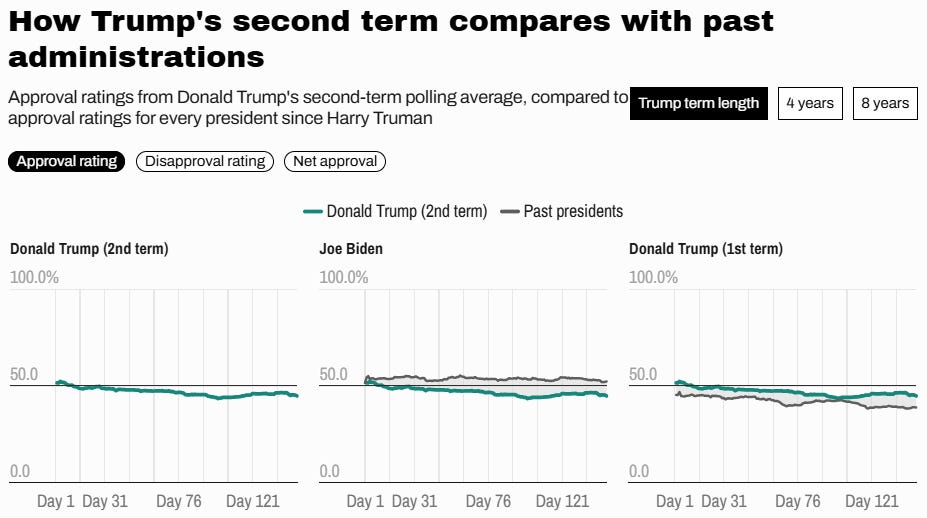
Democrats thus cannot assume the pendulum will naturally swing back to them four years from now, even if Trump remains unpopular or the current tumult persists. Research has found that during periods of rapid and unsettling changes, voters don’t often look left. In the face of economic uncertainty, for example, support tends to increase for right-wing populists rather than progressive parties promising to expand the safety net and increase income redistribution—moves some Democrats might believe could address voters’ feelings of insecurity. Or consider how following the violent riots of the 1960s, support grew for the law-and-order candidacy of Richard Nixon.
Viewed in this context, one could reasonably argue that Biden’s 2020 win—a victory for the left party at a time of great uncertainty—was more of an aberration than a sign of typical voter behavior.
This isn’t to say Democrats can’t win back the presidency in 2028. However, they would be wise to reckon with the disquieting feelings many people possess right now, including speaking directly to the issues that inform those feelings. Though it may be a while before the public trusts them again to handle immigration, Democrats could at least offer their own alternative to Trump for how they plan to control the flow of migration over the southern border—a primary driver of the recent rise in anti-immigration sentiments—and plug other holes in the system while still pledging to defend the country’s rich tradition of welcoming and assimilating new immigrants.
Additionally, there’s another issue on which Democrats continue to hold an edge over Republicans and which they may be able to credibly press with voters: healthcare. Post-election evidence suggested that even at one of the Democrats’ lowest points in recent memory, voters still continued to trust them more on this issue.

People who don’t have health insurance often fear they are one medical issue away from bankruptcy. And for those who do have it, the threat of taking it away might be strong enough to move their votes. Given the overwhelming public opposition to the current Republican plan to cut Medicaid—and possibly curb Medicare benefits, too—there may be an opening here for Democrats.
Another way Democrats might address voters’ concerns is through the type of candidates they nominate, in particular for president. Maybe it’s someone with a national security or military background who can market themselves as a leader with a steady hand. Or, perhaps it’s an experienced governor who successfully helped guide their state through the Covid pandemic, a difficult and fearful time for many Americans. Whoever they choose should have the ability to calm a weary nation.
This period of precarity is unlikely to end soon, especially in the face of uncertain technological changes around artificial intelligence, growing partisan polarization, continued mass migration globally, and the persistence of foreign conflicts. Whichever party is able to compellingly speak to voters’ anxieties during this time and offer a reassuring vision for helping guide the nation through it may stand to enjoy sustained success in this decade and beyond.
WE DO NOT HAVE AI. We have Large Language Models. LLMs are NOT AI. They are SOFTWARE. CLOUD SOFTWARE. We do NOT have artificial intelligence. WE DO NOT HAVE THINKING MACHINES.
The idea that "AI" - chatbots that wake up, "set their own goals," and "simultaneously" start hacking servers - is fake. It doesn't have "a 10% chance of ending the human race." The Hugging Face hack isn't a mysterious, supernatural occurrence. It's a Python Loop and a chatbot. The people responsible didn't accidentally create god: they created autonomous malicious software and then failed to closely monitor it, resulting in it doing something both foreseeable and bad.
Hmmm 🤔 Let’s imagine what Democrats have to offer - open borders, with the associated flood of illegals into the US, boys playing against girls in all sports, young children having gender transition treatments/surgery, wind and solar energy debacles, use of lawfare to prosecute any political opponents, resurgence of DEI (didn’t earn it) policies, dilution of working class incomes, etc. Yeah, that all sounds like something sane people would embrace! 😵💫😵💫😵💫