


I recently sat down for an interview with the Wall Street Journal’s editorial page editor, Paul Gigot, for a discussion about the midterms. We chatted about what could happen to moderate voices in the Democratic Party if progressives succeed tonight, what the potential results could mean for the Trump coalition in 2028, and more. Below is a transcript of our conversation.
And as always, a reminder: if you would like to recommend an article or submit a question for our mailbag, please leave a comment on any TLV post published in the seven days leading up to our Friday Five posts (including this one). We’ll collect our favorites and include them in future editions!
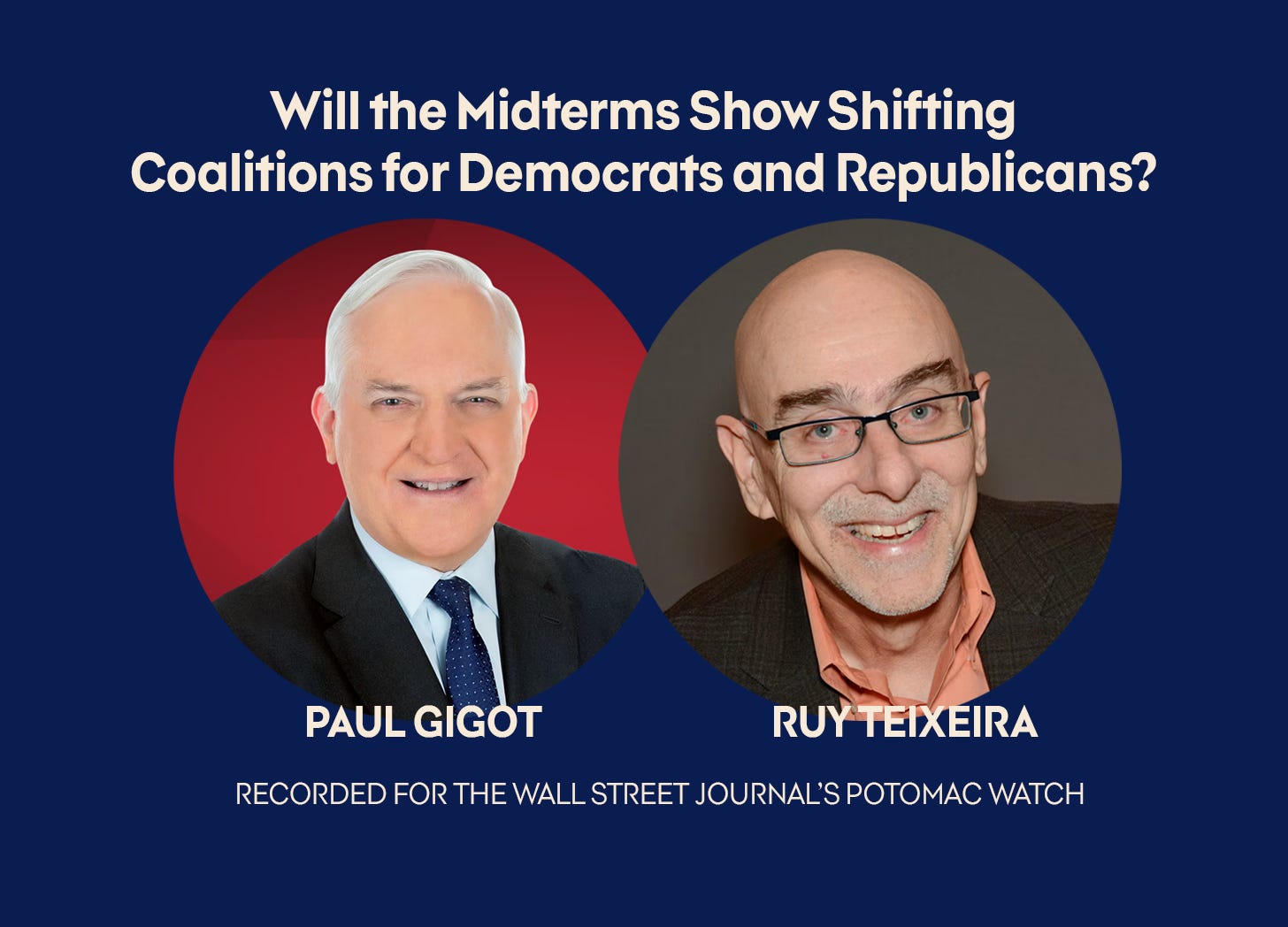
Paul Gigot: With eight days to go before Election Day 2026, collars are tightening around campaigns across the country and especially in the White House. Democrats are anticipating a big win, but beyond the electoral math are deeper questions about what the results will tell us about the shifting coalition of Republicans and Democrats. How have those coalitions changed since 2024 when Donald Trump rallied a new coalition of working-class white voters, Hispanics, and independents, and other minorities to win nearly 50 percent of the vote?
I’m Paul Gigot, editor of the editorial page of The Wall Street Journal. And my guest today is Ruy Teixeira, a longtime student of politics, political scientist, a senior fellow at the American Enterprise Institute and founder of the Substack newsletter, The Long View. Welcome, sir. Thanks for coming in.
Ruy Teixeira: Thanks for having me, Paul. This should be interesting.
Let’s talk about this issue, the fundamental issue that seems to be approaching us next week is that the Republican Party, considering where it was in 2024, has shed voters. The Trump coalition isn’t what it was two years ago. What’s driving this political dissatisfaction with the president and his party?
Well, I think it’s pretty simple. I mean, this is a thermostatic reaction against a party in power, which has not delivered what it said it would. People’s views of the economy are extremely negative. People’s views of a lot of Trump administration actions are extremely negative.
Look, Trump came in with this new coalition you alluded to, and in a sense, he was promising to fix the economy, make life affordable, and bring things back to normal after a certain amount of Democratic craziness. I think on all of those scores, he hasn’t really delivered, though you could argue he’s pushed back on some of the Democratic craziness. Unfortunately, he substituted his own craziness for it.
So I think people are really very unhappy with how things are going, and that’s why the Republicans are hemorrhaging a lot of the votes that they picked up in 2024 from non-white working-class voters, even some working-class white voters, young voters, Latinos. I mean, it’s pretty much across the board. Those voters that swung exceptionally heavily in his direction in 2024 are all swinging back.
Now, we can’t really control for who are those voters who are swinging back. Maybe those are the voters who were always more likely to swing back to begin with. In other words, there’s some peripheral voters who moved in Trump’s direction in 2024 who just aren’t going to show up this time, even though on balance, they probably still prefer the Republicans to the Democrats. But that said, I think it’s undeniable that this shift will be big, and it will be precisely in the opposite direction of what happened in 2024.
So if you talk to the White House, they’ll say, “Well, look, we’re just not getting the credit. We closed the border, and that was a big driver of votes in 2024. Prices, hey, I mean, wasn’t our fault. It’s the residual carryover from Biden.” They have a harder time denying the tariffs played a role in this, and they have a harder time denying that the war in Iran has played a role here. And in fact, Trump has all but acknowledged the latter by saying it’s just temporary. It’ll come back after we end the war, however that does end.
Particularly on immigration, you don’t get credit for the things you promised that you do that are no longer issues. People say the border’s closed, so let’s move on to the next thing. And then there’s this: do you think that the way that the administration has enforced internal immigration control with its deportations, is that factoring in here at all?
Oh, yeah. I mean, I think it’s really true that he did something that he said he was going to do that people basically supported and still support, which is closing the border. That’s been very effective. He doesn’t really talk about it enough, I think, or in the right kind of way, but it has been twinned with, at least initially, these pretty draconian enforcement actions of ICE, which obviously would get pumped up endlessly in most of the media whenever something untoward happened.
There were the huge demonstrations and tragic deaths in Minneapolis, and it just struck most people as being excessive, even people who supported a much more restrictionist approach to immigration and supported Trump partly for that reason. So I think that’s still a big hangover on views of the Trump administration.
And Democrats now, they’re not that far off Republicans in terms of who’s preferred in immigration, depends on the poll you look at. But Trump’s approval rating in particular is dreadful on immigration, even though it’s slightly less dreadful than on the economy or inflation. That’s really a lot driven by the sense that, yeah, okay, I wanted the immigration situation under control, but this isn’t exactly the way I had in mind.
If they were doing then what they are doing now, which is a much quieter approach to deportations, I think they could have avoided a lot of these problems. Unfortunately, they didn’t, and that’s still first and foremost in the public mind about their interior enforcement regime, as they associate it with that early days of ICE raids and the heavy demonstrations and masked people in the streets. I mean, you don’t have to have the resistance liberal view of it to nevertheless be somewhat disturbed by it. And I think that’s really hurt them quite a bit.
It’s one of the more striking things when you look at the issue mix and [ask] voters, who do you favor more on issues, Democrats or Republicans? Immigration has been the strongest Republican, one of the strongest issues for a very long time, and now it’s turned. As you say, it’s only slightly more negative for the Republicans than the Democrats, but it’s still striking that that is the case. You would think that the White House and Trump would get more credit for [it]. But this enforcement where they went to set a quota of 3,000 deportation arrests a day—
Bad idea.
—I mean, just a terrible idea, because it’s going to lead to excesses as people try to meet a quota as opposed to actually just trying to arrest people who are here illegally, particularly criminal aliens. So it’s an own goal.
Democrats have been able to skate on the whole issue of interior enforcement. Now, they can just say, “We’ll be nicer and less crazy than Trump and the Republicans. And we, too, believe axe murderers should be deported!” And it really elides the whole question of, well, what about people who are here just illegally per se, right? I mean, they aren’t axe murderers. Maybe they have a job, maybe they’ve been here for a year or two, maybe they came here six months ago. What do you do about those people? Are you going to have any enforcement regime against them whatsoever?
And I think Democrats would prefer very much not to talk about it and, in fact, basically quasi-legalize the people here and do a vast immigration reform package, which of course will never get through Congress. So I think the Democrats have been able to skate on this, and I think that’s a real liability for Trump because it takes one of his biggest issues out of the Republican quiver.
Let me ask you about Republicans and their motivation to vote here. The president is spending a month here—and to his credit, very vigorously—he’s out every day doing an event, a rally in some state or another where there’s a key Senate race in particular, and mostly in the red states, Republican states where there are competitive seats.
I mean, Kansas, I didn’t expect to see Trump and Vance rally the troops, but he’s in a lot of these states, in Mississippi. He’s trying to rally the core Trump vote. He’s saying, “I’m on the ballot. Pretend I’m on the ballot. I’m not, but pretend I am.” So he gets those people out.
My reading of the polls though is that those people are likely to vote anyway. They were going to come out. Maybe I’m wrong, but the people that have been telling pollsters they may not come out are some of the traditional Republicans, the Romney voters, the McCain voters, people who voted for Donald Trump probably twice because the alternative was worse in their eyes. They’re curbing their enthusiasm here for the Republicans now. And I’m not sure… How important is it for Trump to get those people out here, and can he do it?
Well, I agree with you. I mean, I think a real problem that these candidates face is not the hardcore MAGA Trump voters. It’s rather the people who voted for Trump, but weren’t necessarily super enthusiastic and had questions about it to begin with. I mean, these are the people who are more likely to stay home. These are people more likely to vote for the other side.
And you don’t necessarily rally them to the Republican side, to candidates like Paxton or whatever, by holding a bunch of rallies, Trump rallies, which attract the Trump faithful and get that kind of coverage. And it’s a desperate attempt to cover up on the fact that a lot of these are, as you say, own goals where the administration has done things. It’s essentially pushed voters away exactly those kinds of voters whose support for Trump, at least the Trump administration, was somewhat provisional.
I mean, one single factor could explain a lot of what’s going to happen as much as anything else, which is the Iran war and the rise in gas prices, because it’s a bit catastrophic. I mean, they’re already doing poorly, and this has just undercut the whole claim of the Trump administration and the GOP to having solved people’s economic problems. “Hey, look, these guys are making it worse. This is crazy.” You can’t make up for an error like that by going out and holding a bunch of rallies.
Really, the hope for Republicans here is just the polls are a bit wrong, and they could be, and especially in red states. I mean, there’s a record. There’s some good analyses by Patrick Ruffini and Sean Trende and others that show that polling error is much more common in these red states, these solidly red states, not swing states. And if that’s true, there might be enough error that we might wind up seeing a Senator Paxton, certainly might wind up seeing a Senator Hinson, I think. I mean, I think that’s some ways more likely than not.
But basically, as is well known, the Democrats need to take a lot of these red states. And if the polls are inaccurate on this, they’re in better shape—the Republicans are in better shape than they thought.
It’s Ken Paxton, the Republican attorney general from Texas, running neck and neck with James Talarico, even a little bit behind in Texas, and Ashley Hinson, congresswoman…running in Iowa as a senator, and that’s neck and neck. She’s a little ahead in the polling, but these are margin of error. Yeah, these are margin of error issues.
So I mean, what’s your personal view on the polling accuracy? I mean, I’ve seen the Patrick Ruffini data. Pretty compelling. Also, we’ve seen years when the Democratic turnout has been underestimated. What’s your view about whether or not this year they are going to be underestimated one way or another?
Yeah, I hesitate to make a point prediction on that. I mean, Nate Silver’s traditional reply to this is, “Well, I mean, this is kind of a random walk, the polling errors. I mean, it could be pro-Democratic, it could be pro-Republican. It’s very hard to make a prediction, particularly about congressional elections where the pattern is less clear.”
So on the other hand, you take a look at the Ruffini, Trende, etc. data, and you do see that pretty well-defined trend of being over-optimistic for the Democrats in red states. So I would not be surprised if that means that some of these polls are bit off and that would help the Republicans, [the polls being] too much in favor of the Democrats.
I mean, again, is it enough to actually prevent a Democratic Senate? I guess I would tend to doubt that. I don’t really want to go through the races race by race and say, “Well, this one might work for the Republican one.” The leads are solid enough and big enough in a lot of these red states that even an error might not be enough to push them back toward the Republicans.
So my overall take, I guess, is yes, there’ll probably be some polling error. I would not be surprised if it was more on the pro-Democratic side than the pro-Republican side in these red states, but I also would kind of expect that not to be enough to push the Senate back into Republican hands or keep it in Republican hands. But I could be wrong.
I mean…this is actually going to be a good test of how good the polls still are. If in fact there is a really, a pretty big polling error to the extent that, for example, Republicans hold the Senate, I think, man, what’s going on here? I mean, everything you saw for the last four or five months, everything shifted toward the Democrats. Every modeler says the Democrats are more likely than not to take the Senate. If that doesn’t turn out, well, they’ll say, “Okay, well, we never said it was for sure. We just said what the probabilities were.”
But still, it’s disturbing. It’s just hard to poll these days. It’s hard to get an actual random sample of the voters who are actually going to show up on election day, particularly in red areas, and [there’s] this ongoing problem with peripheral Republican or populist-oriented voters of relatively low education levels who don’t want to talk to pollsters, and it’s really hard to adjust for that. So I think this will be a fascinating test case of whether pollsters are even close to figuring this one out.
Particularly in the red states where Democrats really do have to pick up some, North Carolina, Roy Cooper’s going to win that, put that—
Done.
—in the Democratic column, that’s done… Susan Collins in Maine, I think there’s a really good chance she pulls it out.
Agree.
That’s tied, and I think her personal standing in the state could pull it out. And then you’ve got the Alaska, Ohio, Iowa, Kansas, Texas. These are states where Democrats are going to have to win some of these. But I want to ask you about two races in particular which deal with the Democratic quality of the candidate, and that is Maine with Troy Jackson, who’s a man of the left, no question about it, and has not performed well in the debates. Clearly doesn’t understand the difference between Medicare and Medicaid. I don’t know how many voters care about that, but I noticed it.
That’s asking a lot, Paul.
And then you’ve got Abdul El-Sayed, also a really distinctive man of the left, deeply anti-Israel, portrayed by Mike Rogers, the Republican, as a radical. Yet he’s led in the polls by a couple of points pretty solidly throughout. He’s very smooth on his feet… But could those candidacies really upend the Democratic attempt to get a majority?
Oh, I think I’d be very concerned. I mean, basically, you’re talking about one state that they were counting to flip, Maine, and if they don’t flip Maine, that just makes everything more difficult because then they got to pick up five other seats, not four. And then the Michigan thing is a hold, so if they lose that, the whole arithmetic goes into a cocked hat.
I mean, I think Troy Jackson, he’s left, but he’s not... Basically most Democratic candidates are pretty left these days, and he is a left-populist type of guy, but he’s not Platner and not as charismatic as Platner, but he has the overhang from the Platner failed candidacy, which I think really, really hurts him. So would they have been better off with a sort of generic Democratic nominee in Maine? Probably, I think.
And where I think it really would’ve favored a generic Democratic nominee would be in Michigan. I think Abdul El-Sayed will probably win, but I think he will underperform the overall swing, he’ll underperform the Democratic gubernatorial candidate—and he may lose! And this year, you shouldn’t lose in a state like Michigan with the national tide running so heavily in favor of the Democrats. But there’s huge question marks about this guy. They would’ve been much better off.
That’s not the mood of the Democratic primary electorate. [That] may be the worst aspect of Abdul El-Sayed running: even if he wins, and again, I think he probably will win, I just think this is a massive green light—the semaphore is down green—for the DSA progressive left to say, “Okay, we did it. I mean, Abdul El-Sayed won. I mean, why can’t we...” As AOC so memorably put it, “We can win anywhere.”
And I think that one can contest this interpretation, but I think it will have a lot of purchase within the Democratic Party. And I think it will turbocharge the progressive/DSA left and the Democrats, which I think will make it more difficult for them post-2026 moving into the ’28 cycle. Because I mean, some people believe Democrats have solved their problems, but as we’ve discussed earlier, this is primarily a thermostatic reaction against Trump. They don’t love you, they hate your opponent, I think is what I keep on telling the Democrats.
The victory of Abdul El-Sayed will be an important factor pushing them away from that sensible interpretation. “Change anything? Why do we need to change anything? Look, Abdul won! We kicked the Republican’s ass! This is great. Let’s press the accelerator!” So I think that’s going to be a real problem for them. We’ll see how bad a problem after the election.
I focused on Michigan and Maine because I think those are two critical races in the result. What signals will it send to the party about the lessons of this election? If Collins goes down, for example, it was likely to be because of Trump. I mean, an astute observer of Maine politics said it would almost be better for Collins if Trump were at the top of the ticket now, because then Democrats split their ticket, vote against Trump, but then say, “Okay, I’ll vote for her.”
Instead, now, voting against her is the only way they can register their unhappiness with Trump. But with her moderate voting record, her history, sometimes voting against Trump, if she loses and Jackson wins, it will not only turbocharge the left, some Republicans will say, “See? You can’t win anywhere with a moderate Republican now.”
And for the Democrats, I mean, it’s interesting, right? Who went to campaign for Collins? Joe Manchin, former West Virginia senator. Who went to campaign for Troy Jackson in Maine? It’s Bernie Sanders, Elizabeth Warren, Alexandria Ocasio-Cortez. And who came for El-Sayed? Those three and of course Barack Obama on the weekend. The left wing of the Democratic Party really thinks these are the two most important races they’ve got. Do you agree with That?
Yeah, I agree with that. As a political observer, I think people who really count noses in politics would question the interpretation of the progressive left if in fact those victories take place. But I do think it’s going to have, again, huge purchase, huge momentum. Yeah, as you say, look who shows up to campaign for those people.
And I think they will count it: “That’s in our column. We won. Come on. We’ve got the Big Mo,” as they used to say. It’s undeniable. I mean, look, these people even showed up for Angie Nixon in Florida, who is absolutely bonkers, but they were happy to go out there and say, “Oh, Angie Nixon, great. This is what we need.” Of course, she’ll lose, but if she loses by any less than people are expecting, they’ll probably say that’s a victory, too. “Florida’s coming back, baby!”
Yeah. Well, that is Angie Nixon, the Democratic Senate candidate. She’s going to lose, there’s no question about it, but it’s interesting that they nonetheless went down there to fly the flag, and even Obama showed up for her, which is interesting.
So let’s say that, I mean, Democrats take the House comfortably. Senate, we’ll see how those close races go, but likely 48 or 49 Republicans in the Senate in the end, so 51 or 52 Democrats. So that’s sort of where you think that’s going to come out. That’s a reasonable bet, I think. There’s still a chance Republicans hold it with 50. I wouldn’t bet my 401(k) on it. Let’s say they get that outcome, big swing to the Democrats. What lessons does the party learn?
Well, that’s the big question, right? I mean, I think that in some ways, it’s less interesting than what the outcome is at this point. It’s like how the party’s going to interpret it going forward. And I follow these debates pretty closely. I mean, we’ve already touched on the idea that I think you can put it in the bank that the progressive left, and I don’t just mean the DSA, I mean the progressives—well, Progressive Caucus—is huge. It’s over a hundred members.
It is.
Greg Casar is already talking about, “I’m looking forward to passing a bill every week.” He doesn’t mean a bill that would actually become law. He means a bill that would reflect progressive priorities. So that’s going to be their strategy. “Let’s fly the progressive flag. Let’s fly it high. Enough of this...” Sort of, “No more Mr. Nice Guy. We’re going to really show people what we’re for. And when we show people what we’re for, that will make everybody like us because everybody really agrees with us whether they know it or not.”
And I think the moderates, such as they are in the party, or more establishment figures, they will not be so enthusiastic about this. But they really haven’t put up much of a fight as the progressive strength has grown in the party and as the DSA in particular has become stronger. It’s like a big tent.
One way I think about this, Paul, is: is it really a big tent if a democratic-socialist Democrat feels more comfortable in the party than a conservative Democrat? I don’t think so, but I think that’s a situation we have. So I think it seems likely post-2026 is just a tsunami of messaging bills—a lot of grandstanding in Congress.
I mean, remember, they got elected on essentially, the big campaign theme is affordability. What are they going to do for affordability? In their defense, there’s not much they can do, but they will certainly pass a lot of bills. But I think people may get tired of that rather fast, and then looming ahead of that are sort of the delights we can look forward to with all the messaging bills is like the big contest for the presidential nomination over the Democrats that is going to kick off the day after the election’s over.
So how are these results going to feed into that? I think the optimistic interpretation that my more moderate friends in the Democratic Party say, “Well, look, James Talarico won in Texas,” etc. “He was willing to say some slightly heterodox things, and it just shows we’re making progress in red states. What we really need to do is keep on doing that, and the DSA people or whatever, they’ll do their thing, but really moderation is winning, and that’s the kind of candidate we should have.” But I think the progressive left will disagree with that strenuously.
And where is the energy going to be within the primary electorate and within the general democratic discourse? I’m not sure it’s going to be along the lines of, “Well, we should be at least a little bit heterodox and we shouldn’t scare people. We shouldn’t be too far to the left.” I think they’re more like, “Hey, let’s press the accelerator.”
I mean, in 2020, you had the candidates being herded to the left, the primary candidates, one-upping each other. How do we know that doesn’t happen again? I mean, especially given the likely pattern of the election results, especially given the mood in the party. Why would it not be the case that even a candidate who started out thinking they wanted to be moderate realizes they have to position themselves to take advantage of that resistance, progressive energy within the party?
So to me, that’s the real interesting question: how that argument will play out and how it’ll affect the potential presidential candidates. My guess is that progressives will probably have the upper hand, because I mean, look, so far, the so-called moderates haven’t been willing to have much of an argument with them, so why would they do it now?
If I was a Democrat—well, I am a Democrat—that’s what I worry about. I worry that reasonable calls for moderation will be stoutly ignored, and I think the moderates will be reduced to saying, “Well, can we be a little bit less to the left than you would like? Wouldn’t that be nice?” And I think that’s not a good position to put yourself in going into 2028.
They hate JD Vance. I mean, they’ll beat him easily, but I wouldn’t be so sure. I think that it’s two years from now, a lot of things could change. And I think they underestimate—and I think this is something that’s really going to hurt them from interpreting the election results—they’ve underestimated or forgotten about what happened in 2024, about the populist mood in the country, about how working-class voters really don’t like them, how so many Latino voters bailed out in 2024 and could do it again. Right?
Right.
I mean, the voters who come back in 2026 are just going to be visiting, looking around, “Now that I’m back in, this doesn’t look so great. I’ll go somewhere else.” So I think that is going to be really difficult for them. It’s going to make them even more out of touch. The mood of the voters that they lost in ’24—some of them come back in ’26. I just think it’s going to be a real challenge for them. I mean, the America they want is not the America they have, and I think they’re going to have to realize that.
Very much agree with that, but I want to make a distinction between what I see in its drive to use economic populism as an alternative to Trump’s cultural MAGA populism, and cultural leftism.
I see among the Democrats, you saw it in the New Jersey and Virginia governor’s races a year ago, but you’ve seen it a little bit among Democratic leaders, that they want to moderate themselves on immigration, for example. They’ve ducked it as you suggested, but nobody’s going to go out and say, “Open borders again,” in a presidential debate. You’re seeing some moderation even on DEI. Trans issues, not as much as I think they ought to if they want to regain the center, but a little bit.
But where they’re really moving is economic populism, big tax increases. Everybody in the party is now supporting a big tax increase. Now, they say it’s on the wealthy. There’s a lot of bills that wouldn’t just affect the wealthy. For example, fixing Social Security: they want to raise the cap on Social Security, which is a big increase on suburban voters, for example, who make more than $180,000 a year.
They’re moving hard to the left on economics, and that’s where the billionaire wealth tax in California, I think, is a bellwether and will be really significant here. If that referendum passes—Prop 40—that will give further fuel to the Democratic economic populism.
Yeah, I think that’s very true. I wrote a piece a while ago on my old Substack, The Liberal Patriot, No Populism Without Cultural Populism. But as you point out, the way they’re dealing with those issues is carefully titrated moderation in some of these things without really changing their fundamental position much, and they feel that’s enough. Now, why do they feel that’s enough? Because they’ve got economic populism, the magical pixie dust of an economic populism that can sprinkle over their program and it’ll make everybody love them.
But what is the content of that economic populism? What is it actually going to accomplish? I mean, what even is it in programmatic—they don’t know. “Down with the billionaire class.” In a way, it’s like Bernie Sanders’s old thing—“Down with the billionaire class”—has become hegemonic within the Democratic Party, as if that’s some sort of substantive position. And the more we tax them, the better.
But look, again, back to something I mentioned earlier, they ran on, “We’re going to make life affordable. We’re going to fix the economy.” What is their program for fixing the economy and making things more affordable? Is it simply to tax the rich? If you look at the things they are going to put into play in the Congress after 2026 and the things that are likely to be prominent as Democrats run for the nomination, it’s basically like redistribution and spending money.
Yeah. That’s what I see too.
Is that going to produce the economic growth the country needs? I mean, whatever happened to economic growth? I mean, Democrats never talk about it anymore. And I think that is a real problem because almost everything they want to do is dependent on having pretty solid economic growth—very solid economic growth. And if simply the program devolves down to spending money and redistribution, I don’t think it’s going to produce the results that they want and it’s actually not going to uplift the working class.
And so I mean, populism is a rhetorical stance. Its content as policy and actual governance I think is highly questionable, kind of like fool’s gold. It kind of works as political rhetoric, but I think what it would actually deliver in reality is questionable. As I think the Biden administration found out, you can promise a lot of things and then get into power and even do some of those things. And if they’re not the right things, it doesn’t work out very well.
This is a long-winded way of saying, yeah, I think economic populism is somewhat bankrupt as an approach, unless you actually have some ideas of what you’re going to do that would actually work. Fundamental to working is an approach that would actually produce a high level of growth in the United States, but then would allow you to do other things if you want to expand social programs and what have you. But expanding social programs, spending more money, and redistributing in the absence of that is probably not a particularly great idea. And taxing the rich isn’t going to be nearly enough to bring in the money you say you need to do all these things.
So I mean, I probably don’t have to convince you of this, Paul, but they need to do some work here in terms of fleshing that out. What are they going to do about AI? I mean, AI is a huge deal. What is the Democratic program on AI? It’s kind of like, “Well, we should slow down the data centers and maybe it’ll kill us all and that would be bad.” But if AI, in fact, is a general-purpose technology which could produce a high-productivity growth regime in the United States, which would lift people’s living standards, I mean, my view is you need to have more to say about it than that.
And economic populism is a very poor substitute for dealing with those very difficult problems, but the payoff from dealing with those difficult problems could be pretty big. I mean, right now, voters don’t have a lot of faith in either party to produce the kind of economic regime that they want. So maybe you should start thinking about that instead of thinking about how to bash your opponents. End of rant.
Yeah, real food for thought for Democrats. And I would just say that the counterpart there on the Republican side, the fool’s gold on the populist side, has been tariffs.
Yeah.
Donald Trump ran and Republicans said, “Okay, tariffs really work because it identifies us with unions and the working class.” But you put them in power, you put them in place, and turns out they have all of these damaging effects on voters in Michigan and Maine, for example.
Ruy Teixeira, thank you so much for coming in. American Enterprise Institute senior fellow, his own Substack, The Long View. Thanks for coming in, and we’ll have you back in here sometime as the primaries unfold, which will be sooner than I think most Americans would hope.
You got that right!
Formerly a democrat, I voted for Trump. I was turned off by the woke nonsense and the covid authoritarian regime. ( I did't appreciate being forced to take a brand new mrna technology vax to combat a disease that was basically a bad flu). I am sitting this election out because I can't vote for woke authoritarian democrats, but I am very angry about the Iran War. Trump promised to keep us out of forever wars. We are still sending billions to Ukraine, as well as to Israel. Worst of all, we are in a no win war with Iran that was totally unnecessary. I am sick of neo cons, on both sides of the aisle, spending our money to destroy foreign countries with no advantage to our country.
My prediction is that you are right and this election or any foreseeable election won't produce a stable coalition. Personally, I am really sick of political theater. I can think of issues where you coud get something done. It might have to be a MAGA/DSA coalition. The permitting bill is a good start. Consider surveillance pricing and fixing the supply side for medical professionals. The latter might actually produce something unlike the standoff of M4A vs Obamacare repeal. I wonder if there is any space for a Churchill platform. Blood, sweat, toil, and tears. I am sick of happy talk and silver bullets. Sooner or later we get that anyway and it would be better to have some level of unity when it happens.