


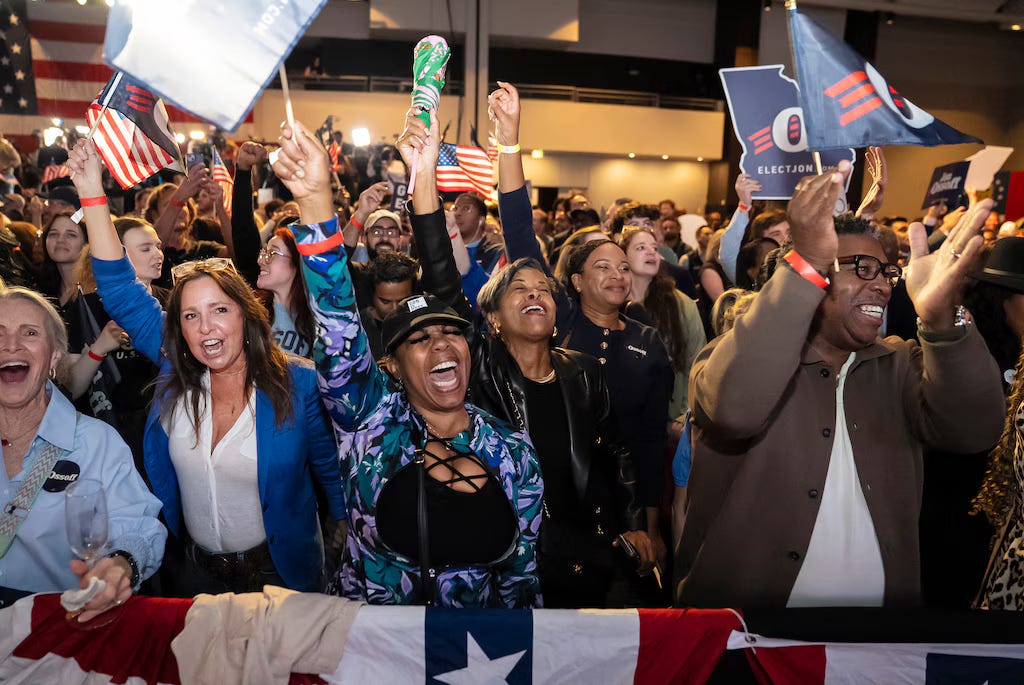
In the end, the polls basically got it right: a large share of Americans were angry with the Trump administration and ready to send a message. And the primary beneficiary of that anger was the Democratic Party, the vehicle through which many frustrated voters could express their displeasure. Democrats won big all across the country and at all levels of government. Virtually no Republican who was even moderately vulnerable was safe.
According to projections from the New York Times, Democrats could win as many as 259 House seats once all the votes are counted. They have already flipped seven Senate seats and could win as many as nine, which would tie the largest such gain in any cycle this century (Republicans also gained nine seats in 2014). They have flipped five governorships and could get two more. And the party’s national House popular vote margin could reach as high as 13 points, which would be the biggest win for either party in 50 years.
While more detailed data about this election won’t be available for weeks or even months, there are some other important things we do know that are worth exploring further.
The election was a referendum on Trump—not a total endorsement of Democrats
According to early data from the exit poll survey, a plurality of voters (44 percent) said that one reason for their vote was to “express opposition to Donald Trump.” Among these voters, a whopping 97 percent backed Democrats in House races.1 Pre-election polling data told a similar story.
Moreover, fully 63 percent of the electorate said they disapproved of Trump’s job performance, 86 percent of whom voted Democratic. Perhaps more strikingly, an outright majority (54 percent) strongly disapproved, and 94 percent backed Democrats.2
Trump’s war in Iran also appeared to play a major role in the results: three-quarters of voters (74 percent) said the war was either a “crucial or major factor” to their vote choice, and they broke for Democrats by 30 points.
Voters did view Democrats slightly more favorably (47 percent) than they did Republicans (40 percent). But the Democrats’ net favorability was still underwater at -6 points, even with the electorate that delivered them such resounding wins. And among the country more broadly, their numbers are much lower.
Though Democrats are right to be excited by the results, it’s important to understand them for what they are: an indictment of Trump rather than a resounding endorsement of the party and its agenda. More on this in a moment.
Democrats’ majorities will be big, though not quite historic
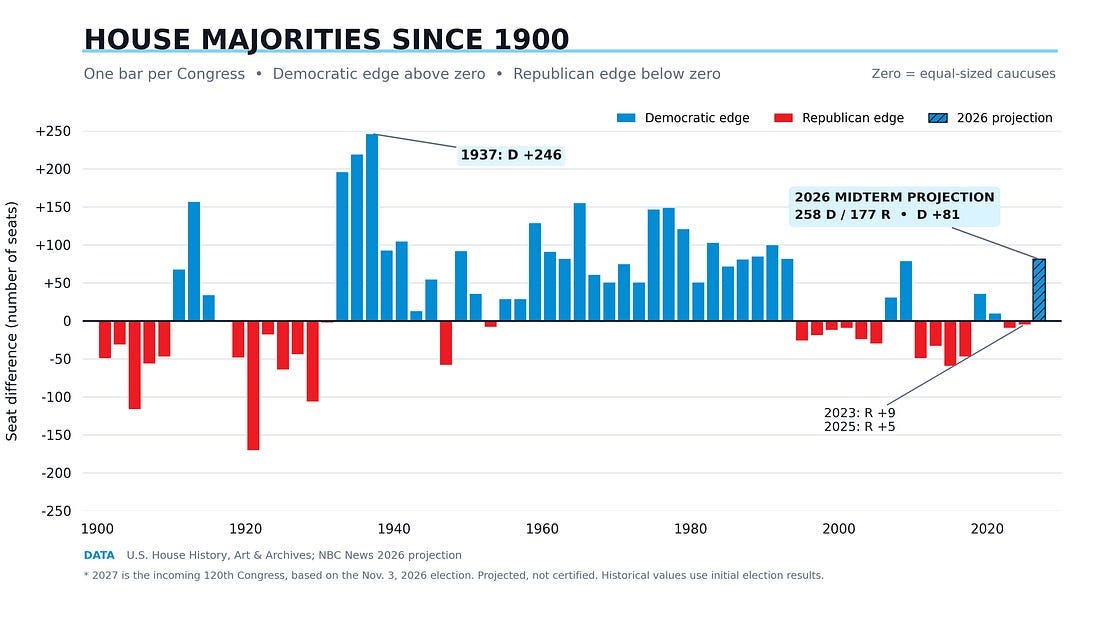
Friend of The Long View and GWU Professor Casey Burgat noted this morning that Democrats’ projected 258 House seats would be the largest majority for either party since 1993. While that’s certainly an impressive feat for the modern political era, it’s still considerably smaller than many majorities in the 20th century.
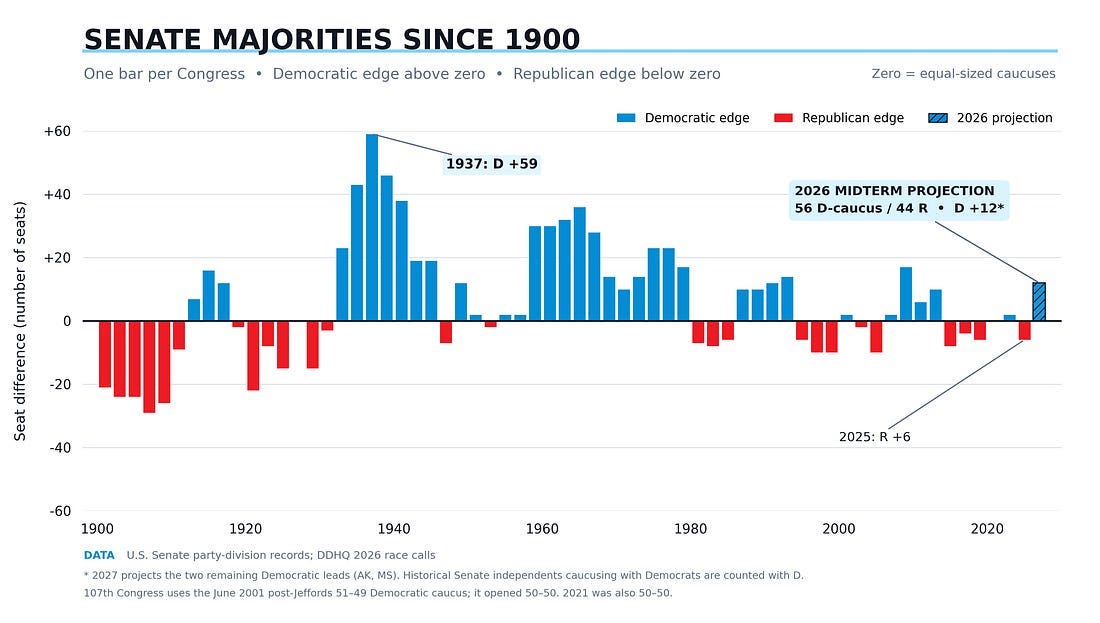
The Senate tells a similar story: Democrats’ projected 56 seats would represent the largest Senate majority for either party since 2009—but it would still be smaller than many majorities of the 1900s.
Trump’s coalition was more fragile than it appeared
According to Times data, Democrats’ biggest gains came from the groups that swung hard toward Trump in the 2024 election. These included Hispanics (-28), young voters overall (-32), and young minority men in particular (-34).3 Some of this was likely driven by changes in turnout, which we’ll discuss in more detail below.
This tells us a couple of things. When members of these populations shifted to Republicans in 2024, many were apparently just visiting rather than making a new, permanent home there. In essence, Republicans may have taken these gains for granted—as evidenced by the Texas gerrymander—which backfired on them in a big way.
Still, the 2024 election results showed that many of these voters are open to supporting Republicans and are not necessarily as reliable for the Democrats as they thought. So while Democrats can celebrate the swing back in their direction this cycle, they, too, shouldn’t assume these shifts will stick.
Democrats’ advantage was powered heavily by differential partisan turnout
Early indications suggest that a major reason for Democrats’ wins was higher-than-normal midterm turnout among their own voters—and a sharp drop-off among Republicans. According to preliminary analysis from the Democratic firm Blue Rose:
Harris supporters actually turned out at a higher rate in 2018 (59%) than they did this year (56%). The bigger advantage this cycle came from Trump supporters staying home: only 47% voted, down from 56% in 2018 and 51% in 2022.
The Washington Post’s Lenny Bronner detailed how differences in turnout affected states with competitive Senate races, noting that “Democrats showed up as if this were a presidential election... and Republicans didn’t.”
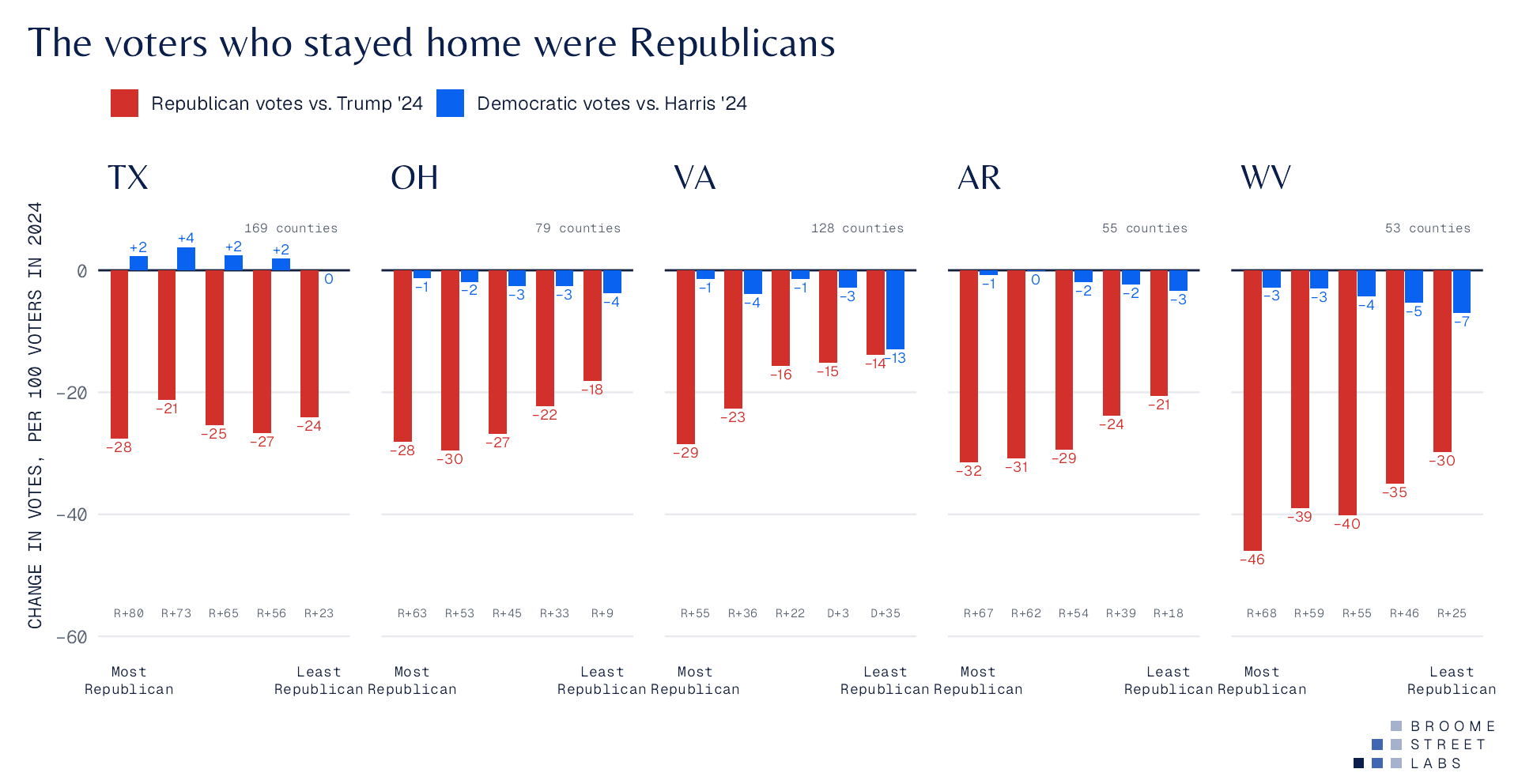
There is also evidence that some voters likely switched their party preference between 2024 and 2026. According to the exits, seven percent of 2024 Trump voters backed a Democrat in House races this year, compared to just two percent of Harris voters who backed a Republican.
We will know more about the relative importance of turnout and persuasion in this election once organizations like Catalist and Pew Research publish their voter-file analyses next spring. But these early results point to differential turnout as a primary factor in the Democrats’ success.
The wave came crashing down on the South
One of the most remarkable developments was the extent of Democrats’ gains in the South.
In Alabama, Democrats held on in AL-02 (which was gerrymandered to make it more Republican-friendly) and came within six points of flipping AL-05, a district thought to be solidly Republican. The GOP is also on track to win the state’s Senate contest by fewer than ten points, which would be the narrowest victory in a Senate race for them since 1996.
In Florida, where Republicans passed another gerrymandered map, Democrats not only retained all of their potentially vulnerable seats but may flip one (FL-09). They are also within one point of flipping four other races that remain uncalled. The Democratic candidates for Senate and governor came within three points of winning, just four years after Republicans won those offices by 16 and 20 points, respectively.
In Georgia, Senator Jon Ossoff is set to win re-election by 18 points, the largest margin for a Democratic Senate candidate in the state in 26 years. Keisha Lance Bottoms became the first Democrat since 1998 to win the state’s governorship. Democrats also carried this momentum down the ballot, capturing all seven other statewide offices up for election. And Democrats came within three points of flipping GA-01, which was considered solidly Republican.
In Mississippi, Senate candidate Scott Colom currently leads incumbent Republican Senator Cindy Hyde-Smith 1,724 votes. If he were to hold on, he would become the first Democratic senator from Mississippi elected since 1982.
In North Carolina, Democratic Governor Roy Cooper won the state’s open Senate race by nearly 20 points—this, in a state that narrowly broke for Trump two years ago. And it appears his coattails may have helped his party overcome Republicans’ gerrymandering effort there, too: across the state’s 14 districts, Democrats have already won nine races and are still in the running in the five uncalled races.
In South Carolina, Annie Andrews scored a surprise victory, making her the first Democrat since 1998 to win a Senate race in South Carolina. Democrats also came within six points of flipping every other statewide office on the ballot. In the House, they are on track to flip SC-01 and are within striking distance of SC-02—another seat handicappers thought was solidly Republican. While the remaining three districts all broke for the GOP, Democrats came within six points of two others as well.
Tennessee was just red enough to keep most of the big races out of reach for Democrats, but they came surprisingly close in several contests. One of the more shocking results came in the governor’s race, where Republican Senator Marsha Blackburn secured a narrow, 2.5-point win over Democrat Jerri Green. In the House, the GOP’s gerrymander basically worked—Republicans have officially won eight of the state’s nine districts, though Democrats may pull off a massive upset in TN-04 (which handicappers also saw as solidly Republican). And they came within five points of picking off Republicans in five additional districts.
One likely reason why Democrats surged so strongly in this region of the country is that black turnout was way up relative to a typical midterm. Here’s a visualization of this phenomenon, courtesy of analyst Sean Trende:
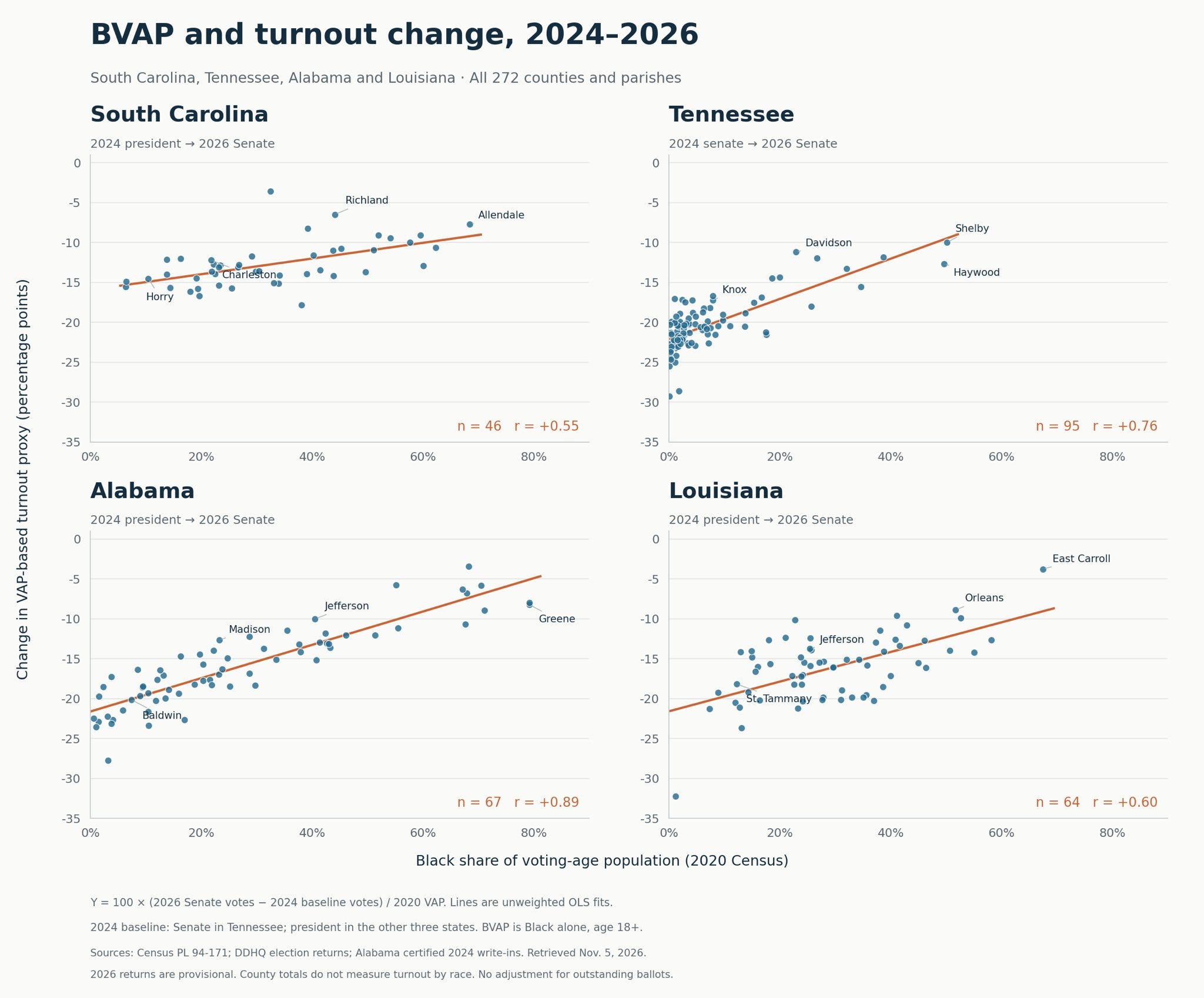
Briefly: the chart shows that counties in these four states with larger black populations generally saw a smaller decline in total votes cast in Senate elections this year compared to the 2024 presidential election.
These results raise an obvious question: did the Supreme Court’s ruling in Callais, which allowed Republican state legislators in the South to draw maps breaking up majority-black districts historically protected under the Voting Rights Act, contribute to the surge in turnout? Trende noted that “causation is always very difficult to prove, but the intuition that the VRA redistricting supercharged black turnout in the south seems to hold up reasonably well at first blush.” We will know more once the Pew and Catalist analyses come out next year.
Moderates overperformed expectations; progressives not so much
Earlier this week, our friends at Welcome co-published an analysis examining how Senate candidates in several battleground races performed relative to Kamala Harris’s 2024 margin in the state and the statewide House margin this cycle. The results were unequivocal: candidates viewed as center-left all ran ahead of the statewide House vote and ahead of Harris by double-digit margins (and an average of 20.8 points).
By contrast, candidates who campaigned unabashedly as progressives outran Harris by an average of just 4.8 points. None reached double-digit margins, and each trailed the statewide House margin.
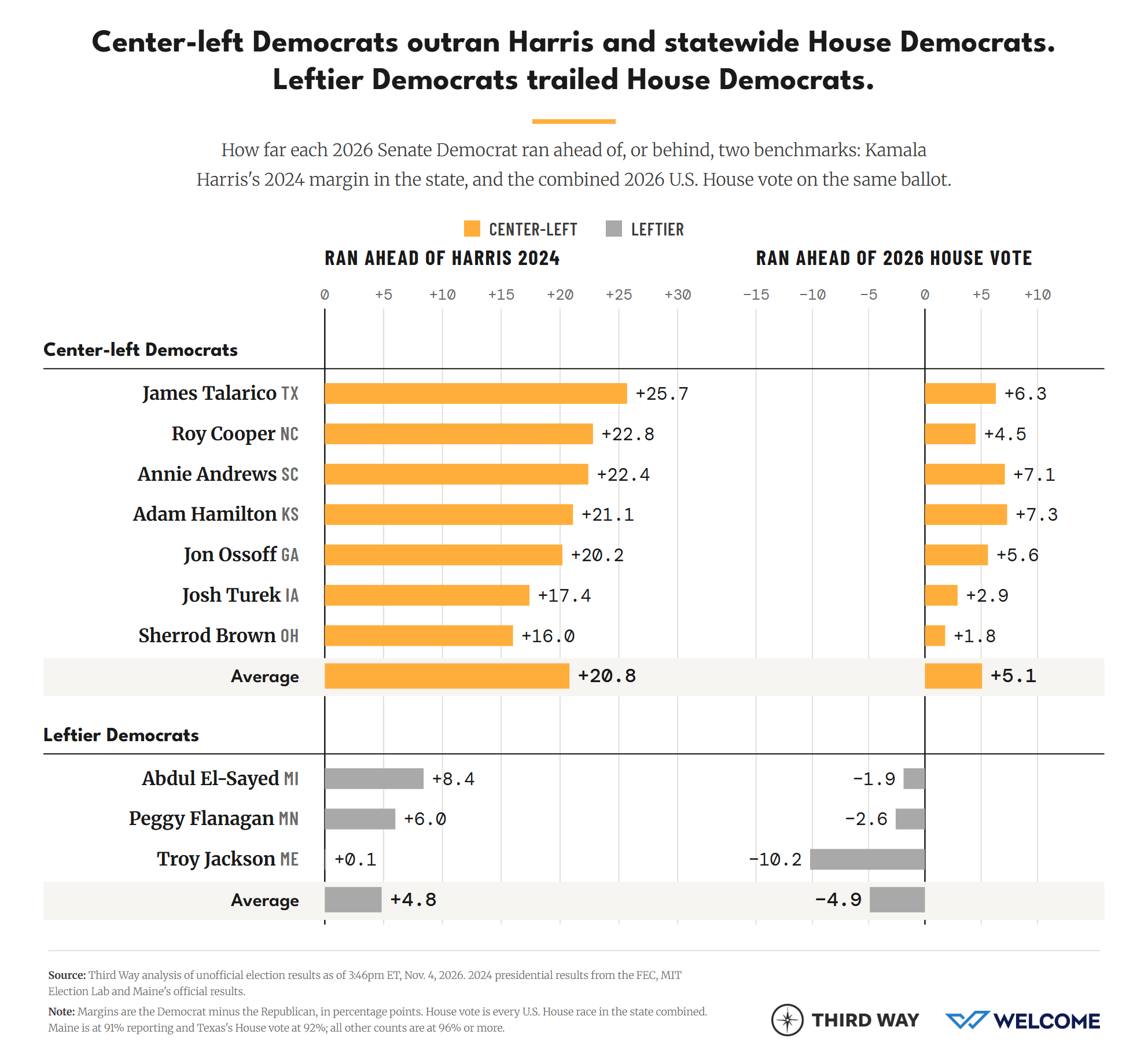
Each of the three more left-leaning candidates they analyzed—Jackson in Maine, Flanagan in Minnesota, and El-Sayed in Michigan—also ran behind the gubernatorial candidates with whom they shared the ballot. The biggest underperformer was Jackson, who trailed Democrat Chellie Pingree by 12.2 points in the two-way vote.
Of course, progressives are right to note that their candidates did still win in a handful of swing races. But the data suggest they were buoyed by the national shift, and that in a less friendly environment they may not have been as successful.
Voters (still) really hate inflation, but don’t really trust either party to address it
After the 2024 election, I noted that voters’ frustration with inflation, and the Biden administration’s struggles to tame it, were major culprits behind their loss. Two years later, voters are telling their leaders the same thing:
Eighty-nine percent said the cost of living was a “crucial or major factor” in their vote choice, and they broke for Democrats over Republicans by 20 points (59 to 39).
Seventy-five percent rated the nation’s economy as “not so good or poor,” and they backed Democrats by an even wider 42-point margin (70 to 28).
Sixty-six percent of voters said they believe Trump’s tariffs have hurt the national economy, and they voted Democratic by a massive 63-point margin (81 to 18).
Fifty-nine percent said they are “very concerned” about the cost of healthcare, and they backed Democrats by a more than two-to-one margin (67 to 31).
However, while a plurality of voters (39 percent) highlighted the economy as the top issue facing the country, they broke for Democrats by just six points. And when asked which party they believe is better able to handle the economy, Democrats led Republicans by just six points (44 to 37). Nearly 20 percent said they didn’t trust either party.
Indeed, it’s hard to believe voters suddenly trust Democrats on the economy again, just two years after punishing them in an election centered on that issue. The party should keep this in mind as it takes control of Congress and pursues its legislative agenda, especially given the recent rise of “slopulist” ideas that could put even more pressure on already spiraling costs and the national debt. If they go down that road, they risk being blamed for the same problems Trump was.
A real Republican reckoning may not come immediately
After riding a wave of anger at the Biden administration to power, Trump burned through his goodwill with lightning speed, with his net approval rating turning negative after just two months. It has ticked steadily downward through his entire term. And all the while, Republicans have stood by him.
However, in the aftermath of an electoral drubbing, it’s reasonable to expect the losing party to take stock of how they veered so off course and away from the median American. Republicans would be wise to reassess their relationship with Trump, who now looks much more like a liability than an asset. In fact, one might argue that he is to Republicans what Biden was to Democrats: someone who succeeded at building a winning coalition but who quickly became an albatross for his party once in office.
But even if some Republicans believe there’s a need for a reckoning over Trump and the party’s current trajectory, it may be a minute before they get one in earnest. For starters, Trump remains quite popular with Republican voters. Moreover, almost by definition, elected Republicans who survived the wave are more likely to represent deeply red states or districts where support for Trump is even higher. As political scientist David Hopkins put it, “The resulting minority caucus is even more ideologically extreme than the outgoing majority.”
A lot will likely hinge on whom the party’s voters nominate for president in 2028—and whether that person can chart a new path forward that keeps most of Trump’s coalition in line while also appealing beyond the GOP base.
America remains a center-right country
Polling has shown for years that a large majority of Americans consider themselves either moderate or conservative-leaning, and this midterm offered further evidence. For starters, nearly three-quarters of voters in this election identified as either moderate (41 percent) or conservative (33 percent), compared to just one-quarter who called themselves liberal (26 percent), according to the exit poll survey.
Additionally, the same electorate that broadly rejected the Republicans this cycle also trusted them slightly more than Democrats to handle immigration issues, 43 percent to 41 percent. And among the 14 percent who identified immigration as the top issue facing the nation, nearly nine in ten broke for Republicans.
Voters in many places also had the chance to express their policy preferences on various ballot measures. In several states—including some deeply Democratic ones—voters backed policies that some might code as conservative or rejected others thought to be progressive. Among some of the more notable results:
A proposed “billionaire tax” in California is on track to lose by a decent margin.
In Colorado, voters supported increasing penalties for trafficking fentanyl (and even possessing it).
Eight states passed new restrictions on voting, including five that explicitly limited voting rights to U.S. citizens (Alaska, Arkansas, Kansas, South Dakota, and West Virginia), two that added a photo ID requirement (Nevada and North Carolina), and one that added new requirements for in-person and mail voting (Ohio).
A big majority of voters in North Carolina passed measures to cap state income tax rates and limit property tax increases.
Wisconsin voters supported banning DEI policies in state government by nearly the same margin that they elected the state’s first black governor.
Perhaps the most notable result was a slate of ballot measures that sought to address so-called “trans issues.” Voters in four states passed more restrictive measures, including banning the participation of people who were born male in women’s sports and banning gender-transition surgeries for minors. Surprisingly, two of the states that passed such measures, Washington and Colorado, are deep blue. But it’s a reminder that many of the views about sex and gender associated with the left wing of the Democratic Party are not broadly shared by much of the country—including even among Democrats themselves.
These results offer Democrats a reality check: the electorate that just delivered them massive gains doesn’t necessarily agree with them on some key issues. Yet a pre-election Politico survey found that a strong plurality of Democratic midterm voters and a big majority of progressives believed that if the party won big on Tuesday, they should run more left-wing candidates in the next election. With the 2028 presidential primaries expected to ramp up by the beginning of next year, we’ll find out soon which path Democrats choose.
New Electoral College paths may be opening up for both parties
One reason for Democratic optimism moving forward is the possibility that they have expanded the Electoral College map ahead of 2028. They have now demonstrated an ability to win states that haven’t voted Democratic at the statewide level in a very long time. These include Kansas, (likely) Mississippi, South Carolina, and their white whale: Texas. They also dominated in swing states that Trump won two years ago, including Michigan, Pennsylvania, North Carolina, and Georgia.
For Democrats, the biggest question mark is Texas. If they can regularly compete statewide there, it could fundamentally change the Electoral College map. Currently, Texas has 40 electoral votes, four fewer than the Blue Wall states of Michigan, Pennsylvania, and Wisconsin (44 combined). However, post-2030 redistricting projections suggest that Texas could gain two House seats while Michigan and Pennsylvania could each lose one. This would give Texas the same number of electoral votes as the Blue Wall states combined—a bloc that has been trending away from Democrats over the past decade. If states like Arizona, Georgia, and North Carolina also become more reliably Democratic, the party would no longer need to rely as heavily on the Upper Midwest.4
There may be some encouraging news for Republicans heading into 2028, too. Earlier this week, political scientist Matt Grossmann shared a graphic comparing each state’s U.S. House vote margin to the national U.S. House margin.
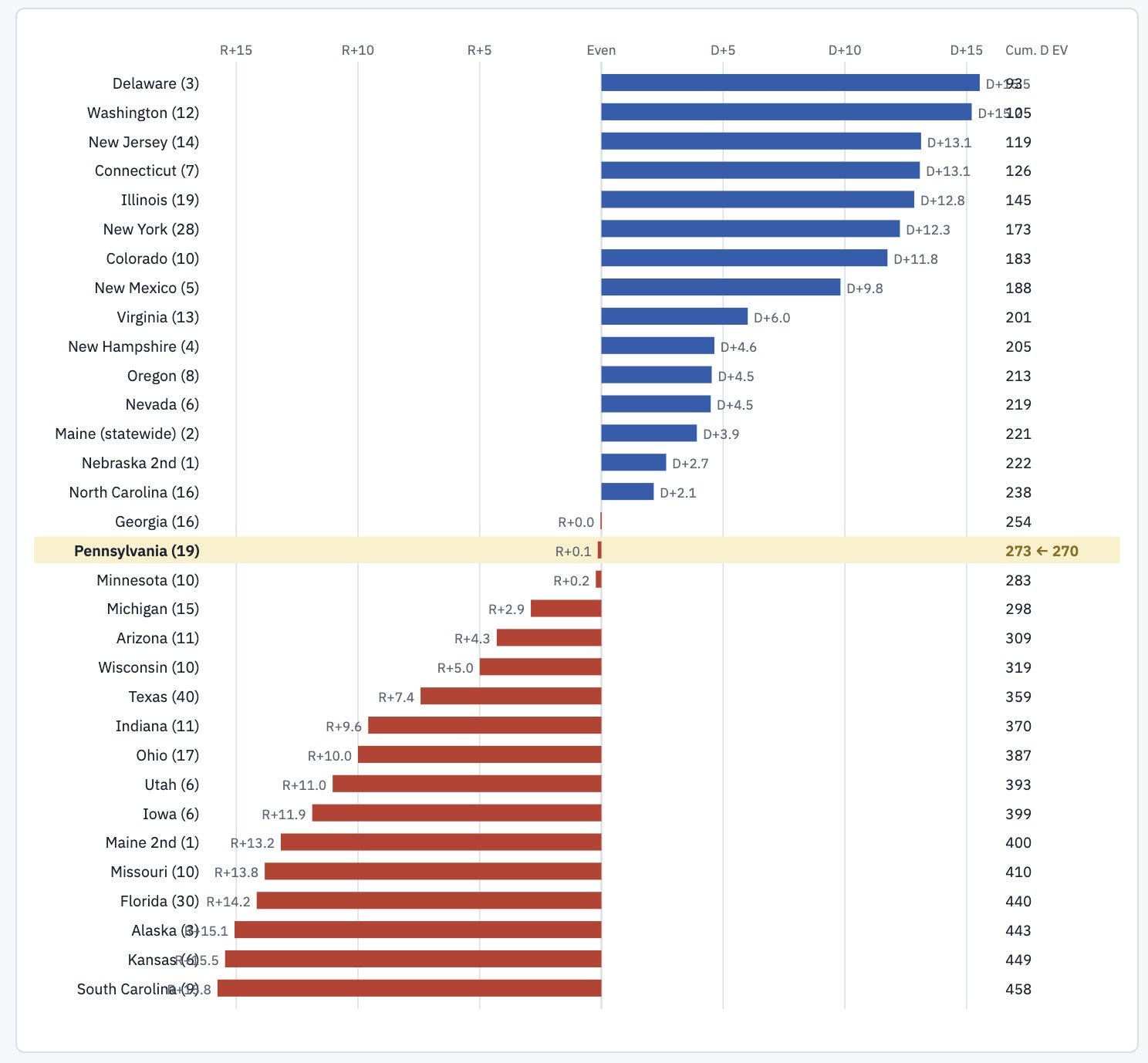
In almost every state where Democrats picked up Senate seats, the statewide House vote was more Republican-leaning than the national vote. This notably included Texas and the three Blue Wall states. It also included Minnesota, which many likely consider a blue state, but which has also been competitive in presidential years since the turn of the century more often than not.
The main caveat is that the composition of the electorate varies greatly between presidential and midterm years. So while Democrats should certainly be encouraged by their newly demonstrated ability to win states that have long voted Republican, replicating those results in a more competitive presidential election environment could be harder.
Perhaps the biggest takeaway from this election is that America remains in an era of politics without winners. Frustrated with their leaders and political system, Americans are losing patience with both parties, as evidenced by the record-high share identifying as independents. This has created an increasingly unstable system that produces thermostatic backlash against the party in power every few years and constant change.
Democrats no doubt have much to celebrate after Tuesday’s election, but it’s far from certain that these results will translate into long-term success. Many political observers have drawn parallels between this election cycle and 2006, the sixth year of George W. Bush’s presidency when Democrats came roaring back to power. They continued their winning streak two years later, electing Barack Obama and growing their majorities in Congress. And then, in 2010, they suffered one of the worst midterm defeats in modern history.
If Democrats hope to remain in power long enough to enact durable change, they’ll have to resist getting bogged down in tribal political squabbles and culture war fights and instead focus on seriously addressing the issues voters continue to say matter most: the cost of living and the economy. So long as Americans believe neither party takes their concerns seriously, the pendulum will continue to swing—and Democrats could find themselves out of power just as quickly as they came into it.
Notably, Republicans actually won the 40 percent of voters for whom Trump was not a factor, and quite overwhelmingly: 67 percent to just 30 percent for Democrats.
Those who approved of his performance or only “somewhat” disapproved broke big for Republicans.
Kansas offers an instructive example of how the shift among Hispanics played out. There are three small, rural counties in the western part of the state—Finney, Ford, and Seward—with a Hispanic CVAP (citizen voting-age population) of over 40 percent. All three backed Trump by more than 30 points in 2024, and it appear all will narrowly break for the Democratic Senate candidate, Adam Hamilton.
However, this would carry its own set of concerns.
In San Antonio, there was a huge blue wave but people voted down every school bond even though the tax increase would have been trival. I worry we are more like the French than we think- people want the government benefits but don’t want to pay taxes. Fixing the country will take shared sacrifice which no one is willing to take on.
Memories are short, voters are fickle - and the pendulum will continue to swing until one party or the other finally gets things done. Buckle up for 2008! Sure to be a riveting and contentious Presidential election. Can’t wait to see who throws their hat in the ring.