


As the 2026 cycle moves into the election year, the gap between where competition should exist and where it actually exists is becoming clearer. The fundraising numbers, the electoral map, and national trends all suggest a sizable battlefield. But there are still a number of winnable districts that remain undercontested by both parties.
The latest Congressional Competition Index report from Welcome Democracy Institute tells the story.
The Map So Far
There are now 113 seats that should be fully competitive (based on the partisan lean of the district), up one from 112 at the end of Q3. The addition is the newly redrawn Texas 35th, which went from a D+19 seat to an R+4 seat after Texas Republicans aggressively redrew their map.
Of those 113 seats, just 42 have challengers who have raised at least $1 million this cycle. Another 33 are on pace to be competitive, with challengers posting strong numbers early. That leaves a significant gap: seats where the electoral math says “compete here” and neither party has answered.
The gap between where competition should exist and where it actually does will become increasingly difficult to close.
Follow The Money
At the topline level, the financial environment looks balanced. Democratic challengers are raising an average of $492,000 compared to $455,000 for Republicans. On the incumbent side, both parties average roughly $1.5 million. Neither party is conceding its own turf.
Party committees and SuperPACs are close. The Congressional Leadership Fund (CLF) holds $54.5 million on hand, while House Majority PAC (HMP) sits at $46 million. The National Republican Congressional Committee (NRCC) has $50.8 million and the Democratic Congressional Campaign Committee (DCCC) has $49.2 million.
The wild card: Republicans hold a significant national cash advantage. The RNC has nearly $100 million more than the DNC. Trump’s SuperPAC, MAGA Inc., has over $300 million on hand. Some of that may go to Senate races. Much of it could flow into the House.
The Lopsided Challenger Field
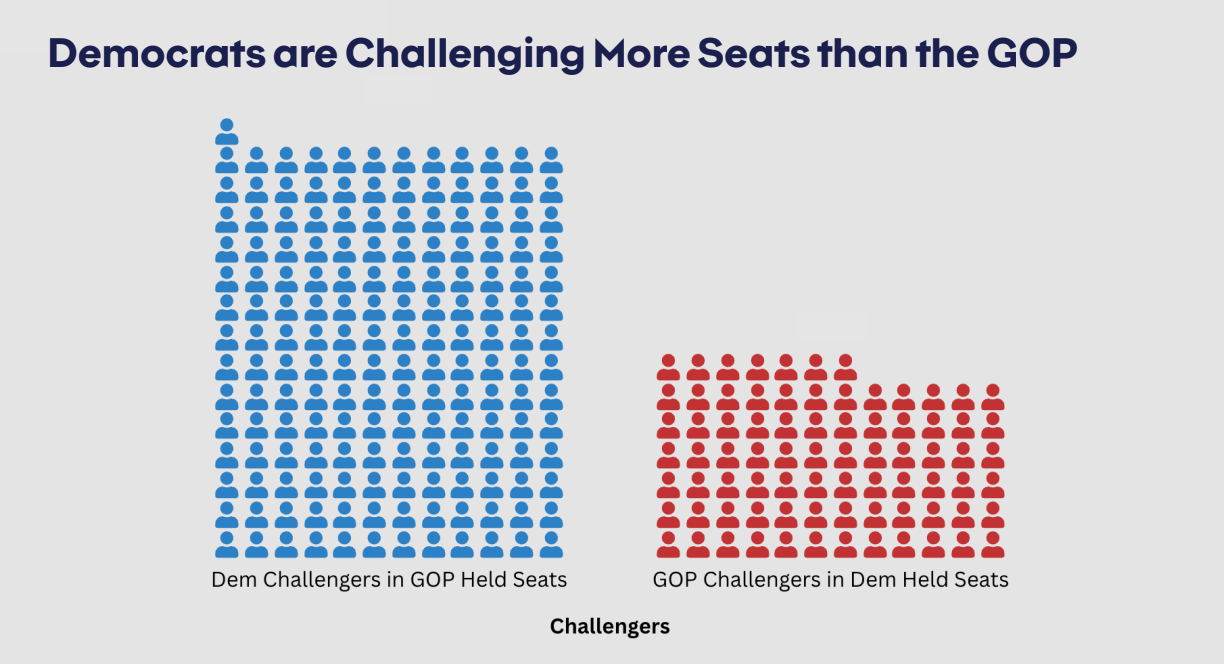
This is one of the most significant findings this quarter. Democrats currently have challengers raising money in 169 Republican-held seats, more than double the 79 Democratic-held seats that Republicans are contesting.
Whether this breadth translates into actual gains is an open question. But the asymmetry matters. Republican challengers are either absent or underfunded across large swaths of the map, effectively ceding terrain that recent results suggest should be in play. Democrats are present even in tougher districts, creating the possibility of volatility if national conditions shift.
Democracy Deserts
The most persistent problem the CCI tracks: competitive districts where one party simply isn’t showing up.
FL-13: Anna Paulina Luna remains one of the weakest electoral performers in the GOP. The Democrat running against her overperformed the fundamentals by 6.1 points in 2024. This cycle, Earle Ford has raised just $144,098 in an R+5 district that could flip with real investment. Welcome has flagged this district before. In an environment like 2026 is shaping up to be, she is at real risk of defeat if Democrats field a strong challenger. With the August primary still a ways off, there is still time for a challenger to emerge. In just the last few weeks, retired Army Brigadier General Leela Gray has entered the race with the support of Whitney Fox (2024 nominee and friend of Welcome), signaling Democrats are ready to mount a strong challenge here.
WI-01: Bryan Steil’s R+2 district is among the most competitive Republican-held seats in the Midwest. Democrat Mitchell Berman has raised $217,257. In Wisconsin, where statewide races are decided by fractions, that’s a missed opportunity. Trump only won this seat by 4 points in 2024 and 2 points in 2020. However, congressional candidates have been unable to keep up with the top of the ticket, with Steil scoring a 9 point victory in 2022 and a 10 point victory in 2024. Wisconsin also has an August primary, so there is still time for one of the candidates to move this seat onto the map.
Early Warning Signs: Challengers Outraising Incumbents
Over 20 Democratic challengers outraised the Republican incumbent in Q4, including returning candidates like Christina Bohannan, Rebecca Cooke and Janelle Stelson.
Two new challengers stood out.
FL-07: Bale Dalton, a Navy veteran and former NASA Chief of Staff, launched his campaign against embattled Cory Mills and raised $343,650 in just six weeks. Mills raised $61,309 in Q4 and started the year with just $110,651 on hand, with over $2 million in debt. This R+5 district could be an unexpected opportunity in Florida. For those who haven’t followed Welcome closely, Mills has had… quite a few scandals. We wrote about him here, here, here, and here. Let’s summarize quickly. Cory Mills is under House Ethics Committee investigation for campaign finance violations, misuse of congressional resources, and sexual misconduct stemming from an extramarital affair. A Florida judge issued a protective order against him after he threatened to release explicit videos of his mistress. He faces stolen valor allegations after five veterans who served with him, including two he claims to have saved, say they have no recollection of him being at the scene that earned him a Bronze Star. Before Congress, he made his fortune selling tear gas and crowd control weapons used against civilians in Egypt, and he carpetbagged into Florida’s 7th district to run for the seat. An Office of Congressional Ethics investigation found that Mills’ companies had secured close to $1 million in federal contracts for munitions and weapons distributed to prisons since he took office, and he misrepresented this information on his House disclosure forms. Mills became the subject of three censure resolutions in 2025, including one from fellow Republican Nancy Mace. So yeah… he’s vulnerable, if Democrats can raise enough to make it competitive.
NC-11: Jamie Ager, a farmer and small businessman from western North Carolina, raised $391,129 in Q4 against Chuck Edwards, who raised $350,407. Ager is the grandson of former Democratic Representative James Clarke, who held this seat more than 30 years ago. The district’s Republican lean has shrunk from R+9 to R+5 in recent years. Democrats haven’t had a shot this good at this seat in a generation, and Ager can make this a tight race.
Potential Surprises
GOP-Held Seats
TN-05: Andy Ogles is underwater. $62,080 in cash on hand, $70,368 in debt. The FBI executed a search warrant on him in 2024 over campaign finance irregularities. Meanwhile, Chaz Molder, the Mayor of Columbia, raised $412,744 in Q4 and holds $977,977 in cash. The top Republican fundraiser last quarter wasn’t Ogles but Charlie Hatcher ($410,910 raised), suggesting Ogles may not survive his primary. This R+8 district was held by Democrats for nearly a century before 2022 redistricting, and the DCCC has targeted it for a reason. Ogles has been on our radar for quite some time, due to his penchant for scandal and extreme positions. Ogles has proposed a constitutional amendment that would allow Trump to run for a third term, denies the results of the 2020 election, supports overturning the Supreme Court ruling that legalized gay marriage, and called for a Congressional inquiry into Bad Bunny’s halftime show (what?). He’s extreme.
Molder is exactly the type of candidate who can make this seat competitive. When Molder first ran for mayor in 2018, he unseated a two-term incumbent. He secured reelection in 2022 against the popular local chair of the Maury County Republican Party. More impressive: he won both elections in a county Donald Trump carried by over 45 points. As mayor, he passed seven balanced budgets with no property tax increases while investing in public safety and saved taxpayers $10.5 million.
TX-15: Trump won this R+7 district by 18 points in 2024. It shouldn’t be on anyone’s radar. But Bobby Pulido, a Tejano music legend with a recent Latin Grammy win, raised $415,452 against Monica De La Cruz ($809,763 raised, $2.01 million on hand). In a district that is 75% Hispanic, Pulido’s cultural celebrity could be a factor that traditional metrics don’t capture. Latino voters (particularly Independents) have swung dramatically against Trump, which could break this gerrymander. However, Democrats may field Ada Cuellar, a progressive (no relation to Henry Cuellar) whose extreme views could make the district unwinnable in the general election.
What Comes Next
There is still time. But the window is closing.
Redistricting decisions in Florida and Virginia could still alter the battlefield, either expanding the number of competitive seats or further constraining it. How parties respond to those changes may determine how competitive 2026 actually becomes.
In a midterm environment, the out-of-power party should seek to build the largest battlefield possible, because their base will be extremely motivated, a dynamic that Trump’s polarizing approach to government magnifies. So far, Democrats are doing that, with some exceptions. Uniquely vulnerable incumbents like Andy Ogles and Cory Mills could put even more seats in play.
In Texas, the GOP’s attempt to gerrymander Latino voters could backfire if Latinos swing back, and Trump’s brutal immigration policy could cause that.
The next quarter will bring primary outcomes, post-primary fundraising and signals from party committees that will sharpen the picture. We’ll be tracking it.
See here for the full Q4 Congressional Competition Index report.