


As we head into the final weeks of the 2026 midterm cycle, analysts, voters, and candidates are all keeping a close eye on public polls to make sense of how things might play out. At the national level, polling shows Democrats are poised for a very good, potentially even great, election. According to Nate Silver’s generic congressional ballot aggregator, they have gained two full points on Republicans over just the past month and now lead them by 8.6 points—the same margin by which they won the national popular vote in the 2018 midterms.
Of course, there are important caveats to this data. First, national polls cannot tell us what will happen in individual races at the state and district levels. Consider 2022. Republicans entered the midterm election with a 2.5-point lead on the generic ballot and ultimately won the national House vote by 2.8 points, narrowly flipping the House. Yet Democrats held key seats in both chambers and even grew their Senate majority, largely thanks to race-specific dynamics.
Second, there are serious questions about the state of the polls right now—chiefly, whether they are fully capturing Republicans’ vote preferences and likelihood of turning out. If the problems that have plagued polling in recent presidential elections persist this cycle, Democrats’ dreams of flipping states that broke for Trump by double digits less than two years ago may remain just that: dreams.
However, there’s a very real possibility that these polls are largely accurate, which would be consistent with polling performance in recent midterms. If that is the case, then we may already have a good idea of how things will shake out come Election Day, such as how how various populations might vote—and how their voting patterns could differ from 2024.
But this type of data is often presented without important context. For example, a news report about how Hispanic voters have swung back toward the Democrats would likely have readers concluding that Trump’s Hispanic gains in 2024 were more of a facade than a sign of an actual demographic realignment.
What such reports often fail to do, however, is compare a population’s shift from 2024 to the national shift. This matters because if much of the country is swinging against the incumbent president, this will necessarily be true for most demographic groups as well. The more revealing question is how much a given group is moving toward Democrats compared to all voters.
Put another way: it isn’t enough to merely say that, in 2024, Democrats lost white voters by 14 points but are now only losing them by five points. Such results must be adjusted to account for the national swing (of ten points) toward the Democrats since then. Below is a chart of what this looks like:
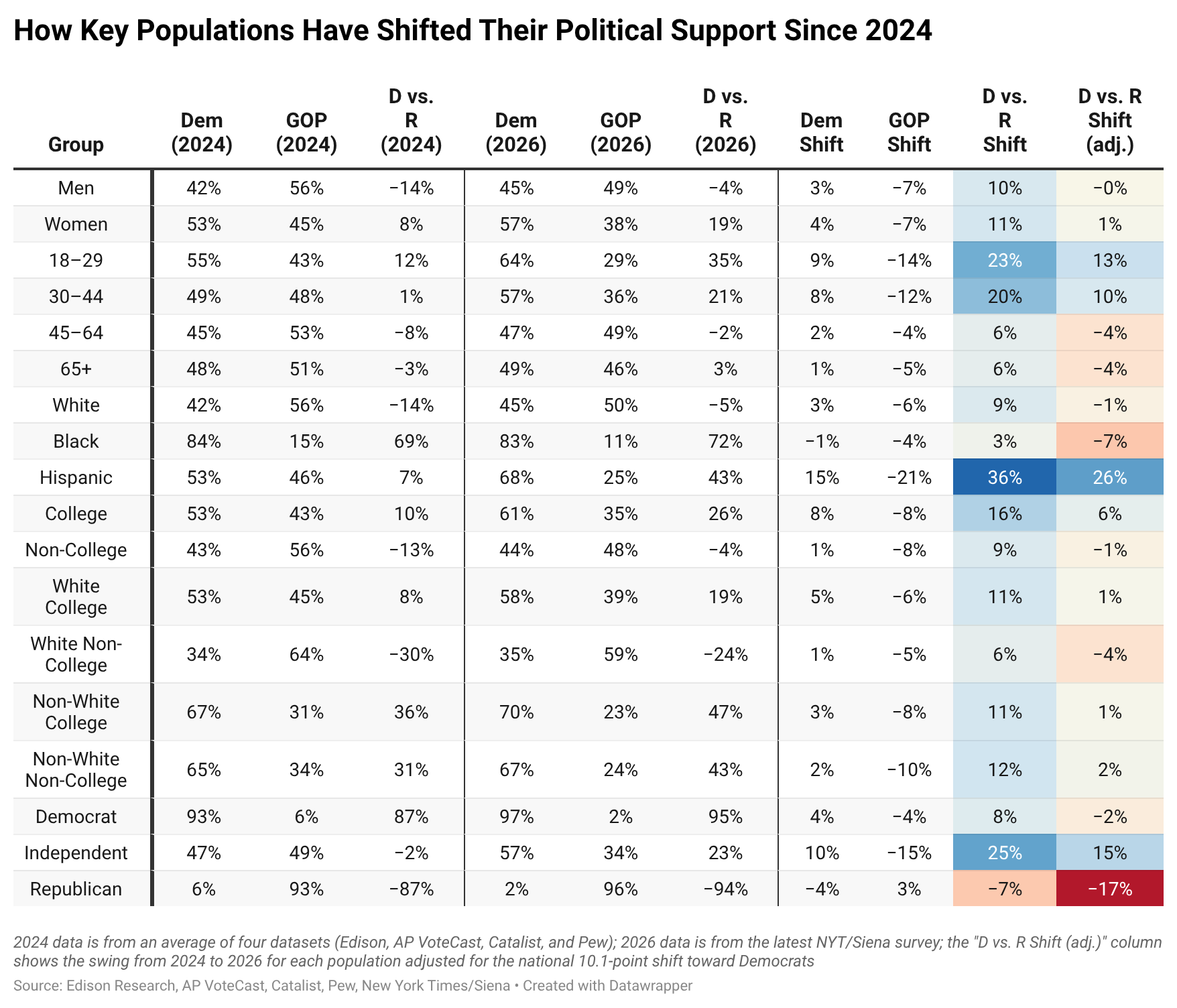
As the second-to-last column shows, Democrats have improved their margins over Republicans with virtually every key group since 2024. The final (or rightmost) column, however, adjusts for a national leftward swing of 10.1 points from two years ago, revealing a more complicated picture. Democrats have certainly gained ground with some of the groups they underperformed with in 2024—namely, independents, young voters, and Hispanics. These would represent crucial improvements for the party.
However, their gains have been more muted with other important groups relative to the national swing, including older voters, black voters, and non-college voters (especially non-college whites). This could pose challenges in places like Michigan or Ohio, where each of these populations makes up a significant share of the electorate.
But let’s take a slightly longer view and compare Democrats’ performance with another midterm cycle. We have a nearly perfect candidate for this: 2018, a midterm election also held during Trump’s presidency and in which Democrats won the national House vote by 8.6 points—the same margin of this week’s generic ballot polling. That gives us about as close to an apples-to-apples comparison as we can find. Here’s what that looks like:
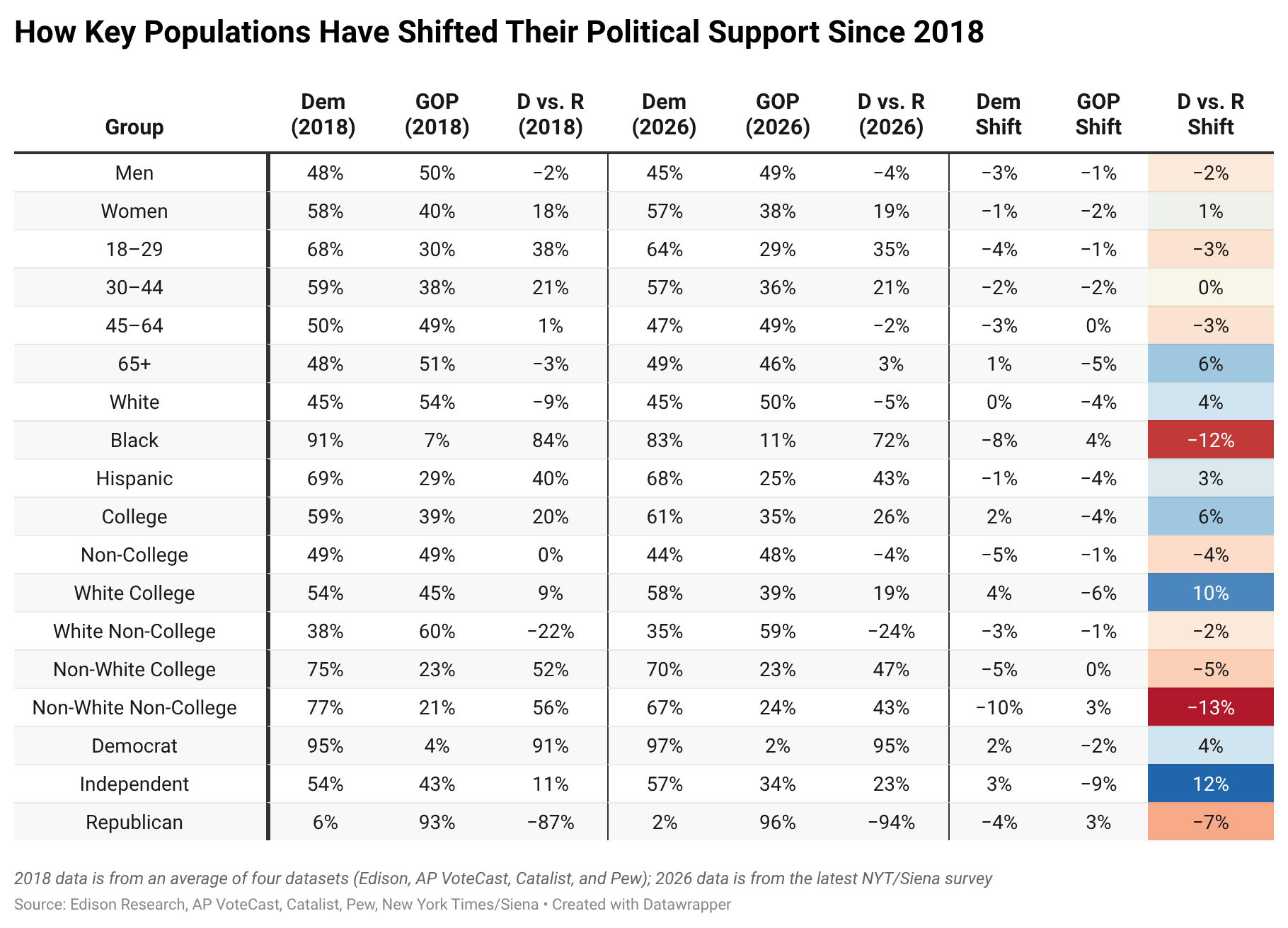
This comparison confirms many of the shifts that we have seen in the two parties’ coalitions during the Trump era. Democrats, for instance, have improved their standing among older, college-educated, and white voters. Meanwhile, Republicans have improved with non-college voters of all races, and while Democrats still enjoy huge levels of support with black voters, Republicans have made real gains with them.
So, what does all this mean? Let’s start with the immediate implications. Again, assuming the polls are generally accurate, Democrats are poised to claw back some of the gains Trump made in 2024 with core demographic groups. This would lend some credence to the argument that 2024 was not a “realignment” but rather a “dealignment” election—that we were not witnessing the start of an inexorable rightward drift among working-class minorities. Instead, more of them may just be less wedded to either party, meaning gains from one cycle can be wiped away as soon as the next.
For now, that change is coming largely Republicans’ expense. If, for example, the Democrats relative bounce-back with Hispanics is real, it could help make sense of why James Talarico appears to be faring so well in Texas. Many of the gains that Trump made in places like the Rio Grande Valley may simply not be sticking. Similarly, Democrats’ apparently strong gains with college-educated voters—a highly engaged group—relative to 2024 could be a big reason for their strength right now.
But the data also shows that Democrats have not returned to pre-2024 standing, either. While they have made meaningful gains since 2024 with independents, young voters, and Hispanics, their gains with older voters, black voters, and non-college voters have lagged the national leftward shift, suggesting they still have work to do to hit their benchmarks.
Moreover, the comparison to 2018 suggests that some of the changes in the parties’ coalitions during the Trump era have endured, at least to some degree. This may not prevent Democrats from having a strong midterm, but it’s something they’ll have to contend with looking beyond November—perhaps as soon as 2028.
The failure of both parties to solve problems has led to the bounce back phenomenon without ever creating a durable coalition for anyone. When they get a bounce in their favor, they think they have won and fall victim to the reverse bounce. The interesting question is does this operate on a 2 or 4 year cycle. It doesn't help that the electorate also has a short attention span. This applies far beyond elections.
I'd argue what we're seeing is both parties massively screwing up in the eyes of the voters, rather than either party's policies or platforms being rejected or sought out.
In 2024 voters we fed up with the lies of the Biden administration, that the former president was still coherent, that we weren't committing violations of our own laws arming a genocidal Israel, that inflation was only temporary.
Today voters are furious a president elected to keep us out of wars has gotten stuck in yet another Middle Eastern conflict, and that the reduction in oil and natural gas supplies have raised gas, diesel and fertilizer costs among other issues. Trump campaigned on affordability and prices are higher than ever and rising.
In short we've had two terrible presidents in a row and voters, having only the choice between them, are once again throwing the bums out.
I wouldn't read much more into it than that.