


One of the most important developments in American politics over the past decade has been the shift of working-class voters away from the Democratic Party and toward the Republican Party. For more than half a century, voters consistently said the trait they liked most about the Democrats was that they were the “party of the working class,” and the results showed it. According to data from the American National Election Studies, working-class voters1 supported Democrats at a higher rate than college-educated voters in nearly every presidential election between 1952 and 2012.
However, this changed in a big way during the Trump era. After breaking for Barack Obama in 2012 by four points, non-college voters supported Donald Trump by six points in 2016—a swing that, importantly, occurred across both white and non-white voters.2 Since then, these voters have shifted even further right. In 2024, Trump carried them by 13 points, the largest margin for a Republican presidential candidate in at least the last 30 years.
Today, the Democratic Party is defined less by its support for the working class and more by its affiliation with the Brahmin left. As a result, it has become harder for the party to build an electoral coalition capable of consistently winning all over the country. For example, states like Michigan, Pennsylvania, and Wisconsin were a core part of the party’s “Blue Wall” from 1992 to 2012. However, Trump won all three in both of his victories, buoyed by working-class voters who are overrepresented in these states.
So, how can Democrats win back at least a meaningful share of these voters—and keep them? It’s a topic we regularly covered at The Liberal Patriot and plan to dig into more at The Long View. Helpfully, there are several new survey studies that offer additional insights into this question.
Understanding what really divides the social classes
Back in July, Jared Abbott, director of the Center for Working Class Politics (and friend of TLV), and Joan C. Williams, professor emerita at the University of California Law San Francisco, published a report called “The Left’s Coalition Crisis.” Though they did not explicitly say this, their intended audience appeared to be a group they referred to several times: liberal college graduates.
Designed to help the political left “develop the cultural competence to bridge the diploma divide between college grads and voters without degrees,” the report offered some tough love to middle- and upper-class liberals. For starters, the authors note that many liberal college grads live in a class bubble where most everyone around them shares their views on culture and climate issues—views that are often not held by working-class Americans.
Each cohort often has different priorities as well. Among the 12 issues that working-class respondents prioritized, ten were economic in nature (the other two were corruption and crime). By contrast, college-educated liberals are much more likely to prioritize cultural and social issues. Relative to the working class, they care far more about resisting authoritarianism, protecting LGBT rights, addressing climate change, and protecting abortion access.
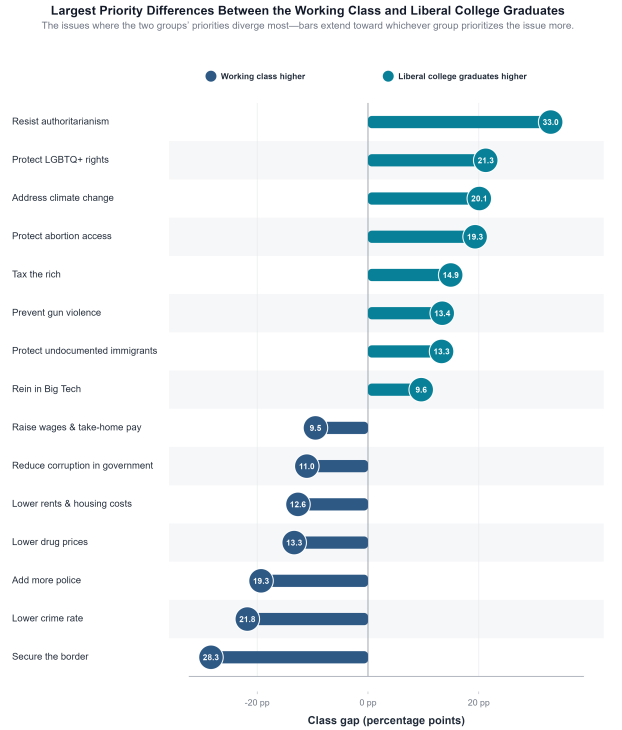
In particular, “defending democracy” is a top priority for liberal college grads, but for working-class Americans it ranks 19th out of 30 possible priorities. In fact, resisting authoritarianism was a far higher priority for college liberals than for working-class respondents across every racial sub-group.
As the authors write, “This helps explain why Kamala Harris lost noncollege voters by 14 points. She centered two issues—defense of democracy and abortion rights—that liberal college grads prioritize but most working-class Americans don’t.”
Even when there appear to be agreements on the surface, there remain meaningful differences. This includes economic priorities: whereas working-class people typically focus on raising wages and creating more jobs and growth, liberal college grads, perhaps feeling more secure in their jobs, care more about prices (though the working class also cares about this). Another key contrast relates to whom each population directs its anti-elitist anger toward. College liberals often focus on the top 1% and business elites—but rarely political elites.
These disconnects can make it hard for liberal college grads to understand that their views reflect a particular class bias, and that people from other walks of life may approach those topics from a very different place. It can also be difficult to understand why others sometimes hold very different values from them. The authors also note:
Upper-middle-class language and priorities that make perfect sense among liberal college graduates often lack the cultural resonance to win working-class votes. Working-class voters’ principal concerns are paychecks, prices, and personal security. And their values tend to run in the opposite direction from those of the college-educated left: loyalty to community and country over globalism, family and self-discipline over self-actualization, tradition over sophistication, physical safety, and a distrust of credentialed experts. These are values the Right has learned to channel effectively; the Left, less so.
Finally, they note that liberal college grads’ class bubble can engender scorn toward people who disagree with them—and fuel the political right. While most liberal candidates steer clear of rhetoric like “deplorables” to describe more conservative-leaning working-class people, many ordinary liberals still view them as deplorable. This reality is reflected in the lawn signs pervading many liberal neighborhoods, which Abbott and Williams say signal that “if your priorities aren’t race, gender, and immigration, you’re so beyond the pale that you don’t even understand the importance of love or kindness.”
The authors offer several pieces of advice to the left for how to break this toxic cycle and build bridges with working-class Americans, including:
Respect working-class priorities, especially economic and personal security;
Replace a politics of scorn with genuine cross-class respect, which requires leaving one’s bubble and approaching those outside of it with curiosity; and
Better understand how working-class values reflect working-class lives, including deep loyalty to community and country, the high value of self-discipline, the prioritization of personal security, resentment of experts, and the role of traditional institutions in their lives such as the military, religion, and the traditional family.
Without these steps, it will likely be very difficult for the left to break through to many working-class people and convince them to hear its perspective.
Understanding the value of moderation
Democrats who are interested in reaching working-class voters would also do well to acknowledge that many such voters do not support seismic changes to America’s institutions. Though they aren’t uniformly against left-leaning ideas or reforms, many working-class people are less ideological and simply want a stable and effective government.
Two reports out this month buttress this idea. The first, also from Abbott and Williams, is called “The Working-Class Win-O-Meter.” This study, which surveyed more than 40,000 respondents, examines strategies to help Democrats win back working-class voters (more on those strategies in a minute). The authors find that “moving to the most progressive position significantly costs working-class votes” on four specific issues:
Defunding the police. This carried the biggest penalty across all positions they tested. Candidates who support it ran 5.7 points behind those who advocate for less severe reforms like body cameras and de-escalation training.
Women’s sports. The lowest-scoring proposition in the survey was male participation in women’s sports, which received just 38% working-class support. Candidates who supported this position ran 5.6 points behind those who took a more moderate stance.
Assault rifle bans. Candidates who support this position ran four points behind those who support universal background checks.
Abolishing ICE. Candidates who support this position ran two points behind those who support reforming the agency.
The authors also note that candidates who hold “working-class resonant or moderate” positions on cultural issues, specifically, run ahead of those who stay silent. By contrast, candidates who run on progressive or “non-resonant” positions tend to do worse than those who say nothing at all about culture. The penalty for this is, perhaps unsurprisingly, even steeper in red or purple districts.
Welcome Democracy Institute—an arm of our friends at Welcome—echoed many of these findings in a new report out this week titled, “The Industrial Heartland Swing.” WDI conducted focus groups with working-class swing voters in Obama-Trump communities across Michigan, Pennsylvania, and Iowa. They found that many of these voters feel cross-pressured by the two parties, which they believe are captured by their respective extremes.
Many focus group participants identified themselves as moderate or “middle of the road” and made explicit—often unprompted—appeals for more moderation and bipartisanship. Said one Pennsylvania woman, “They’re not working together. They’re working against each other, which is making all of us suffer.” Democratic politicians like Pennsylvania Governor Josh Shapiro, Michigan Governor Gretchen Whitmer, Iowa governor candidate Rob Sand, and Congresswoman Marie Gluesenkamp Perez received high marks from several participants.
Meanwhile, candidates like Congresswoman Alexandria Ocasio-Cortez and California Governor Gavin Newsom were viewed less favorably:
Voters often agreed with their words about inequality but perceived Newsom as a polished multimillionaire from another culture and Ocasio-Cortez as demagogic, performative, and short on solutions. Her line that “what they call radical, I call common sense” backfired: several participants heard it as confirmation that her “normal” is not theirs.
Members of the focus groups also rejected extremism on a policy level. Several fringe positions on the left tested negatively across every group, including abolishing ICE, banning fracking and natural gas, and abolishing the police. If a candidate took positions like this, many participants believed it signaled that he or she was “pandering to the loudest crowd.” They similarly looked unfavorably upon the “socialist” label.
The report’s authors take care to note that this doesn’t mean these voters do not support institutional reform. But they prefer to fix what’s broken—not do away with it entirely.
What does—and does not—resonate with the working class
For Democrats to repair their relationship with working-class Americans, they must first become reacquainted with their values and priorities, especially where those things substantially differ from those of the party’s college-educated, liberal base. So what, exactly, might a pro-working-class message and agenda look like?
Abbott’s and Williams’ Working-Class Win-O-Meter used survey data to identify six “dials” candidates can turn to boost their support among working-class voters and outperform a “Kamala Harris-style 2024 Democrat.” Here’s what they found moved the needle:
Lead with working-class economics (+2.8 points). Prioritizing economic issues—especially over non-resonant culture, climate, or democracy issues—is a more effective way of increasing working-class support. The most appealing ideas overall are defending existing popular programs (e.g., Social Security), finding ways to reduce costs, and “taking bold action” on skills-building and unions. By contrast, failing to prioritize any economic issues is especially costly, particularly when replaced by social issues. Candidates who do this underperform with working-class voters overall (-4) and especially working-class independents (-5.3) and Trump 2024 voters (-5.1).
Adopt culture and climate policies resonant with the working class (+2.9 points). Taking positions on hot-button cultural issues that please the Democrats’ progressive base is a surefire way to turn off many working-class voters, which can make the difference in swing districts and states. This does not mean candidates can’t embrace liberal goals, such as a more humane immigration system or actions to forestall climate change, but working-class voters want to see policies that account for their interests and values. For example, advocating for “clean energy that protects workers’ jobs” is far preferable to “100% clean energy by 2050.”
Explicitly prioritize working-class people (+1.9 points). Candidates who say that they will listen to working-class Americans boost their support by nearly two points, more than appeals to any other group, including the middle class, business leaders, policy experts, or specific demographic groups. This held true across several different populations, especially women and racial minorities.
Combine working-class policies with an explicit statement of working-class values (+1.6 points). Appeals rooted in working-class values—self-discipline, self-reliance, prioritizing family and community—are unsurprisingly more effective than those couched in middle- or upper-class sentiments like “life is about finding your own path and personal fulfillment” or “our institutions need to be updated to keep up with social change.” Notably, messaging around “defending democracy” and holding Trump accountable plays with the party’s base but not many working-class voters—in fact, it backfires with the Trump-curious right and does nothing to increase support with independents.
Lean into populist rhetoric, but pick the right enemy (+1.7 points). There are three types of populist language that perform better than “establishment” messages: people-centric, anti-political elite, and anti-economic elite. However, establishment messages aren’t all viewed unfavorably. For example, candidates who say they want to “work with both parties to get things done” barely see any penalty at all. By contrast, saying they will “listen to more experts and evidence” actually has a negative effect (-3.1). Moreover, left-populist messaging against the establishment often omits political elites, but including them resonates with independent and right-leaning respondents.
Run candidates with non-elite backgrounds (+1.0 points). The study also finds that candidates who have elite backgrounds will pay a penalty—but a working-class job doesn’t necessarily move the needle. In other words, it is more important for working-class voters that a candidate not come from an elite sphere than that they come from a working-class one. Interestingly, many respondents view small business owners as working class, not because they make a working-class salary but because “they occupy a distinctive place in working-class life. The owner of the local garage, salon, or diner is someone working-class voters meet as a neighbor and a self-made worker, not as a distant professional or executive. […] It appears working-class voters appraise small-business owners as peers who build things—a livelihood earned through one’s own work rather than through credentials…”
The authors find that when a candidate turns all six dials, it increases their support with working-class voters by 10.9 points, and that boost is even greater among the core groups Democrats need to win in competitive states and districts.
One other recent report, “Kitchen Table Messaging for the Populist Era,” came from CWCP and the Rural Urban Bridge Institute (or RUBI). The authors tested several economically populist messages to see how they actually landed with Americans. Though they found that some economically populist rhetoric does have resonance, they also caution that not all such rhetoric is created equally and that it must be employed thoughtfully.3
The report’s main takeaway is that addressing the pocketbook issues that affect voters’ daily lives is virtually always a winning proposition. The seven messages they tested that did this included three key components: they addressed people’s cost-of-living woes, pointed to a culprit, and offered a solution.
Their best-testing message, dubbed “The American Way,” focused on broadly shared values like hard work and fairness:
Most people just want to work hard, get ahead, and give their kids a better shot—and they should be able to. But the cost of rent, groceries, and health care keeps going up faster than working families can keep up, and paychecks just aren’t stretching the way they used to. I’m going to bring those costs down for working people, make sure the biggest corporations pay their fair share, and crack down on corruption and the people who game the system for themselves. Hard work should pay off again – that’s the American way.
They also tested a more confrontational variation of this message, which took a harder line against the wealthy and corporations. Though there wasn’t much drop-off among working-class voters (-3 points versus the original message), it fared far worse with many other core groups whose support Democrats need if they want to consistently compete in difficult terrain, such as independents (-11), rural voters (-16), Trump waverers (-13), and undecided 2026 voters (-20 points).
Meanwhile, “divide-and-conquer” messaging—often employed by progressives—was among the least effective ways to break through on these issues, including rhetoric about “fighting the oligarchy.” Interestingly, messaging taken from James Talarico’s Senate campaign website, which argues that billionaires are pushing divisive cultural issues to distract from the fact that they are “defunding our schools, gutting our healthcare, and cutting taxes for themselves and their rich friends,” underperformed all seven economic-focused messages.
Among the worst-performing messages were those centered on the “race-class narrative,” for which the authors pulled language straight from ASO Communications, a progressive firm known for recommending Democrats tack left to win elections (and for often engaging in histrionics). By far, the least popular of these three was the one that leaned heavily into racial rhetoric:
Every family, of every color and background, deserves to have what we need. But today, Republicans spread lies to keep us divided while they abduct our neighbors, start wars abroad and jack up prices. If you want to know who took your money, it’s the people with all the money. And if billionaires and Republicans can talk you into thinking Black people and new immigrants are to blame for your hard times, they will keep getting away with it. The many—white, Black, and brown—can take on the money by voting for leaders who will fund our futures and respect our freedoms.
The report’s authors conclude that these “divide-and-conquer” strategies are far less resonant with many voters—especially working-class voters—than simply acknowledging their economic pain and pledging to do something about it. They also add that attacking Trump or MAGA accomplishes little at this juncture. Messaging that included this similarly performed poorly, and “bringing Trump into the picture muddies the story and triggers defensiveness on the part of anyone who has ever supported him.”
What should Democrats make of all this? The overarching lessons from these reports echo many of the things we at The Long View have said for some time. First, Democrats must become more aware of the fact that a big reason for their struggles with working-class voters is the growing influence of the Brahmin left in the party. Middle- and upper-class liberals with college degrees have far different priorities and sometimes very different values from working-class voters, and the party’s growing reliance on the former has made it more difficult to connect with the latter. Though it’s hardly advisable for the party to actively antagonize its current voters, it needs to be more open to running candidates who have credibility with working-class voters, including those who are more conservative-leaning.
Second (and relatedly), most voters are not down-the-line partisans, and many are desperate for candidates who are either moderate or who espouse a desire to be problem-solvers and embrace bipartisanship. This is especially true for the kinds of voters who will help Democrats win difficult races and be competitive over the long run in institutions like the Electoral College and the Senate.
Finally, working-class appeals rooted in addressing Americans’ day-to-day economic struggles are more effective than anything else. Most people aren’t left-activists looking for a populist revolution, nor are they moved by antagonism toward “the oligarchy” or warnings about “threats to democracy.”
The formula for making inroads with America’s working class isn’t difficult to comprehend, and there are a handful of Democrats who have heeded the above advice. But if the party hopes to rebound to its supermajority glory days—to grow its appeal in parts of the country that have fled it since the start of the Trump era—it will take a concerted effort from more than a few of its members to change course.
The term “working class” has been the subject of much debate for years. Most political analysts define it as voters without a college degree, which we’ll do as well, though analysis can sometimes include voters are under a certain income threshold as well (typically less than $50,000 annually).
These figures are based on an average of data from four sources: the exit polls, the AP VoteCast survey, Catalist’s “What Happened” reports, and Pew Research Center’s voter-validated studies.
We should of course caveat: sometimes voters simply disagree with a candidate on the merits of an issue, and simply changing the candidate’s rhetoric won’t be enough to sway them.
Look, I don't disagree with any of this. But the hour is way later than you know, this ship has sailed years ago. Go read Thomas Franks' Listen, Liberal (2016).
"For every blue-collar Democrat we lose in western Pennsylvania, we will pick up two moderate Republicans in the suburbs in Philadelphia, and you can repeat that in Ohio and Illinois and Wisconsin." -Chuck Schumer, 2016
Thanks to Pelosi's legacy, the Dems are just as hopelessly collaborators and servants to big money donors as the Republicans. The difference between the Pritzker and Trump families is more aesthetic than anything.
Hell, I remember very well being castigated as a "Bernie Bro" and basically slapped around by everyone in that dammed party for years and multiple rigged primaries before I left. NONE of the internal reforms or pivots to rebuild working class legitimacy has occurred. If anything, the party structurally has gotten even more deranged, rigged, and elitist. The Kamala campaign was the most elite-based campaign I've ever witnessed, entirely a firehose of corporate money sprayed across celebrity endorsements.
If the Dems gain any ground, it's because the Repubs eff up so massively the Dems can eat up the scraps for a cycle. But there is no appetite or desire in the party to do any of this stuff outside of performative aesthetics. Their long term outlook is grim.
Good column and data. However, I think the fundamental challenge is that to appeal to working class voters, Dem candidates will need to stake out positions that alienate a good portion of their left leaning primary voters - who will subsequently not move them forward to the general.