Happy Friday! If you missed this post last week, a reminder that we are launching a new feature on The Long View called Friday Five, where we aim to help you weed through an oversaturated media environment by highlighting five perspectives or pieces of analysis that caught our eye. This includes two pieces from the past week, two from further back, and one data visualization to take you into the weekend.
We would be remiss if we didn’t also take a moment to acknowledge the somberness of today, which marks 25 years since the terror attacks of September 11, 2001. For those of us old enough to remember that day, it remains one of those rare moments that still divides our lives into a “before” and an “after.” Life in America has irreversibly changed since then in ways that are sometimes difficult to fully appreciate. Whatever today holds for you, we hope you’ll find a moment to pause, reflect, and spend some time with those closest to you.
Despite its posturing as an elite club, Hamas, from its inception, behaved like a mob of gangsters, brutalizing Palestinian women who violated its fanatic sense of morality, torturing and killing those who were suspected of opposing them and carrying out grisly suicide attacks against Israeli civilians, which weakened the Palestinian Authority and empowered the extremist right in Israel, which seized the opportunity to destroy hopes of a new Palestinian horizon or future.
Now, in the ruins of my once beautiful homeland, we are witnessing the coda of the group’s two decades of horrific rule. By agreeing in principle to a disarmament plan after its Oct. 7, 2023, attack on Israel and slaughter of hundreds of civilians led to over two years of Israeli bombardment that killed tens of thousands of Gazans, including much of my family, Hamas is acknowledging what Palestinian leadership knew 30 years ago: that only peace could lead to freedom and armed struggle was a disastrous strategy.
Hamas should have no role in Gaza’s future but, appallingly, so many in the West who consider themselves allies of the Palestinian people still see the group as honorable resistance fighters. Their support for, or failure to denounce, the group only helps perpetuate the degradation of Gaza.
In 1995, Jesse Ausubel published “Technical Progress and Climatic Change” which was perhaps the very first paper to identify the flawed assumptions that would more than 30 years later lead to the retirement of the RCP8.5 scenario.
Ausubel wrote about technological trajectories — computing speed, aircraft engines, corn yields, lamp efficiency — and argued that these evolve at rates steady enough over many decades that we can say useful things about the technological world of 2100.
For projecting future energy trajectories, Ausubel chose decarbonization1 — which he defined as the long decline in the carbon intensity of primary energy since 1900, which occurred “without gloomy climate forecasts or dirty taxes.”
Ausubel compared historical decarbonization to the IPCC 1990 “Business as Usual” (BAU) scenario, which halted that decline and reversed it. He wrote: “‘Business as Usual’ was a scenario of technical regression. It essentially ignored the scientific and technical achievement of the past 300 years.”
Ausubel had already made this objection as a reviewer of the first IPCC report, where he called the scenario “Brezhnevite.” The IPCC did not accept Ausubel’s 1990 critique, but in 2026 it seems that climate research has finally caught up to Jesse.
A party reveals its priorities not in its slogans but in its spending and actions. Democrats still favor redistribution, but the party’s attention has drifted elsewhere. Political scientists tracking Democratic platform language since 2012 find that references to “growth” have dropped 32%, while “climate,” “LGBT/LGBTQI+,” “equity,” and “environmental justice” each rose by triple-digit percentages.
Modern Democrats have a different relationship to redistribution than their predecessors. The wealth of many college-educated professionals lie in credentials, skills, experiences, and networks of professional relationships. These assets are largely insulated from the threat of income redistribution because it is portable across state lines, industries, and national borders. No state can easily seize, tax, or redistribute what is inside a software engineer or an attorney’s head. […]
…the modern Democratic Party has found a way to avoid the challenge of redistribution completely: it simply changes the subject from class conflict to cultural progressivism. This enables the high-earning coalition to protect its economic privilege, neutralize the threat of redistribution, and maintain the moral high ground.
What strikes me this trip is besides being polite, people here are not performative. They aren’t navel-gazing self-aware, playing up a role, a stereotype they saw online, like Southerners and Hillbillies more and more do, as social media osmosis has made everyone influencer aligned. I’m not even sure what the Midwest stereotype is, beyond being polite and naively sincere, which is not really something you can play up.
There is no cloyingly saccharine politeness here, no nosy time-wasting grilling, rather it is a genuine hold the door, say hello, and then move on politeness, that only goes deeper if both want it, or if you are clearly in need of help.
Between jobs that ground them, and with few aspirations to act a part, people here are consequently comfortable in their own skin, and that makes for a very relaxing time. I’ve spent more evenings here in dive bars than I want to admit, and I’ve never yet seen anything close to a fight. No spats, no arguments over anything more intense than sports, and that is always done with humor. […]
Labeling a people as “real” is abused to a point of meaninglessness, but if it is to have any value, it’s about a genuineness divorced from promotion, and bounded by proximity to the logistical necessities of life, and by that measure, the Midwest is the most “real” place in America, and why I would suggest to any foreigner wanting to “see the real America” they should focus on the Midwest first. It’s not that they are more American than any other region, but that you can view America more easily, more inexpensively, and comfortably.
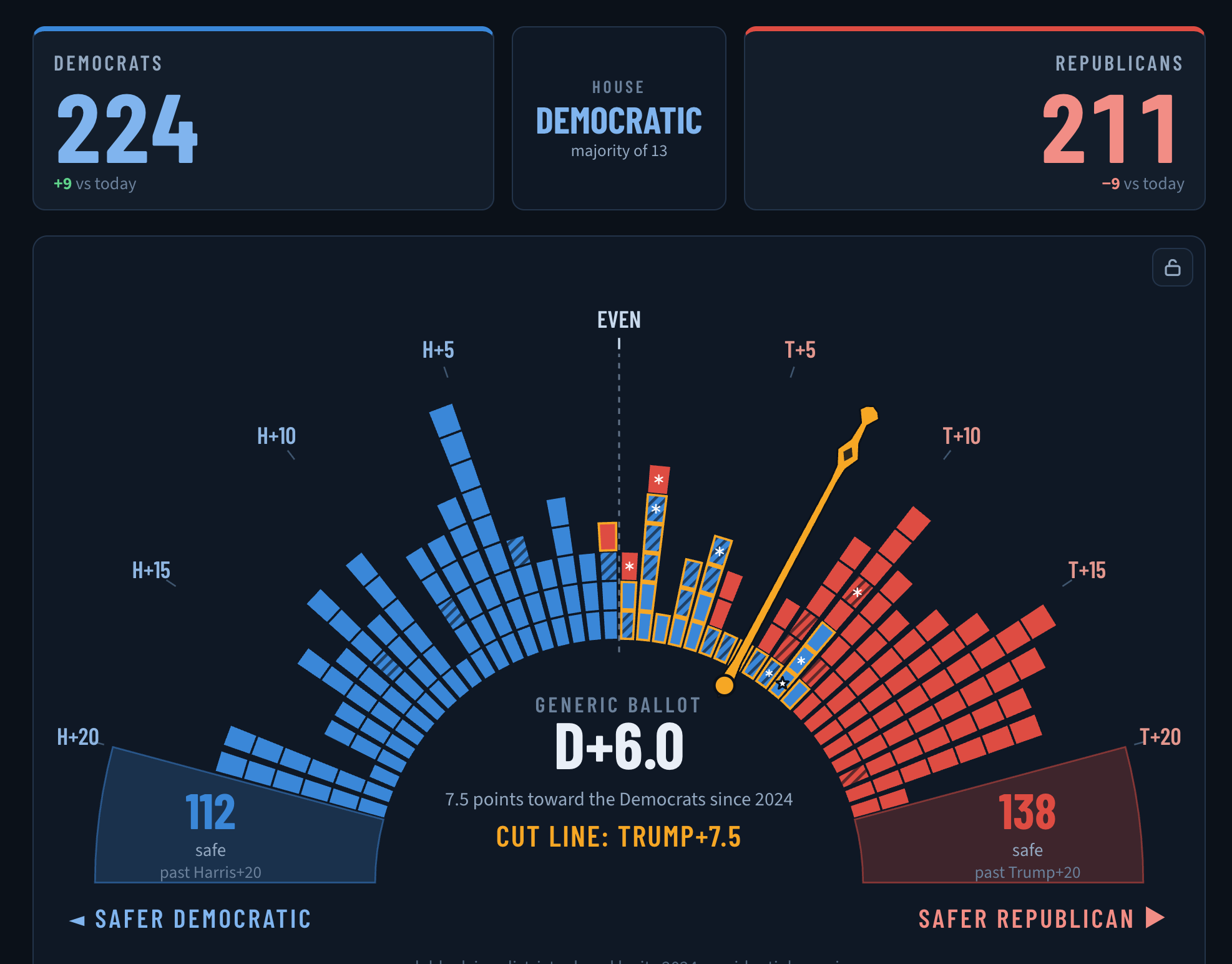
Pollster and friend of TLV Patrick Ruffini recently built a new tool to help political analysts and observers better understand the 2026 midterm environment. His “2026 Swingometer” uses an array of factors—the generic ballot, demographics, candidate quality, etc.—to game out how the House of Representatives might swing this November.
Paying subscribers of Patrick’s Substack can access the Swingometer to see how the national winds are likely to impact specific races, but he has offered some early insights for all readers, too:
The Intersection’s 2026 Swingometer starts with Democrats winning a 224-211 majority in the House based on today’s D+6.0 generic ballot polling average. […]
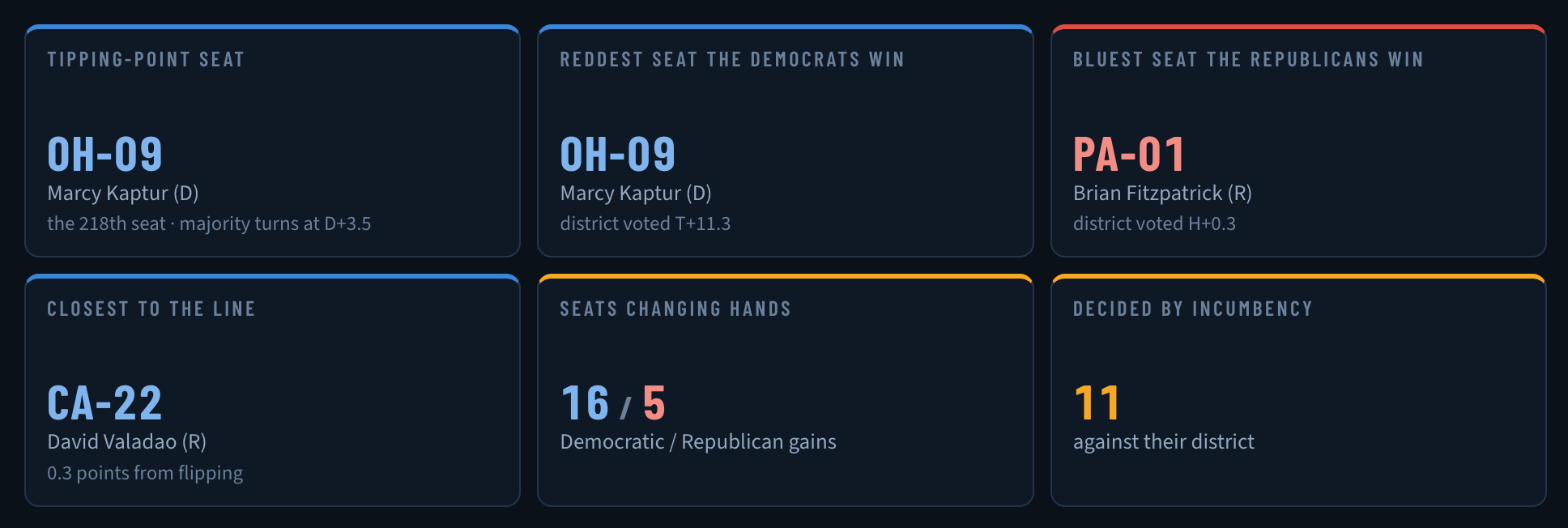
The Swingometer shows electoral tipping points a few different ways. With randomness turned off, it expects Marcy Kaptur’s OH-9 to be the tipping point and also the reddest seat a Democrat in Congress will hold after the election. Only one Republican would survive in a Harris district, and you can guess who that is: Brian Fitzpatrick in PA-1.
The closest seat in the country is expected to be David Valadao in the redrawn CA-22, with the swingometer more bullish on him than his primary results because of his past overperformance and his drawing a progressive opponent. Other extremely close seats feature controversial candidates we’ve accounted for with 2026-specific adjustments. These include Tom Barrett, who survives in a Trump +1.3 due to his past performance and the 4-point penalty applied to his leftist challenger Will Lawrence, and Max Miller in OH-7, who squeaks by in a Trump +11.5 even with a 5-point penalty.
This is great a great tool if you’re into wonky analysis of American politics and elections. Consider supporting Patrick’s work to access it!
Please consider becoming a paid subscriber of The Long View today!
This is definitely a great series! In this “episode,” I appreciated particularly learning of Alkhatib’s essay, and even more, of Chris Arnade’s paean to the Midwest. (Can’t imagine why the latter might be, says this woman who was born and raised in Illinois and was a union organizer and Rep for 6 years, traveling all across the state of Iowa.:))
If the Swingometer is correct, the Budgeting Process may become much more interesting. DSA members and DSA adjacent Dems may have de facto control the Budget process. What would the US budget contain, if Dems are unable to pass a budget or even a CR, without DSA support, and they also hold the Senate?
A refusal to pass any budget lacking funding for Medicare for All, nationwide subsidized childcare or a Green New Deal 2.0, is not out of the realm of possibility. Not just DSA candidates support those ideas, but many Dems, who refuse to be labeled as actual DSA members.
Dems cannot realistically kill the Electoral College, without torching the entire Constitution. Budgets are different. Budgets do not require Presidential signatures. Biden rather famously took the US annual budget from $4.5 trillion to $7 trillion, annually. Now imagine a $12-$15 trillion annual tab.




This is definitely a great series! In this “episode,” I appreciated particularly learning of Alkhatib’s essay, and even more, of Chris Arnade’s paean to the Midwest. (Can’t imagine why the latter might be, says this woman who was born and raised in Illinois and was a union organizer and Rep for 6 years, traveling all across the state of Iowa.:))
If the Swingometer is correct, the Budgeting Process may become much more interesting. DSA members and DSA adjacent Dems may have de facto control the Budget process. What would the US budget contain, if Dems are unable to pass a budget or even a CR, without DSA support, and they also hold the Senate?
A refusal to pass any budget lacking funding for Medicare for All, nationwide subsidized childcare or a Green New Deal 2.0, is not out of the realm of possibility. Not just DSA candidates support those ideas, but many Dems, who refuse to be labeled as actual DSA members.
Dems cannot realistically kill the Electoral College, without torching the entire Constitution. Budgets are different. Budgets do not require Presidential signatures. Biden rather famously took the US annual budget from $4.5 trillion to $7 trillion, annually. Now imagine a $12-$15 trillion annual tab.