



One of the most notable developments in last week’s midterm election was the strong pro-Democratic shift among Hispanic voters. Just two years ago, Donald Trump received 46 percent of the Hispanic vote, the strongest performance for a Republican nominee since at least 1972. Moreover, this had followed two successive cycles of rightward movement among Hispanics.
But since then, much of that support has disappeared. Pre-election surveys showed that Hispanic Americans’ approval of Trump plummeted, and that he was becoming a big factor behind their midterm vote choices—and not for good reasons.
Post-election surveys appear to have been confirmed much of this. Let’s start with the national exit poll:
Hispanic Americans broke for Democrats by 30 points over Republicans, 64 percent to 34 percent, representing a 21-point swing from 2024.
A majority (52 percent) said that one reason for their vote was to express opposition to Trump, compared with 42 percent for all voters. And among these Hispanics, a whopping 95 percent supported the Democratic candidate in their local congressional race.
An even bigger majority (62 percent) “strongly disapproved” of Trump’s job performance, versus 54 percent of the overall electorate, and these voters also broke overwhelmingly for Democrats.
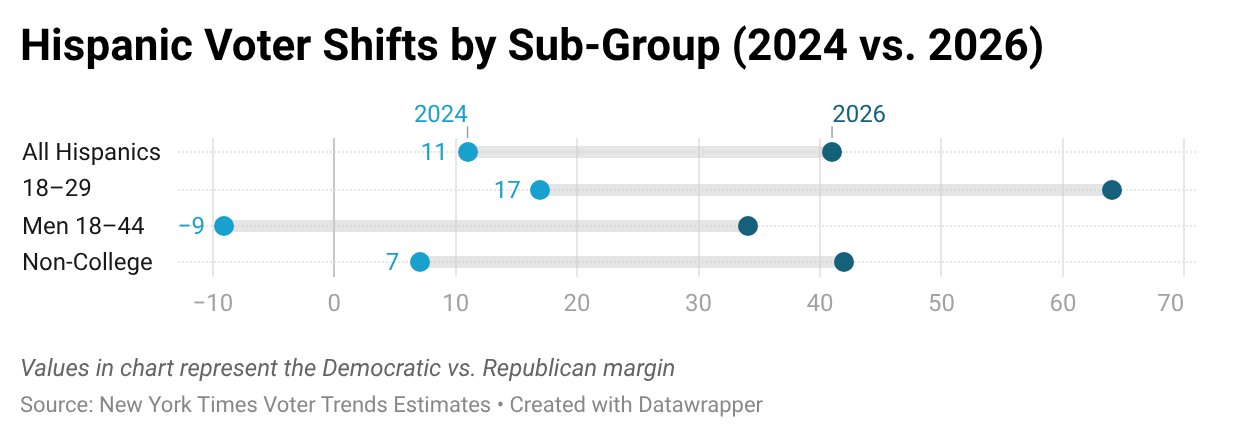
Then there is a new project from the New York Times, which draws data from numerous sources to track how various segments of the electorate vote from one election to the next. Among its findings from 2026:
Hispanic voters swung even more sharply toward Democrats (30 points) than the exit polls suggest. After 54 percent voted Democratic in 2024, fully 70 percent did this year.
The largest pro-Democratic swings came from several of the groups with which Trump made his largest gains in 2024: young people (a 45-point swing toward Democrats), particularly young men (D+44), and non-college voters (D+35).
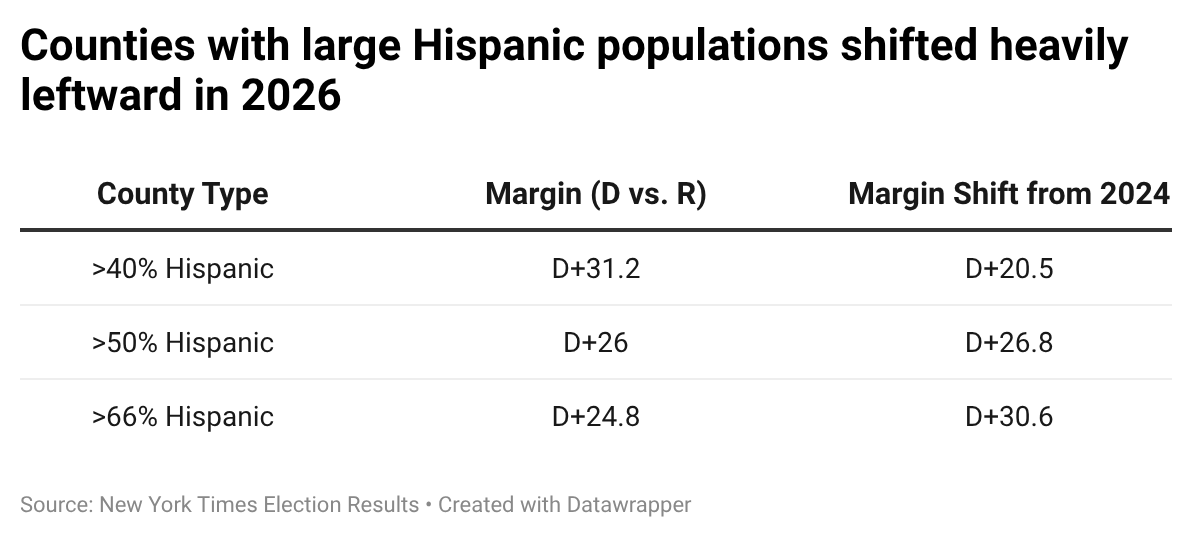
Actual election results buttress this survey data. Across counties where the Hispanics made up at least 40 percent of the CVAP (citizen voting-age population), Democrats won 65.3 percent of the vote in top-of-the-ticket races, compared with 34.1 percent for Republicans. That 31.2-point margin was the largest in any national election during the Trump era and represented a 20.5-point swing toward Democrats from 2024.
Among only majority-Hispanic counties, the shift toward Democrats from 2024 was an even larger 27 points. And among counties that are at least two-thirds Hispanic, it was 30.4 points.
Though exit polls suggest that the economy was the top issue for a large plurality of these voters, another big motivating factor was the Trump administration’s handling of immigration enforcement. Nearly 70 percent of Hispanic voters disapproved of how ICE is handling immigration enforcement, including 58 percent who “strongly” disapproved. Additionally, 75 percent said immigration enforcement policies were a “crucial” or “major” factor in their vote for Congress, and these voters broke for Democrats by 23 points (60 percent to 37 percent).
Detailed, voter-validated studies will be available in the spring to give us an even more accurate picture of this election, but it’s clear that Trump’s gains among Hispanic Americans in 2024 were temporary, rather than the start of an inevitable rightward shift.
But before Democrats convince themselves that 2024 was merely a fluke—a temporary aberration in Hispanics’ otherwise long-term loyalty to them—it’s important to put all this into context.
On the whole, Hispanics remain a fairly moderate-to-conservative demographic, as several major surveys have found. This was also evident in some of the ballot measure results. For example, voters in majority-Hispanic counties in Colorado, Arizona, and Washington all supported more restrictive policies regarding certain “trans issues.” In Kansas, three such counties overwhelmingly backed a measure limiting voting rights to U.S. citizens. In California, 11 of the state’s 13 majority Hispanic counties voted against the proposed billionaire tax, with ten doing so by double digits.
Even on the hot-button topic of immigration, Hispanics often have mixed feelings. For example, while many have serious misgivings about the Trump administration’s aggressive approach to deportations, Pew Research found that a majority (56 percent) believe that at least some people living in the country illegally should be deported (95 percent agreed with this in the case of violent criminals). Another 16 percent believed that anyone living in the country illegally should face deportation.
Additionally, there is reason to believe that a big part of Democrats’ success this cycle came from lower turnout among Trump voters. If the voter-validated studies next year bear this out, it’s highly likely that Hispanic voters followed the same pattern. That would mean the Hispanic electorate in 2026 was inherently more favorable for Democrats—something the party can’t count on in higher-turnout presidential elections.
Both parties would be wise to view Hispanics as a new swing group: a large, growing, ideologically moderate population that remains largely unwedded to either party. They are fast becoming one of the most influential segments of the electorate, and as they go, so, too, might future elections.
A reminder that if you would like to recommend an article or submit a question, please leave a comment on any TLV post published in the seven days leading up to our Friday Five posts (including this one). We’ll collect our favorites and include them in future editions!
Would be curious to know if there will be research into the possibility of voter fraud by illegal immigrants as per claims made by conservatives prior to the election. It's unlikely of course, even more than apologies from liberals who had simultaneously warned about Trump administration suppression of various voting groups.
Very helpful analysis, including thecautionary note. Thank you.