

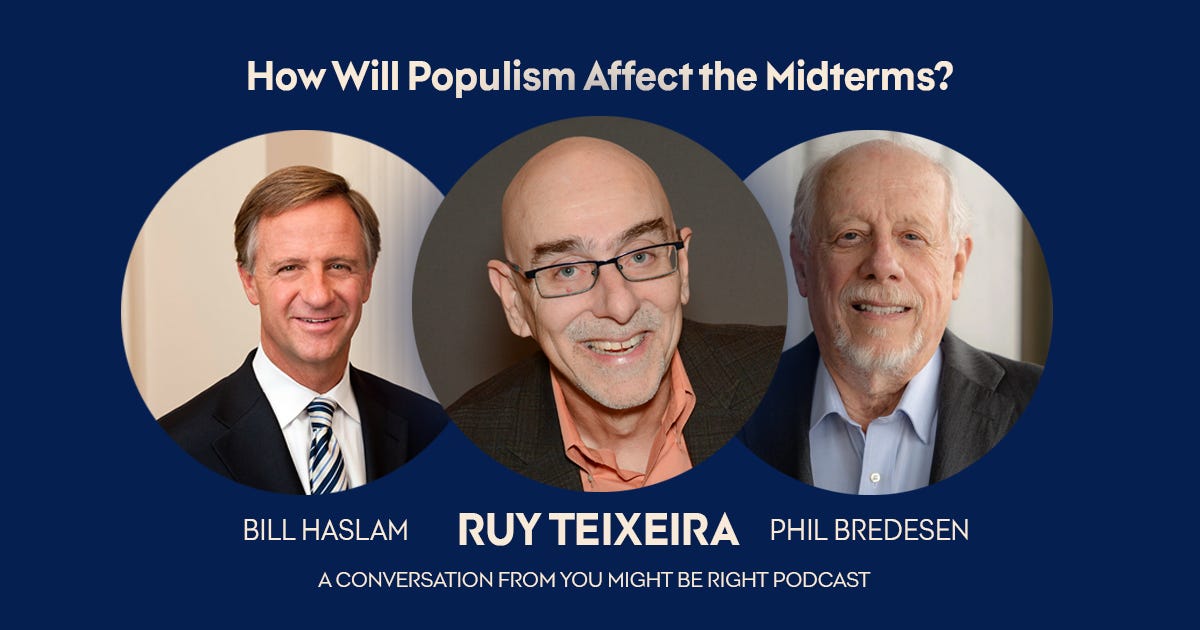
The Long View’s Ruy Teixeira recently sat down with former Democratic Governor of Tennessee Phil Bredesen and former Republican Governor of Tennessee Bill Haslam to discuss next month’s midterm elections, with a focus on how issues like cost of living, AI, and culture are fueling the rise of populism on both the left and right.
You can find the full podcast episode, which includes a separate conversation with friend of TLV Patrick Ruffini (with whom Ruy chatted just last week), here.
Below is a lightly edited transcript of the governors’ conversation with Ruy.
Gov. Phil Bredesen: Bill, I want to start today with something I’ve been noticing, and I’m curious if you’ve been seeing the same thing. Everywhere I go, people are pretty frustrated right now. And it’s not the frustration I remember from maybe 20 years ago when I was more involved in political office. Do you see that?
Gov. Bill Haslam: 100%. There’s a frustration, and I’d combine it with a serious drop in trust of institutions of all kinds, from the military to the church to the media to Congress to business. The level of [trust] in institutions has diminished incredibly, and a lot of terms are thrown around, but maybe the key one is this idea of “populism.”
Bredesen: Right. There does seem to be something going on underneath all this that’s driving it. Obviously, you have housing costs, which if you step back and look at them have become absurd, just unrealistic for so many people. You’ve got AI moving very fast, and lots of people are freaking out; they’re so worried about what’s going on there. Energy policy, immigration, all those kinds of things.
Haslam: Yeah, and what’s interesting to me is I see it play out in my party—this tension between what I’d call traditional Reagan conservatives and the folks who are identified in the MAGA wing of the party who are totally skeptical of big institutions across the board, including big business, which has traditionally been seen as a Republican bulwark.
Bredesen: And I think the same thing is happening on my side of the aisle, too. Democrats have spent a lot of time being the party of credentialed expertise—trust the institutions and trust the process. And there’s a real appetite right now for something that sounds a lot less like that and more like, “I hear you, and I’m gonna fight for you.”
Haslam: So I think the question for today and what we want to talk about is, are the old coalitions breaking apart in the Republican and Democrat Parties? I do argue all the time that there are no more party elders on either side. People always say, “Well, what’s the party gonna say?” There’s no voice like that. The second is, does this populist approach contain any answers in terms of how to build something better? Or is it just about burning down what’s there now?
Bredesen: Well, first of all, do you think we’re not party elders?
Haslam: We are, but the argument would be that I don’t know that people are listening—I don’t want to say that just about us but across the board. There’s not only no longer a smoke-filled backroom. There’s no one who says, “Well, we gotta figure this out. Let’s go sit down and talk about it.” It truly is much more of a free-for-all atmosphere in both parties.
Bredesen: Yeah, and the word “populism” gets thrown around so much, and I’m not sure whether it’s just this cycle’s label for what different parties believe in or whether there’s something underneath it. I think it’s something we need to explore with our guests: what does this actually mean?
Haslam: Couldn’t agree [more]. And I think the voters are now—you’re starting to see a little bit of a tide shifting about, okay, what does that actually mean and how is it going to make it better?
Bredesen: I think we need to bring some people in who know something about this subject.
Bredesen: Bill, our next guest is Ruy Teixeira, who’s a senior fellow at the American Enterprise Institute studying political demography and party coalitions and the American electorate for four decades. Back in 2002, he and John Judis wrote The Emerging Democratic Majority, and two decades later they wrote Where Have All the Democrats Gone?, something I think I should have read. Ruy spent nearly 20 years at the Center for American Progress and now co-writes The Long View with Michael Baharaeen. He is also a contributing columnist to the Washington Post.
Ruy, welcome to You Might Be Right. Thank you for being here.
Ruy Teixeira: Yeah, thanks for having me.
Bredesen: I want to just start out with a framing question for this. We’re talking about populism today. How do you define it? Is it an attitude of anger toward elite institutions? Or is there a coherent political philosophy underlying it? How do you describe it?
Teixeira: There is absolutely no coherent political philosophy. That’s why there’s populism of the left, populism of the right, populism all over the place. It’s primarily an attitude toward elites, the sense that it’s the people versus the elites, and the elites are corrupt, and the institutions they run are corrupt. And what populism implicitly is always saying is “we the people” have to unite against the elites and break their control over the country, or “our” country, which is being ruined by the elites who [don’t] really care about “us.”
So that [apply to] many different political philosophies, spanning from the far left to the far right, depending on what you think the solutions are or what the fundamental problems with the elites are.
Haslam: And is the populism of the left and the populism of the right, are those distinct things? Or is it more just about being anti-elite and upset about the economic and cultural dislocation? Are they distinct or are they the same?
Teixeira: I think they can be quite distinct. Populism on the right, typically at this point, it may include—and frequently does include—anger at economic elites, in the sense that they’re betraying the interests of the ordinary people. But also it’s typically got a very heavy cultural overlay, in a sense that not only are the elites corrupt in terms of their economic policies but their cultural policies, their cultural ideas, their priorities are very, very removed from what ordinary people want. And those elites are imposing those values upon us, and they must be fought against.
On the left, a classic economic populist line would be the “billionaire class” like Bernie Sanders always talks about. The fundamental enemies are the people who control vast amounts of capital and wealth. And they are the real problem. And everything else is just a diversion from that. And frequently that’s linked up with a whole raft of different policies, from taxing the rich to spending gobs and gobs of money on social programs.
So there’s a lot of policy variation, but the target of the anger of the left-populists is typically the capitalists, the wealthy, the people who really control the levers of economic power—and through that are really controlling the political class. That’s pretty key to their outlook.
Bredesen: Populism historically has surged during times of economic dislocation. And in talking about this, you’ve touched on how that may be an element of it. Do you think what’s driving this now—is it economic dislocation that’s causing it? Or is it something more about loss of voice and control, of people feeling like they’re not being heard? What’s driving this issue?
Teixeira: Well, I think it’s all of the above. If you look at the way people are viewing the economy, particularly working-class voters in this century, and especially since the Great Recession of 2008–2009, there’s a real sense that for a lot of these people in a lot of these places—again, particularly working-class people—that the whole system is rigged against them, it’s passing them by, they’re not doing well while the coastal elites with their cushy NGO jobs are doing great. And they resent that deeply.
If they are happier with their own lives economically, this would be less of a big deal. But they’re not happy. They do feel pressed. They do feel like their economic mobility isn’t keeping up with their family’s need and what they had in mind for their future. And many of them live in communities that have been adversely affected by the way that the economy has evolved.
I think also part of that clearly is that if you look at the cultural values and priorities of elites in the broad sense—not really the people who have all the money, but the people who dominate the media, the NGOs, the foundations, the universities, the people who are basically the arbiters of what is and is not correct culturally to think—the people with populist feelings, and there are many, tend to feel like these are priorities that [are] not my priorities. And it’s fine for them to be the priorities of the people who live in the People’s Republic of Brooklyn, but why are they making me absorb all this stuff? And why do I have to walk on eggshells unless I pay obeisance to all these priorities?
So there is a very deep resentment of what they perceive to be the cultural elites who are telling them how to live their lives, what to say, what to think. I think that’s very real. And look, we don’t have Donald Trump without that. There’s just no way, no matter what the level of economic discontent was.
Bredesen: My own experience talking to people is that, in sort of the old way of talking about it, it’s less about the one percent—I don’t think people care all that much about whether a Bill Gates or Elon Musk or something have a lot of money. I think of it more as the 80 percent and the 20 percent.
Teixeira: Yes.
Bredesen: That there’s 20 percent of the population that is educated and, as you described, has a great job with an NGO somewhere up in Virginia or whatever. And that that is more the source of the resentment than a few very wealthy people who are throwing their wealth around. Am I wrong about that? I don’t mind being told I’m wrong.
Teixeira: No, I think that’s right. If you talk to normal people, normie voters, that’s really where they’re coming from. Unlike Bernie Sanders, and unlike some of the flamethrowers in the Democratic Party who just love to toss around this stuff, they don’t wake up in the morning and think, “I really hate Bill Gates. I really hate the tech overlords. I just hate anyone who has a gazillion dollars.”
That’s not what they think. They think, “There’s a certain stratum of the country that’s actually really doing well, and I would like to have that lifestyle. I don’t want to be Bill Gates, but I’d love to be as comfortable as those people seem to be. And I deeply resent that I can’t seem to get there.” And I think this is part of the real, underlying problem with left-populism—is that they really do have a theory of the case that is just wrong on how normal people feel about this stuff.
Haslam: But I think those folks on the left and on the right, they might not wake up feeling that way about Bill Gates or Elon Musk. But they do wake up thinking the system is rigged. I think that’s what Trump was able to tap into so well. Folks on the left and the right say that the system is rigged. So if we’re prescribing the antidote to that, what’s the message that you would give to folks who just say, “Sorry, the system’s rigged, and folks like me are never going to get ahead. Folks like the people I run around with are never going to get ahead.”
Teixeira: I think the issue of fairness does run very deep. That’s not only a fundamental political value; it’s a human value. Deep research shows that this is just baked into our genes—the sense that someone gets something they didn’t work for and took advantage of me, I deeply resent that. [It] goes back to the tribal days.
So I think people are very exercised by the issue of fairness. And if you want to convince them that the system is not rigged, you may have to admit that in some ways it is rigged! Because there are things that are unfair. There are people who have unfair advantages. There is corruption. There are people gaming the system, all the way from the poor up to the rich.
I think part of the problem the Democrats have, for example, is they’re very into the idea that the rich are rigging the system—[they] have several billion dollars more than they should have. But they’re not really responsive to the idea that there are people on the other end of the spectrum who are in fact gaming the system, be it the poor, illegal immigrants, or whatever.
I think people’s sense of fairness extends from low to high. And I think that as a political proposition, you would have to make it clear that you stand against the unfair gaming of the system no matter who is doing it. And by God, we’re going to stop that. And we’re going to make sure that you, the ordinary Joe or Jane working-class person, the ordinary middle-class person, you are going to get dealt a fair hand and then you get ahead by your own efforts. There’s no preferences here; there’s no handouts for anybody. But we’re going to make sure you have the ability to get ahead as far as your God-given abilities can take you.
That’s old-fashioned stuff, but it’s what people believe. We want to support those people who work hard and play by the rules—that old Bill Clinton formula. I think people love that. They just don’t believe they have it anymore.
Bredesen: In this rise of populism discussion, a new element has injected itself over the past couple of years, which is AI, or artificial intelligence, which seems to have been particularly good at provoking this anger that you’re talking about. How do you think that the arrival of that has impacted this populist movement in this country and in others?
Teixeira: Well, I think at least here—it hasn’t had quite the impact in a lot of other places—but here it’s become a hot-button, heavily impregnated with populism kind of issue. It’s basically the tech overlords are doing what they want. They’re going to raise my electricity bills. They’re going to ruin my community. It’s remarkably untethered. And plus, the whole issue of AI safety gets walked into that, where people just don’t know what the hell’s going to happen—potentially it’ll come for my job.
So it’s a constellation of things that really do scare people. And it seems to me that the correct position about AI is that this is a general-purpose technology—it’s going to be impossible to get rid of, nor should we want to. And it has potential productivity-improving benefits and it will make us all richer over time. This is an actual source of economic growth that would work if handled properly. This is a little different from the Democrats’ obsession with the clean-energy transition, which was never really the growth engine that they thought it would be. This is really potentially a growth engine.
So how do you both respond to the populist upsurge of distaste for data centers and AI, while still keeping in mind that this is a growth engine for the economy that could pay big benefits over time? How do you convince people you’ll both have guardrails and appropriate regulation, and you’re gonna take advantage of the potential economic growth benefits of AI? I think that’s a very tough conversation to have, particularly right now. I don’t see hardly anyone who’s saying something that sounds plausible on this. Both the Republicans and the Democrats are gleefully getting out their baseball bats and beating up on data centers.
Haslam: Let me ask you one final question we ask all of our guests taken from the name of the podcast—Howard Baker saying, “Always remember: the other fellow might be right.” Is there a time you can look back and say, “I didn’t get this quite right. In hindsight, I’ve changed my opinion. I didn’t nail it the first time”?
Teixeira: Oh, man, too many to count! Actually, I think back to a very common one that occurs to me. When we wrote The Emerging Democratic Majority, John Judis and I, I think we got a lot of things right about some of the demographic and geographic changes that were taking place. And we talked in the book about the rise of the professionals, and how they would be a boon to the Democrats. They clearly realigned toward the Democrats, they have a ton of influence, they vote at high rates.
But I was just wrong about a relatively benevolent conception of that. We did not anticipate how powerfully professionals would not only have hegemony over the party but actually move to the left in very significant ways that would divorce the party and its brand from working-class voters. So we just really got that one wrong. And I’m sorry—they just kinda snuck up on us!
Ruy always seems to understand. No privileges, no payoffs. Especially for literally being born a certain way. No one did anything to earn that. We have to move on and if you are tried in court in a place like DC -96% Democrat - you should either see as many guilty Dems as Reps, Blacks as Whites, etc. or places that heavily loaded should be automatically moved to a more even district anywhere. Stuff like that.
Bredesen has it exactly right, it’s an 80/20 problem, but the discussion glosses over the fact that today’s Democratic Party is the party of the 19% (20% - 1%) and Sanders and AOC unconvincingly pretend that the interests of someone making $300K are more aligned with someone making $30K than they are with someone making $600K.