


“Most political commentary doesn’t think highly of voters” - Gabe Fleisher
The first real test of 2026 is tonight, with primaries that will set the midterm tone in Texas and North Carolina.
But the headliner is not an ideological battle, as Nate Cohn demonstrates in the NYT:
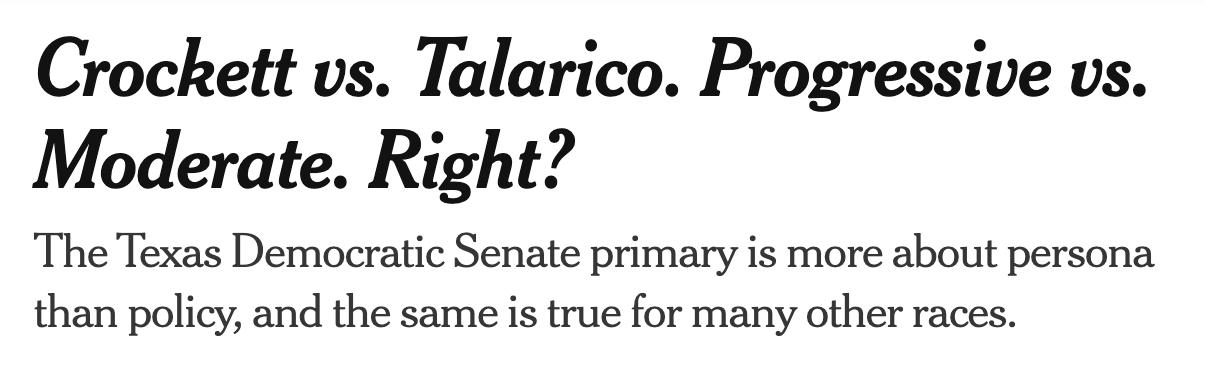
Is that a good thing? Some prominent progressives think so.
Run For Something founder Amanda Litman wrote this afternoon that “the fight over “progressive vs moderate” misses the point (and is mostly a waste of time.)”
I’m sitting next to former congressional candidate Adam Frisch right now (it’s election day!), and we disagree.
We live in a democracy! Voters care about issues! They deserve a choice not only of style, but of substance.
In 2022, some Democratic candidates like Adam said we should secure the border, increase energy production, respect the Second Amendment, and tone down the culture war offensives.
Adam ran in the primary against Sol Sandoval, a progressive activist endorsed by the left-wing Working Families Party. Adam would open his primary stump speech to activists with “I know the Democratic Party isn’t looking for a straight middle-aged white Jewish guy living in Aspen. But …”
After clearing the air, the “But” would be followed by a confident and commonsense explanation of why Adam believed in these policies - and why a majority of voters would too. Before running ten points ahead of baseline in the general election, he won his primary by just 289 votes.
Voters deserved the choice.
Voters Over Pundits
How do we know the median voter is smarter than fancy political pundits? Here’s one example: there is a 20 point difference in voter approval of Trump’s border policy and his immigration policy.
Last year we told the story of MSNBC personality Chris Hayes, who as a recent Brown grad in 2004 went knocking on 1,000 doors because he could not understand “how could any halfway intelligent human remain undecided for long?”
His conclusion? Swing voters are deserving “of the derision that the political class has heaped on them.”
Hayes, ever the committed progressive, stated that “undecided voters aren’t as rational as you think” and “don’t think in terms of issues.”
Yet these three things are all true about the most contentious issue of the last five years:
Voters strongly disapprove of Trump’s handling of immigration (-17)
Voters still net approve of Trump’s handling of the border (+3)
Voters still trust congressional Republicans more than congressional Democrats on the border (+28) and immigration (+11)
Unlike professional anti-Trumpers, the median citizen is taking that highest duty seriously enough to distinguish between “the border” and “immigration.” AND distinguishing between the executive branch and the legislature.
R-E-S-P-E-C-T
Back in 2021, the first article written about Welcome focused on the word ‘empathy.’ The reporter from Slate was “intrigued” that centrists would use such a liberal-coded word.
Over the last five years, the problem is worse than Democrats “lacking empathy.”
Democrats - or at least their elite tone-setters - just don’t RESPECT voters.
The journalist Gabe Fleisher recently said this pointedly: “A lot of political commentary doesn’t think highly of voters, but Americans often do a better job sitting in nuance…”
Fleisher gives a similar example to our border/immigration split:
41% of Americans oppose Trump’s immigration goals + execution. That’s the “never Trump” coalition. (Almost all Dems, about 1/3 of Independents.)
27% support Trump’s immigration goals + execution. That’s the “Trump diehard” (at least on immigration) coalition. (2/3 of GOP, about 1/5 of Independents.)
And, most interestingly, 24% support Trump’s immigration goals, but NOT his execution.
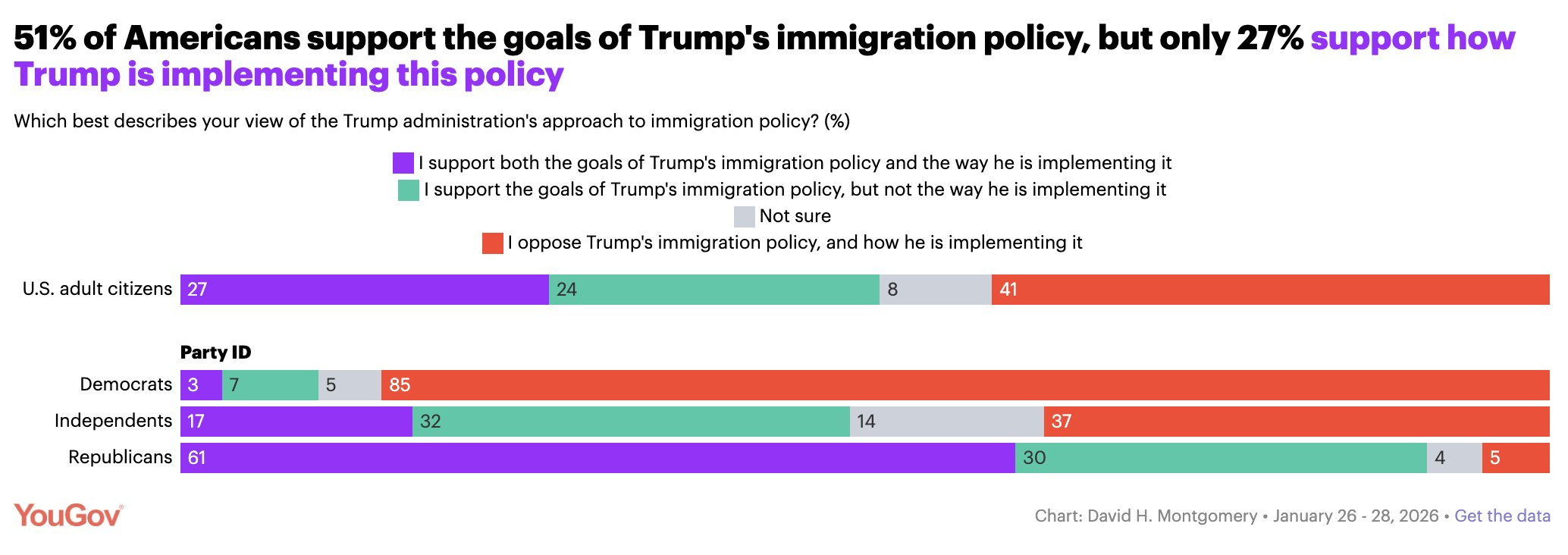
Voters are comfortable with nuance!
That’s why candidates like Mary Peltola and Jared Golden and more are able to run a dozen points ahead of the national ticket by breaking from the party on issues.
Let’s say that again: breaking with the party on issues. The thing Chris Hayes claims they don’t think about.
Voters distinguish between immigration and border security, and many prefer different parties to deal with each one. For a long time, there has been a strain in Democratic thought that denies this fundamental reality: voters know where the parties stand on issues, and vote for the party that agrees with them on the issues they find most salient.
What’s The Matter With Pundits
During the same 2004 period in which Chris Hayes was mentally demeaning swing voters at their doors, liberals were taken in with Thomas Frank’s “What’s the Matter with Kansas?”
The book purported to show that working class voters were voting against their economic interests because they were tricked by Republican support for conservative social issues. He argued the way for Democrats to win back the voters of Kansas was not to move to the center, but rather to move to the left, blaming centrists for costing Democrats working class voters.
Political scientist Larry Bartels responded to Frank, finding that working class white voters had pretty conservative views on the economy. In fact, what Bartels found was that Frank had it backwards,
… contrary to Frank’s account, most of his white working-class voters see themselves as closer to the Democratic Party on social issues like abortion and gender roles but closer to the Republican Party on economic issues.
Bartels found:
Frank’s white working-class voters were neither liberal in absolute terms nor closer to the Democratic Party than to the Republican Party on economic issues. On the central issue of government spending and services, voters who saw themselves as closer to the Republican Party outnumbered those who saw themselves as closer to the Democratic Party by four percentage points. On the issues of government jobs and aid to blacks the pluralities seeing themselves as closer to the Republican Party were even larger – nine and 15 percentage points, respectively. Moreover, 60% to 85% of the voters who perceived differences between their own position and the Democratic Party’s position on each of these economic issues said the Democratic Party was too liberal, not too conservative. Thus, it is hard to see why taking even more liberal positions on these issues, or stressing them more heavily, would help the Democrats win back the white working class.
What’s The Matter With Justice Democrats?
But let's put away the polls and spreadsheets. What happens when progressives run left-wing candidates in Republican areas?
It doesn’t work. The last decade has been defined by attempts from Justice Democrats and their allies to recruit and support the types of candidates who they think would fix the problem with Kansas.
All of them have failed.
Randy Bryce (WI-1): The union ironworker and progressive folk hero lost to Bryan Steil by double digits despite raising nearly $8 million, earning endorsements from Bernie Sanders and Elizabeth Warren. Bryce was touted by groups like the Working Families Party and ran as a populist, pro-Medicare for All progressive, but he still lost badly, running 10 points behind the district’s fundamentals.
Jess King (PA-11): The progressive running on Medicare for All and debt-free college lost by 18 points (though gaining extensive media coverage in the process). Justice Democrats-aligned consultants believed they could make this district competitive by building the most extensive field operation in the district’s history, but she ran in line with the fundamentals. A local post-mortem casts doubts on the canvassing effectiveness, noting that King received fewer votes than Gov. Tom Wolf (7,000) and Bob Casey (1,376) while Smucker out-performed Republican gubernatorial nominee Scott Wagner (11,520) and Senate candidate Lou Barletta (6,321).
Kara Eastman (NE-2): After beating DCCC-backed former Rep. Brad Ashford in the primary, Eastman lost in the general election, running 2 points behind the fundamentals. In her second attempt in 2020, she ran 6 points behind the fundamentals. Kara Eastman was the only Justice Democrats attempt in a swing district, and she lost a district Biden won running on a progressive, pro Medicare for All platform.
Dana Balter (NY-24): Ran in a Clinton+4 competitive district and lost, underperforming Clinton by 10 points — the worst result of any Democrat running in a Clinton-Republican district that year. (Balter ran again in 2020 and lost again). Balter ran 19 points behind the fundamentals in 2018 and 16 points behind in 2020.
Justice Democrats, Working Families Party and the like have tried again and again to replicate their primary playbook with swing voters. Every time it fails.
From “What’s the Matter with Kansas?” to thinking “Tim Walz is a cheat code for white men,” Democrats want to deny that their struggles with working class voters are rooted in legitimate policy disagreements.
Maybe these voters are not just bozos lurching from one candidate to the next, but are onto something?
“Not giving voters enough credit”
A summary of the research from Anthony Fowler of the University of Chicago, via the Niskanen Center:
Anthony Fowler finds that most Americans’ political views fall between the opinions of Democratic and Republican elites. And that’s not because they don’t understand politics in the same way. Most Americans’ views fall into the ideological continuum from left to right; they’re just somewhere in the middle. These moderates matter for election outcomes. While they participate a bit less, they are the consequential swing voters. Fowler also finds that selecting candidates on policy grounds could matter more to voters than the power of partisan identity. We may not be giving voters enough credit.
Pundits often cast voters into narrow, polarized buckets. But voters demonstrate again and again that substance matters.
Fowler shows that perceptions of ideological extremism are driven by the limited response options on most surveys (e.g. do you support or oppose Medicare for All?).
Fowler changed this dynamic by offering respondents a more open set of response options. For instance, when he asked what the minimum wage should be, he simply offered an open-ended text box. Offering specific numbers or a slider to choose different numbers could anchor or artificially constrain opinion.
The results show this nuance clearly. Take the minimum wage example: when Fowler asked what the federal minimum wage should be, the median response was $12 and even 41% of Democrats prefer a minimum wage below $15, while 97% of Democrats prefer a minimum wage below $25. Democratic voters are far more moderate than their representatives (who now support a $25 to $50 minimum wage).
Fowler finds that on other issues, there is significantly less extremism than our politics implies: “only 13% of respondents say that abortion should not be legal at any point in a pregnancy, and only 9% say that it should be allowed through all 40 weeks of a pregnancy.”
Voters are capable of nuance - but too much of our research isn’t designed to measure it. Most issue polling is like measuring the 40-yard dash with a sundial.
Warning Signs
While Democrats are well-positioned for the midterms because of the significant, predictable weakness of the incumbent party, the latest Wall Street Journal polling should be a flashing warning sign for Democrats. While Trump’s approval has fallen more and more, Democrats still aren’t trusted in Congress, relative to Republicans. Congressional Democrats trail on border security (-28), immigration (-11), the economy (-6) and inflation (-5). Democrats lead on the issues where they have effectively messaged such as healthcare (+15).
Voters don’t like what Trump is doing, but Democrats need to prove they’ve moved past the extreme positions many took during 2020, like banning gas-powered cars.
“Elite Disdain”
The attitude of a twenty-something Chris Hayes and his fellow What’s The Matter With Kansas readers epitomizes the ‘elite disdain’ that progressives have towards voters.
The problem is that Chris Hayes is all grown up, but his disdainful mindset has not - and is now dominant in the Democratic ecosystem. And despite all the progressive podcast ads for online therapy services, it doesn’t seem like more empathy for the confused masses is around the corner.
We need to respect the voters.
Can you link to Fowler's paper showing this: "when Fowler asked what the federal minimum wage should be, the median response was $12 and even 41% of Democrats prefer a minimum wage below $15, while 97% of Democrats prefer a minimum wage below $25." Thanks.
Though I agree with the premise of respecting voters, there's a lot here that isn't adding up for me, most of it to do with a failure to distinguish b/w working class voters' economic and social views. Whatever the case may have been in Kansas in the 1990s, the public opinion polling I'm seeing today shows most working class voters to be social moderates/conservatives and liberal populists on a number of economic issues (fed jobs guarantee, union protections, busting monopolies, price controls, Medicaid expansion, etc). The Justice Dem candidates' defeats were probably a function of their failure to moderate on social issues (or maybe they were just lousy candidates or condescending or uncharismatic, idk).
As for Bartels' critique of Frank, it kicked off a major showdown between the two which Frank revisited many years later (https://tcfrank.com/on-the-uses-of-expertise/). It makes for an interesting read that, in my view, shows Bartels to have been wrong about some pretty fundamental things (eg. he denied that Dems were losing working class voters).