


Rolling Off
In most elections, the votes “roll-off” as you move down the ballot. Marquee races that appear at the top of the ballot ticket, like President, Senate and Governor, typically get the most votes while “Down-ballot races,” like county and local offices, typically get much fewer votes.
But in South Texas this year, something unusual happened: there was a reverse roll-off on the ballot.
In both Texas’s 15th congressional district and Texas’s 28th congressional district, more votes were cast in the U.S. House race than in the U.S. Senate race, by thousands of ballots.
At the topline, both districts show the same dynamic:
TX-15: 50,935 House votes vs. 48,557 Senate votes (+2,378)
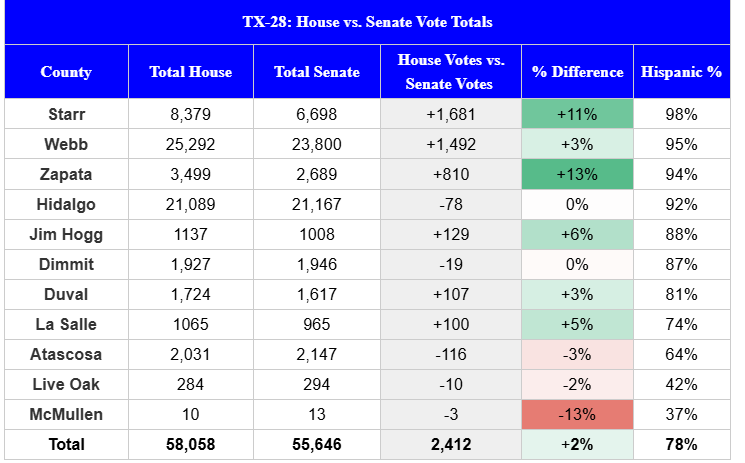
TX-28: 58,058 House votes vs. 55,646 Senate votes (+2,412)
Specifically in Texas’s 28th congressional district:
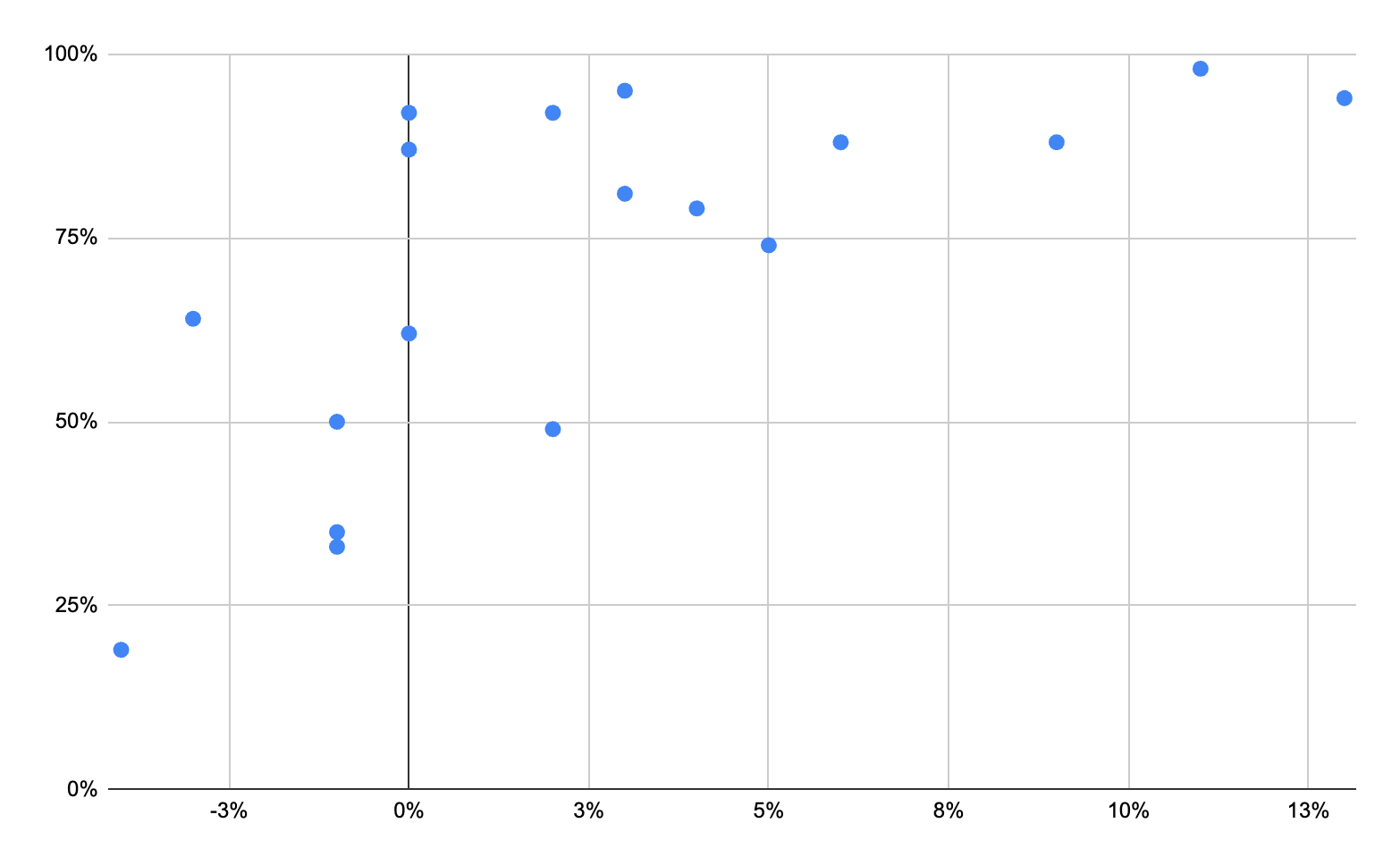
Starr County (98% Hispanic): +11% more votes in House
Zapata County (94% Hispanic): +13%
Webb County (95% Hispanic): +3%
The relationship is pretty clear: the more Hispanic the county, the more likely voters were to participate in the House race relative to the Senate race. Why?
High Turnout, Low Enthusiasm
Turnout numbers also tell an enthusiasm story. Nate Cohn noted:
Take Starr County, a heavily Hispanic county along the Rio Grande. It was ground zero for the Trump surge among Hispanic voters: He won the county by 16 points in 2024; Hillary Clinton won it, 79 to 19, just eight years earlier. The turnout was enormous, leading some to highlight the surge as a sign of a Democratic rebound. Well, about half of Democratic primary voters left their ballots blank in the Senate race and left their ballots blank for most races, other than the county judge election. And among those who did vote in the Senate race, 8 percent voted for Mr. Hassan.
So yes, turnout was high. But participation in the Senate race wasn’t as high. Nearly half of the people who turned out to vote only voted for one race: the primary for county judge.
That distinction matters because it helps explain what we’re seeing in the congressional and Senate data.
If this were a simple turnout and enthusiasm story, more Hispanic voters showing up, more engagement, a rebound for Democrats, you would expect that to show up consistently across the ballot. You’d expect Senate participation to rise alongside House participation. You’d expect Democratic candidates to benefit in the most heavily Hispanic areas.
That’s not what happened.
Instead, voters showed up and then made decisions about where to engage. They’re voting in the House race, but not the Senate race. They’re participating in local contests, but not completing the ballot. And when they do vote, their choices don’t line up cleanly with ideology or party expectations.
What does this mean?
The simplest way to understand what’s happening in South Texas is that voters are becoming more selective.
They’re showing up to vote, but they’re not treating the ballot as a single, partisan decision. They’re deciding which races and candidates matter to them, which races they feel informed enough to vote in, and which ones to skip entirely. And those choices don’t neatly track with party, ideology, or traditional measures of engagement.
That’s what “reverse roll-off” is capturing.
It’s evidence that a meaningful share of the electorate is no longer participating uniformly across the ballot. Because if voters are opting out of certain races altogether, then turnout and vote share alone aren’t enough to explain what’s happening.
Don’t Call It An Autopsy
Democrats have finally released their autopsy - er - “Playbook.” While the party isn’t focusing on what went wrong, there are some nuggets in the report, for instance:
“Over the past decade, the Democratic campaign industry and its funders have become obsessed with massive, shiny output numbers from traditional tactics: Millions of calls made and hundreds of thousands of doors knocked,” the playbook writes. “Despite making 300+ million phone calls in 2024—more than any campaign in history—only 3% of the calls the Harris campaign made actually resulted in a contact with a voter.”
Only 3%!
It’s worth a read, but it’s important to remember that every position is a communication with a voter. Organizing can’t make up for ignoring the positions of the median voter.
Fundraising Eve
Your phone probably exploded last week, the end Q1.
“FINAL NOTICE.” “Account status: LAPSED.” “We’re BEGGING.” Language designed to mimic debt collectors, targeted disproportionately at seniors. Stanford political scientist Adam Bonica found that 95% of the money raised through these churn-and-burn operations comes from donors 65 and older, with a significant share from people over 80. This is elder fraud dressed up as democracy.
Before you tap that button, here’s where the money actually goes.
Ninety-one percent of top Democratic House fundraising went to races decided by 18 points or more. Safe seats. Our own Lauren Harper Pope documented this in The Bulwark: Democratic donors are getting bamboozled by fantasy campaigns. Marcus Flowers raised $10.8 million to unseat Marjorie Taylor Greene in a district Trump won by 48 points. He lost in a landslide. Meanwhile, 16 of 21 actually winnable districts had Democratic challengers who started the year with less than $100,000.
As Lauren told CNN: “We get so caught up on the super villains that we don’t focus on the villains.”
Our “Conceding Democracy” analysis (now Congressional Competition Index) has tracked this for years. In 2022, Democratic nominees had raised less than $100,000 across the entire cycle in 8 of 29 GOP-held districts where Trump received 50-54% of the vote. No Democratic candidate even filed in 19 of 45 competitive districts by mid-2023. Winnable races go uncontested or barely contested with candidates raising paltry sums. The party concedes before a single vote is cast.
Tomorrow, when the texts hit, remember: the machine doesn’t need your money. The candidates in winnable districts do.
Our 2024 slate over-performed Kamala Harris in Trump-won districts by an average of nearly six points. Independent analysis confirmed the highest “Wins Above Replacement” among Democratic groups that cycle. Marie Gluesenkamp Perez, Vicente Gonzalez, Jamie Ager. These are the candidates who win by differentiating, who compete in districts the national party has written off.
So while you spend your day unsubscribing from the emails and replying Stop2End the texts consider giving through our Investing to Win project to support differentiated Democrats running in districts Trump won.