


What is your mental model for Democratic primary voters?
This is top of mind for us - midterm primary season just kicked off and runs into September - and is clearly top of mind for many ahead of the 2028 presidential primary. There has been a flurry of research and opinion on this question in recent weeks.
So we put together this typology based on two key axes: ideology (from left to center) and prioritization (from issue purity to winning).
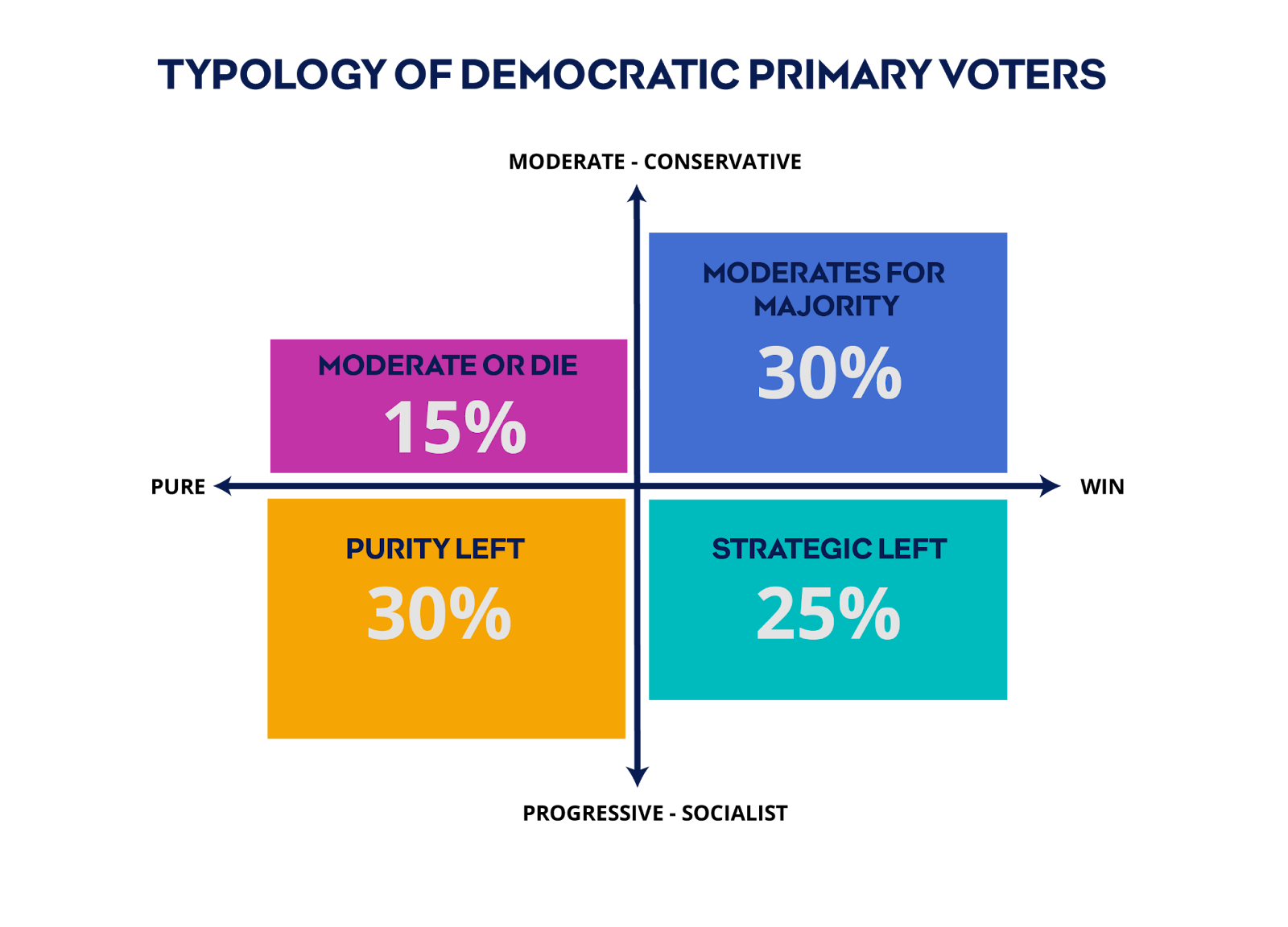
The easiest way to make this framework click is to see it laid out visually. We put together a short video walking through the typology and how the pieces fit together:
Here is the compelling stuff that’s come out recently:
The Truth About Democratic Primary Voters based on a poll of 1,400 likely primary voters from Third Way
Do Democrats Want to Be “Normal”? Survey Analysis of Today’s Democratic Coalition based on a poll of 2,593 Democrats and Kamala voters from the conservative Manhattan Institute
Primary voters prize ideology over electability as their parties get low marks from NBC News
Are Moderate Democrats Becoming Extinct? and The Democrats’ White Liberal Problem from The Liberal Patriot
Read them all - and also watch the related Third Way presentations from their recent Win The Middle conference.
And think about what your mental model is for the Democratic Party, primary voters, and our path forward.
Moderates are outnumbered in the Democratic Party, and that is certainly true in many congressional primaries. Roughly 55% of Democratic primary voters are progressive, liberal, or socialist. But a decent chunk of those lefties have a struggle between heart and head.
And there are enough lefties who prioritize electability over ideology to deliver moderate nominees.
Target Rate for Lefty Inflation: 1%
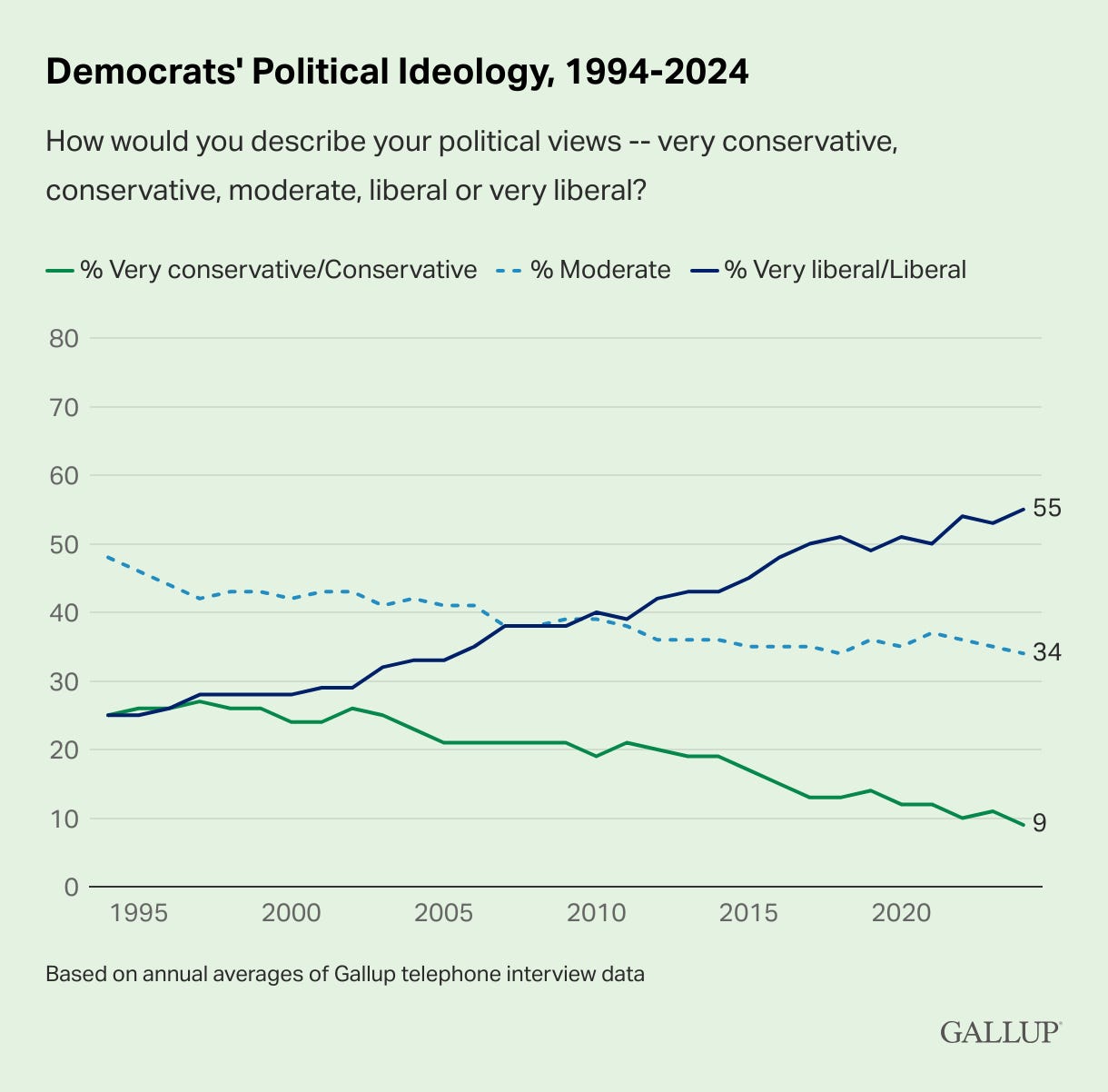
The trend towards a more liberal Democratic Party, chronicled in Deciding to Win, has a legitimate source: rank-and-file Democrats have gotten more liberal in recent decades.
Let’s zoom out to the big picture. The trends are nationalized: parties are increasingly sorted by ideology, and voters overall are becoming slightly more liberal.
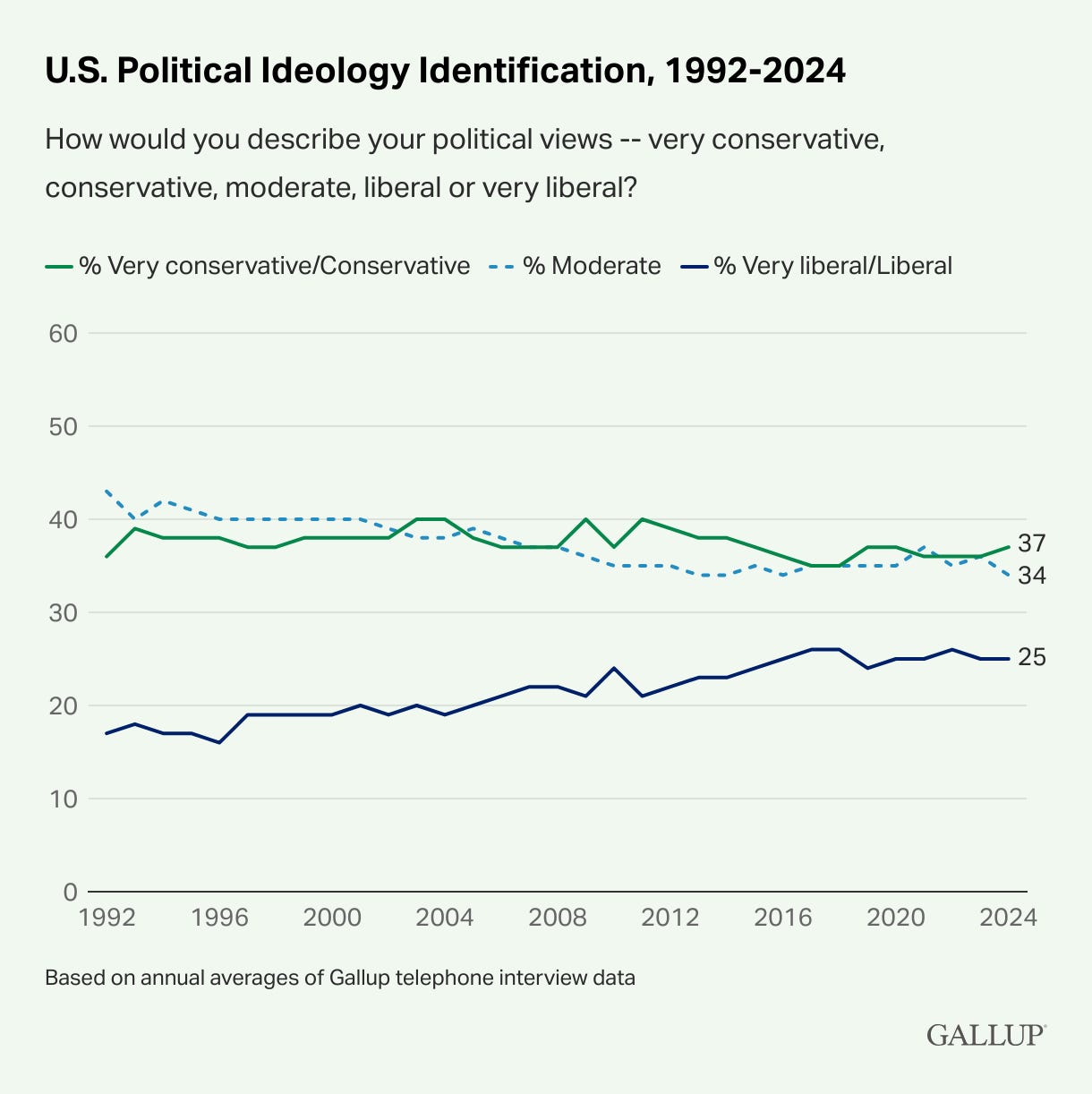
Emphasis on slightly more liberal. This blue bar has been on the incline over a long period. Going from 18% to 25% is a significant change on a relative basis.
But that still leaves moderate and conservative as a supermajority of voters.
That used to be true within the Democratic Party as well. In 1994, 74% of Democrats were moderates and conservatives. That has been on a steady decline in the three decades since, falling on average by a point per year to its current 43%
Focusing only on moderates and conservatives, you see a slight decline (black line below) but a sharp decline among the share of Democrats who identify as conservative or moderate (blue line).
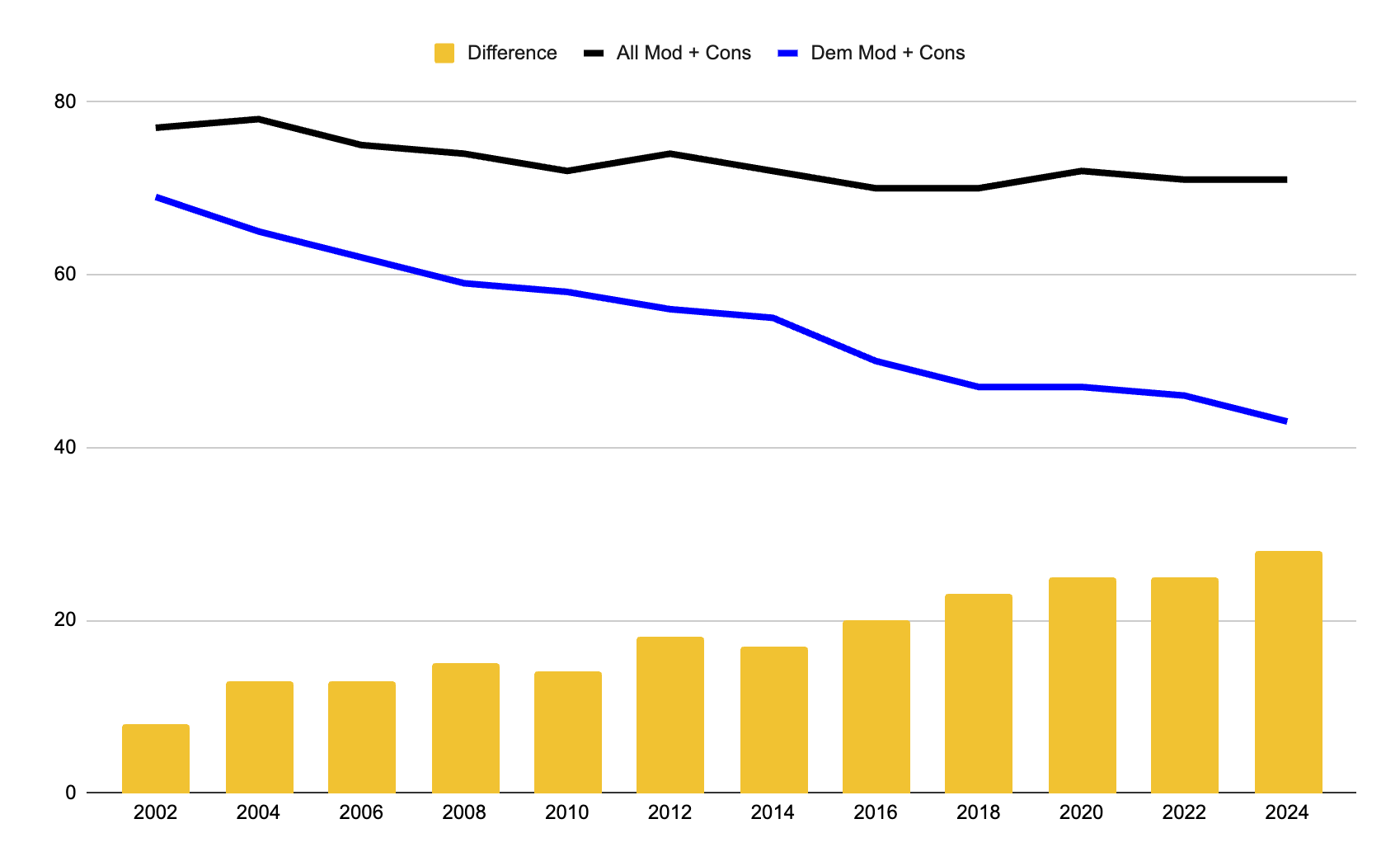
The gap between the black line (share of all voters) and the blue line (share of Democrats) tells a story. The difference (yellow bar) shows no sign of slowing down.
That chasm presents a problem in nominating candidates who can win a majority of voters.
A solution is sewn into the suit of liberal armor, however. Many progressive Democratic voters prize electability over ideology. When a chunk of them are combined with moderate-to-conservative Democrats, that’s enough to win.
Quadrant I: Majority Mods (30%)
About 30% of all Democratic primary voters are both moderate and prioritize electability. We like winning, we like candidates with mainstream views, it’s good all around.
Quadrant II: Mod or Die (15%)
Roughly 15% of all Democratic primary voters are moderate-to-conservative but are not “Electability Democrats.” They vote for the mainstream candidate, not to “win at all costs to protect democracy” but just, well, because it’s a democracy and their preferred candidate is moderate.
Quadrant III: Purity Left (30%)
Let’s get the uncompromising socialists out of the way. This group mostly loves socialism, hates compromise, and tells pollsters winning is not as important as purity.
This group is roughly 15%, but joins together with another 15% of Democrats who have the same effect on the primary: progressives who think the party needs to move to the left to win voters. A recent think tank analysis said these voters tend to be younger and live in the Northeast. I’ve met them. If you’re reading this, you’ve probably met them too.
Quadrant IV: Strategic Left (25%)
OK, on to the swing constituency. About 25% of Democratic primary voters are both progressive/liberal and prioritize electability. This is the swing constituency.
And it is relatively new.
In Fall 2015, just 36% of Democrats prioritized electability over positions on the issues and just 45% identified as liberal.
Four years later, 60% of Democrats prioritized electability and a majority identified as liberal.
Democratic voters know the country is polarized and that the party has gotten too liberal to win consistently. But that doesn’t mean they know how it is too liberal, or how to demonstrate electability.
The number-torturers on the Purity Left know this, which is why they’ve been practicing the dark arts of Electability Muddying for the last year. They want the Strategic Left voter to think that swing voters are completely unknowable, while there are millions of latent socialists just waiting to be activated from the couch. The problem is that Democrats just haven’t elected the True Progressive or held the right rally.
This is part of why the WAR WARs matter. Why amplifying political science research, like Matthew Yglesias did in The New York Times yesterday, is so important. And why overperformers, like our Win The Middle slate of House candidates in Trump-won districts, can show a path forward to win both primaries and set the party on a path that wins again.
The purity left will be the death of Dem viability and electability going forward. Sure, Dems can win on Trump hatred in the midterms. But, this development will only delay the inevitable reckoning that the disparate wings of the Party need to have. It’s really simple-we are a vast and diverse country. Nominate candidates who can win in their district and State. Don’t impose litmus tests. Understand that you can’t accomplish anything without the trifecta and even then you need a solid Senate majority, not a 51-49 majority
Selective shifts to the left on economics while moderating on social issues could win Democrats super majorities. Democrats at the national level should take no action on social issues and direct social activists to pursue action at the state level.
Before 2000 I was a moderate who primarily voted Republican. I primarily vote Democrat now, just sometimes voting Republican state and local. However, I still have a lot of moderate right friends and family. They don't love Republican economics but hate the social agenda the Democrats push and will not vote Democrat because of it. I am at best tolerant of the Democrats social agenda.
Populist economics focusing on tax the rich and reducing the abuses of the oligarchs has broad appeal. Sanders and MLK shortly before his death had the right idea - ignore identity issues and focus on making an economy that works for everyone, not just the oligarchs.
If the Democrats aren't careful the Reformicons like Oren Cass will capture the middle. If the Republicans repudiate their current fascism and don't go back to their post cold war neo liberal economics, I would vote for a Reformicon Republican party.