


One recent political meme that has taken hold is the idea that politics is so nationalized that it’s not worth moderating. For instance, Lee Drutman argues, “The moderation debate fiddles with 2% while Democracy’s dimensionality collapses,” saying that Presidential vote share now explains 98% of House outcomes and 91% of Senate outcomes. G Elliott Morris similarly uses this data to diminish moderation, arguing that the problem Democrats face is not extreme issue positioning, but the nationalization of politics.
The problem is simple. The more parties believe this, the less they moderate and distinguish from the party, the less they moderate the more outcomes are nationalized. Call it the Helplessness Doom Loop.
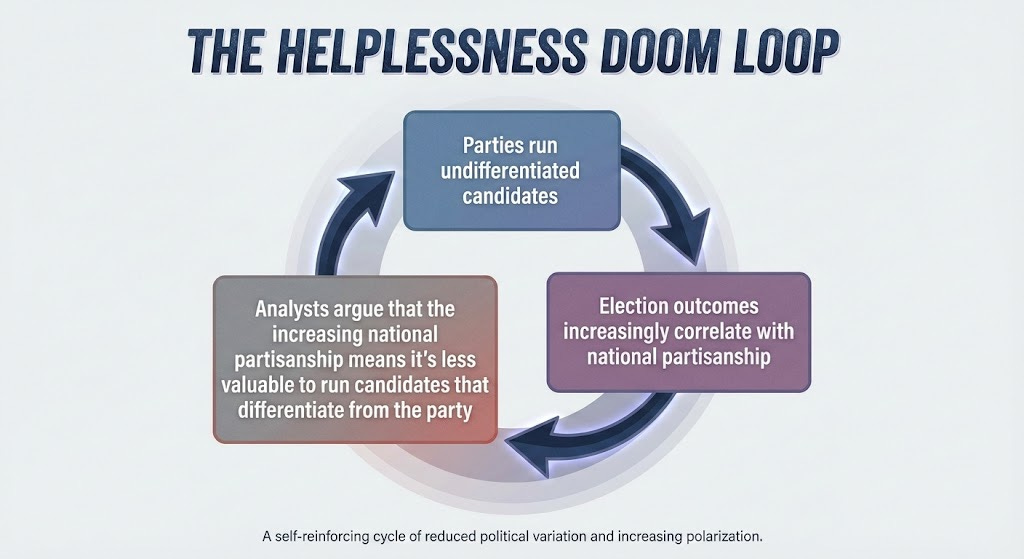
The Helplessness Doom Loop
As Nate Silver noted, Morris’s own analysis showed moderation could increase vote share by 1-1.5 points. Silver argues that translates to 2-3 points of margin, which is a big share in close races.
In professional sports and trading, a 2 or 9 point edge (as Drutman’s analysis applies) is worth a lot.
It’s worth a lot in politics too: The signature policy achievements of the Biden administration were based on politicians who rejected the idea that nothing matters. The decisive vote for the Inflation Reduction Act (IRA) came from Senator Joe Manchin, who won his seat with just under 50% of the vote1 just two years after Trump won West Virginia with 69% of the vote.
And in 2026 if Democrats want to have any chance of winning the Senate, they’ll need more candidates who reject the helplessness trap. One such politician is Mary Peltola, who is considering running for Alaska’s Senate seat.
Given that Alaska voted for Trump 54.5% to 41%, anyone subscribing to the analysis of Drutman or Morris would think the state was unwinnable. But Peltola is the type of candidate who defies the analysis. She’s pro gun, pro fossil fuel but also pro choice. By strategically breaking from the Democratic Party, she created an Independent brand in an Independent state, and won.
The Supply Side Polarization Problem
When pundits assume candidates don’t matter and activists force all Democrats to toe the party line, they create the reality. The truth is that the high correlation between House elections and Presidential results is due to the fact that parties don’t run differentiated candidates anymore. The 98% correlation is not an inevitable fact of life, it’s a choice parties make by running undifferentiated candidates. Many explanations for polarization have focused on the demand side like nationalized media, but few focus on the supply-side: parties don’t run differentiated candidates.
After Manchin retired, Democrats ran a generic Democrat. They did indeed perform exactly as the national baseline would project, Trump won 70% of the vote and Republican Senate candidate Jim Justice won 69%.
The Alaska at-large seat is another example. In 2018 and 2020, when mainstream Democrat Alyse Galvin ran against Rep. Don Young she overperformed by 4 points and 6 points. But when Young retired and Republicans nominated Sarah Palin in 2022, Peltola overperformed by 22 points. Then in 2024 Republicans nominated the more mainstream Nick Begich and Peltola by a strong 9 points - a strong showing, but not enough to overcome Alaska’s lean.
The Alaska example is instructive: in 2018 and 2020 when both parties ran mainstream candidates the House election was correlated with Presidential results. In 2022, Democrats ran a Democrat who broke with the party to the center and Republicans ran an extreme conservative. The result was a massive Democratic overperformance. In 2024 Democrats ran a moderate and Republicans ran a mainstream candidate and the Democratic moderate overperformed, but not as much as 2022. Democrats can’t (always) control when Republicans nominate, but we can control who we nominate and that matters.
Winning The Senate Requires Rejecting Helplessness
Trump won 31 states in 2024. He won 30 in 2016. Even when he lost the election in 2020 he still won half of the states. If Democrats simply accept that Senate results are 92% correlated with the Presidential election and throw our hands in the air we will have a permanent minority. We need the candidates who can break from the party, create a distinct brand, candidates like Mary Peltola.
A libertarian took 4% of the vote.
Appreciate this. Struggling to come up with an analogy to help the "moderation is of no benefit" crowd who don't seem to see election results as binary despite the moment we are living in right now. I keep falling back on football playcalling. The Patriots are told that if they alter their strategy they will up their odds of winning the Super Bowl by 1.5%. And the response "But that would require benching our captain and in 2020 we stuck with our strategy and won the title with that Hail Mary with no time left. Let's do it again."