


If you would like to recommend an article or submit a question for our weekly mailbag, leave a comment on any TLV post published in the seven days leading up to our Friday Five posts (including this one). We’ll collect our favorites and include them in future editions!
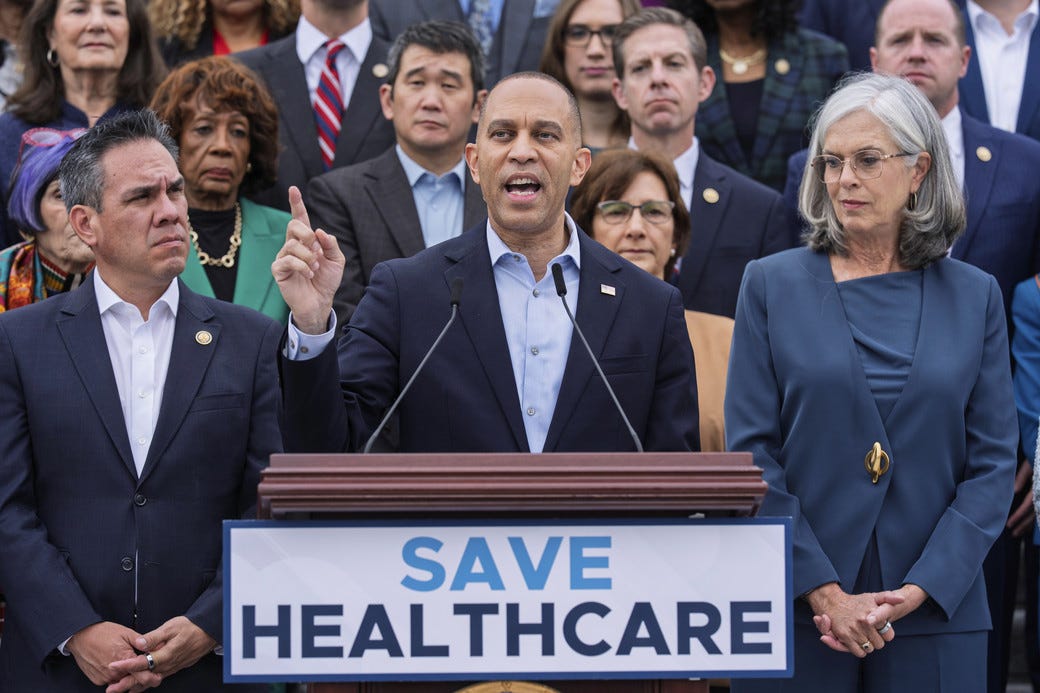
As the Democrats steam ahead to a big election victory, spirits are high in all sectors of the party. So high, in fact, that I have taken some incoming from Matt Yglesias and Ben Krauss of Searchlight, among others, for being unduly pessimistic about the extent to which the party is resolving its underlying problems. Am I? It’s certainly possible, but I have some questions.
1. Do Democrats understand how much of their victory will be attributable to thermostatic reaction against the Trump administration rather than any confidence in the Democrats? That seems obvious to me but, in all likelihood, large sectors of the party will see clobbering the Republicans as an enthusiastic endorsement of their agenda. That typically leads to overplaying your hand, with predictably bad results.
2. Are Democrats willing to stand up to the progressive/DSA left after the election? Speaking of overplaying your hand, we can be sure that the rising left of the party will claim their politics have been vindicated. They will argue that, far from handicapping the Democrats, the party’s increased identification with the left has only produced success. As AOC exuberantly put it, “If Abdul can win in Michigan, anyone can win anywhere.” Greg Casar, chair of the House Progressive Caucus, has promised weekly votes on major progressive legislation, enthusiastically saying, “I want us to be passing so much.” Other Democrats did not stand up to the far left prior to the election—will they do so afterwards?
3. Can Democrats effectively address “affordability”? The overwhelmingly dominant theme of Democrats’ 2026 campaigning was affordability. But can they really do much about it, even assuming they control both houses of Congress after the election? Realistically, no, given that Trump will still be President. That will disappoint voters who instead will be treated to an endless succession of messaging bills suggesting that Democrats not only wish to roll back some of Trump’s less popular measures but also propose a mind-boggling array of new programs, subsidies, and regulations. None of this will make life more affordable for ordinary voters who will simply tune out the Congressional theatrics.
4. Can Democrats embrace bipartisanship and the permitting bill (BAAJA)? If anything useful is actually done after the election, it would have to be bipartisan. The obvious possibility here is the Bipartisan American Affordability (that word again!) and Jobs Act (BAAJA), aka the permitting bill. This is a concrete action that would take attention away from the Democrats’ laundry list of spending and regulatory ideas and over time would likely do more for affordability than most of these ideas. But resistance is developing among the usual suspects in the climate and environmental NGO space and their congressional allies. Can Democrats stand up to the groups (finally) and make this bill happen? I’ve got my doubts.
5. Can Democrats find their way back to economic growth? Democrats’ 21st-century project has largely prioritized goals other than economic growth. They have instead prioritized things like fighting climate change, reducing inequality, pursuing procedural justice, and advocating for various identity groups instead. For example, the “Deciding to Win” report analyzed word frequency in the party’s platforms since 2012 and found a 32 percent decline in the appearance of the word “growth,” versus a 150 percent increase in the word “climate,” a 1,044 percent increase in “LGBT/LGBTQI+,” a 766 percent increase in “equity,” an 828 percent increase in “white/black/Latino/Latina,” and a 333 percent increase in “environmental justice.”
This is remarkably short-sighted. The key to substantially improving living standards for the working class—once the Democrats’ prized goal and really whom “affordability” should be geared toward helping—is precisely more economic growth, especially higher productivity growth. It is therefore completely unrealistic for Democrats to think they can accomplish their ambitious goals without centering the goal of economic growth.
Can Democrats make the pivot back towards growth? Their laundry list of affordability programs/subsidies/regulations does not inspire confidence, but the permitting bill, if passed, would be a step in the right direction.
6. Can Democrats advance a coherent policy toward AI? Speaking of productivity growth, the most plausible path to higher productivity lies in diffusing this technological marvel, a new general purpose technology (GPT), throughout the economy. But Democrats seem far less concerned with this than incorporating data center opposition and “AI safety” concerns into an overarching economic populism. That works for campaign purposes, but they will ultimately need a coherent policy that is responsive to public concerns while ensuring the American economy and workers reap a large AI dividend. Can Democrats dial down the populism and find their way to an agenda that taps the potential of this transformative technology? So far, we haven’t seen it.
7. Can Democrats transition away from the energy transition? As the 21st century has unfolded, more and more of Democrats’ policy plans have centered around combating climate change and promoting a rapid clean energy transition. The claim has been that the clean energy transition is not only virtuous but would also drive the economy forward. That has not been the case, and now many of their policies have been rolled back, with little negative reaction from voters, especially working-class voters.
Can Democrats give up on their obsession and accept that a rapid clean energy transition, facilitated by the IRA and successors, is not in the cards? This could be difficult—climate and environmental NGOs are determined to claw back the IRA provisions abrogated by the Trump administration, including the extremely unpopular EV credits. More generally, climate catastrophism and hostility toward fossil fuels are the reigning philosophy of these groups and their many congressional supporters. That could easily come back in a big way after the election. In fact, I’d be surprised if it didn’t.
8. Can Democrats articulate a viable immigration policy? Democrats are sure they oppose the actions of ICE (and many simply want to abolish the agency), but not much else is clear about their immigration policy. Can they keep the border as successfully closed as Trump has done? How will they handle asylum and irregular immigration pathways like TPS and parole? Are they willing to deport any illegal immigrants besides violent criminals? Or do illegal immigrants who are not violent criminals simply get to stay here forever (which is really a soft version of open borders)?
Democrats will be under enormous pressure from advocacy groups and most of the party’s left to move immigration policy back toward Biden-era openness. Those who want to move toward reform and a tougher policy will have a huge fight on their hands. And forget fundamental changes like a skills-based immigration system that would align the national interest with immigration flows. That would be a bridge too far for many in the party today.
9. Will Democrats try to bring back DEI and affirmative action? Trump moved aggressively against DEI programs and anything with any connection to racial and gender preferences. Activists and advocacy groups will aggressively lobby to bring all of this back, despite the basic unpopularity of affirmative action and DEI-based preferences. Can Democrats resist this pressure, especially given that almost nobody in the party has been willing to dissociate themselves from these programs and take a clear stance for merit-based outcomes? This seems doubtful.
10. Will Democrats be able to move toward the center on trans issues? Democrats are far out on a limb on trans issues, from biological boys and men in girls and women’s sports to medicalization of minors for gender dysphoria. These policies and the embrace of gender ideology (one’s “gender identity” is their “true” sex, and so on) that underlies them are both massively unpopular—but more or less the official positions of the Democratic Party. Even mild heterodoxy on these issues is rare and only tolerated as a tactical campaign adjustment in conservative areas. There is already growing evidence that many Democrats are champing at the bit to push back on Trump’s restrictive actions on these issues and get policy back to where it was when he came into office. My guess is that the Democratic energy will be all behind this restoration of the status quo ante and essentially nil on actually moving to the center on these issues.
11. Can Democrats embrace cultural positions that resonate with the working class? As the last part of this analysis suggests, this will be very, very difficult. Much of the reason for this is that most Democrats don’t consider cultural issues real issues. To reach the working class, they believe, is simply a matter of talking about economics, which represents their real interests, while cultural matters are but a smokescreen for the machinations of the billionaire class. This is woefully wrong and shows how clueless—and condescending—many professional-class liberals are about working-class voters. It is also highly flawed politically: a massive research study by Jared Abbot and Joan Williams, based on 40,000 interviews, found that “embracing cultural positions that resonate with the working class” would be the biggest contributor to Democrats winning back working-class voters, greater even than prioritizing working-class economics.
Despite this, I do not expect Democrats to come to their senses and align their cultural positions with those of working-class voters. That would be very uncomfortable, while they are very comfortable talking about affordability and the billionaire class.
So these are my questions. Am I too pessimistic about the Democrats or merely realistic, given that it’s a long way back to the working class? You be the judge.
With the democrats we will fall back into liberal wokism again. The clinton/ obama machine will be back in charge, and we will keep giving the farm away. These are socialist nonproductive people that have been government hacks their whole lives and know nothing about being productive except how to suck off the government trough.
The republicans aren't much better, but they are better than the democrats. At least productive people will be allowed to be productive. This we could discuss for hours on how this works.
So, republicans suck, but democrats suck worse.
Democracies die slow suicidal deaths from within. Is this the way we are going now? Looks like it to me.
Although I loathe Trump and never have voted for him, this once loyal Democrat will never again vote for them until they address the list of my several grievances with them. These include the trans insanity and especially the surgical mutilation of confused children. Their acceptance of open borders and its impact on working peoples wages and housing costs and their acceptance of the destruction of our cities by crime and homelessness. Finally they are perfectly willing to discriminate against whites and men because of past discrimination against blacks and women. They don’t even see these problems as problems.