


310 days ago, the redistricting wars were focused on Texas vs California. Most partisans had big plans and a narrow goal: $100 million here, $60 million there. Maybe yield a few new blue or red seats.
But in the Axios summary back on July 21, 2025, the final word did not get to a GOP redraw or a Dem redraw. It went to a Dog:
The bottom line: Even Rep. Jared Golden (D-Maine), an arch-centrist who represents the reddest district of any House Democrat, declined to condemn potential redistricting in California — but he did warn Republicans against what is known as a dummymander. “I won in a seat that the president has won by 7-10 points. ... You want to draw some of your incumbents out of R+12, R+15 seats into R+6? We’ll find some good candidates who can win there.”
Today we finally have nominees in Texas. The Blue Dogs have a quartet of candidates in the southernmost Trump districts, two incumbents who won red districts in 2024 and two candidates - one of whom just beat an antisemitic sex therapist propped up by $1m in GOP dark money.
And we also have new research: Welcome Democracy Institute released a deep dive into the four South Texas congressional districts that produced some of the largest rightward swings in the country between 2016 and 2024. The findings should reshape how Democrats think about Hispanic voters, the persuadable middle, and what it takes to compete in territory where losses have been growing for a decade.
The big takeaway: South Texas has not permanently realigned. But Democrats need to change course to win it back. Last night’s primary results offer hope: Democrats have officially locked in strong candidates in four South Texas districts, including two incumbents with a history of over-performance and two challengers who are well positioned to do the same.
Last Night’s Results
Despite the GOP’s best efforts to get a weak Democratic nominee in TX-35 by spending $1m boosting an antisemitic fringe candidate, the compelling Sheriff’s deputy Johnny Garcia won with nearly 64% of the vote. Republicans were the only group spending in support of Maureen Galindo, who raised less than $11,000 and whose vile anti-Semitic comments have been condemned across the Democratic party spectrum. Leftists like AOC and Greg Casar should get credit - they saw through the Republican canard and backed Garcia.
But how did we get here? Why is an overwhelmingly Hispanic district rated Likely Republican?
The Scale of the Swing
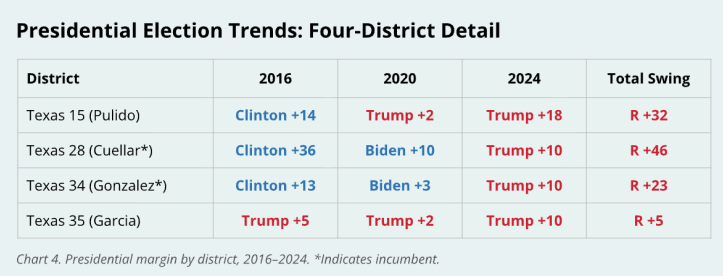
The numbers are stark. WDI looked at four districts in South Texas: TX-15, TX-28, TX-34, and TX-35. In these districts, the aggregate presidential margin moved from a 27-point Democratic advantage in 2016 to an 8-point Republican advantage in 2024. A net swing of roughly 35 points in eight years.
TX-28, Henry Cuellar’s district, swung 46 points, from Clinton +36 to Trump +10. TX-15 swung 32 points. TX-34 swung 23 points. These movements represent a wholesale collapse of what was once a reliably Democratic region. The RGV hadn’t gone GOP on the presidential level since 1972.
The losses were most pronounced among specific groups that tell a larger picture of Democratic challenges nationally by ethnicity, educational attainment, and ideology: minority voters, non-college voters, moderate and conservative voters. Hispanic conservatives moved 14 points away from Democrats between 2012 and 2024. Hispanic moderates moved 12 points. Non-college-educated white moderates moved 16 points.
The Blue Dog Exception
Two incumbents bucked the trend. Henry Cuellar (TX-28) ran 12.7 points ahead of the presidential ticket. Vicente Gonzalez (TX-34) ran 6.7 points ahead. Both are Blue Dog Democrats. Both have emphasized cultural moderation, local identity, and visible distance from the national party.
This is not a new pattern. We have tracked the over-performance of differentiated candidates for years. But the South Texas data adds new texture. After winning a Trump district in November 2024, Gonzalez declared “someone needs to get fired” for DC-based groups running ads in his district on cultural issues that overshadowed the economic concerns of working-class Hispanic voters in his district.
The survey data backs him up. Voters in the open-ended responses didn’t just say they wanted moderation in the abstract. They described the Gonzalez profile almost verbatim: culturally moderate, locally rooted, independent from the national party, focused on affordability and border security rather than culture-war positioning.
Why They Left, and What Would Bring Them Back
Why did these voters leave the Democratic Party? WDI asked former Democrats why they left. Voters who moved toward Republicans most often cited ideological drift in the close-ended version of the question: “the party I used to support moved away from my values” (28-38% across districts), followed by immigration (18-26%). Voters who moved toward Democrats overwhelmingly cited the economy and cost of living (29-42%).
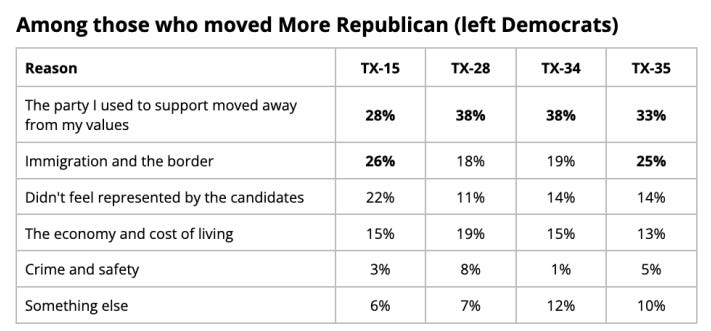
Democrats are losing voters on culture, values, and immigration. Republicans are losing voters on cost of living. The strategic implication is clear: a Democrat who leads on affordability while moderating on culture and immigration is playing to this dynamic.
The open-ended responses made the moderation demands specific. Thirty-six respondents used the literal language of “move to the center” or “be more moderate” unprompted. Six issues came up repeatedly: guns, gender policy, spending, immigration, the Biden record, and abortion. On each, the critique came from Republicans, independents, former Democrats, and current Democrats alike.
Taken together, the six moderation openings describe a coherent candidate profile: pro-Second-Amendment with sensible background checks, opposed to gender transition for minors, fiscally disciplined, tough on the border with legal pathways, willing to criticize Biden-era mistakes, and pro-choice without absolutism.
Immigration: The Both-And Position
Immigration is the second most-cited reason voters left Democrats (18-26% across districts), and the quantitative data explains why. All voters across the four districts prefer Trump’s approach to immigration over Biden’s by 18 to 24 points. On border security specifically, the margin runs +26 to +28 in Trump’s favor.
The focus groups in Pharr, TX added critical texture. Voters blamed the Biden Administration for an “open border” and simultaneously recoiled at Trump’s targeting of longtime residents and family separation. The winning position was not one side or the other.
The open-ended responses reinforced the pattern. Voters consistently described a preference for border security, orderly processing, legal pathways, and prioritization of violent offenders over mass enforcement against established families. They also said Democrats “failed the Dreamers” and “had many opportunities to do something,” a credibility problem that a campaign can address by being specific about enforcement as well as legalization.
The strategic read here is that Democrats do not need to match Trump’s position on immigration. They need to stop being perceived as having no position at all, or worse, the wrong one. The both-and framing that Cuellar, Gonzalez, and Pulido have all adopted, secure the border and protect legal pathways, is the only positioning in the data that holds across moderates and independents simultaneously.
Republicans Are Reading This Data Too
The South Texas research lands in a cycle where Republicans are actively working to ensure Democrats nominate the weakest possible candidates in swing districts. The Left-Right Pincer described last week is directly relevant here.
This is not an isolated case. A new SuperPAC called Lead Left, which turned out to have Republican fundraising infrastructure embedded in its metadata, has been spending millions to shape Democratic primaries in competitive districts. The pattern is consistent: back the more progressive, less electable Democrat. Thus far, Democratic primary voters have seen through the ruse, and Lead Left is 1 for 3.
The South Texas data shows exactly why this strategy works. Voters in these districts are not looking for a national progressive. They are looking for someone fiscally disciplined, culturally moderate, locally rooted, and independent from the national party. Every time Democrats nominate a candidate who doesn’t fit that profile, Republicans gain. And now Republicans are spending money to make sure it happens.
The Bottom Line
The South Texas swing was not a permanent realignment. The voters who produced 32-46 point rightward swings between 2016 and 2024 describe a region that is volatile, frustrated with both parties, and responsive to candidate quality and issue positioning.
Both parties face headwinds. Democrats run -6 to -19 net favorable across the four districts. Republicans run +3 to -12. Trump is underwater everywhere. Abbott is underwater in three of four districts. The loudest version of each party has worn out its welcome.
The path back for Democrats runs through exactly the kind of candidates the research describes: Blue Dog-style moderates who lead on affordability, take clear, credible positions on immigration and border security, and maintain visible distance from national party orthodoxy.
The question is whether Democrats will nominate candidates who fit that profile, or whether the Left-Right Pincer will produce nominees who confirm everything these voters already believe about the party.
Today's coverage of the Texas Paxton win misses major good news, almost never mentioning the importance of the low turnout. There was "only" 1.4m votes in the Repub Primary for both candidates…. whereas the 2024 election total Repub voters was 6.4m. Paxton got only 700,000, and of course zero Dems, and few Cornyn voters want Paxton. A good shot for Talarico considering the total 2024 voter turnout was 11.4m, and then Trump won by "only" 56% over Harris 44%. So for the US Senate, NC, ME, AK, OH, TX are all within reach with hard work and contributions.