


A New York Times poll is driving the news, describing Democrats as “a fractured coalition with at times contradictory views about the party’s best path forward.”
We will explore at WelcomeFest, now less than two weeks away!
These are hazy days for Democrats. Prediction markets show an 80% chance to win the House and 50% to win the Senate.
Those who remember 2018 shudder at what came next: a fleeting congratulations to pragmatic candidates who flipped seats, followed by two years chasing the mirage of a national left-wing ascendancy.
Republicans remember, too. And they are doing far more now than the last Trump midterm to press every possible advantage. Total Gerrymandering - every two years, without Supreme Court restraint. And Total Primary Meddling - whenever Democrats have a choice in a swing district primary between an electable moderate and left-wing candidate, they’ll back the left-wing candidate.
Because Republicans can read polls - and the “Red Boxes” candidates put up to signal where SuperPACs should invest - too.
The House will be Another Senate
Democrats are headed into a new reality: the Senate favors Republicans, with just a handful of swing states that require competing in truly red territory to win consistent majorities.
Total Gerrymandering, combined with reapportionment after the 2030 Census, will soon make the House look more like the Senate.
That means the ‘stretch’ candidates that WelcomePAC has backed in supposedly “Safe Republican” seats will have to become the new normal for a party seeking majorities. Trump won Jared Golden’s district by 10, and districts featuring current challengers Bobby Pulido and Jamie Ager have a similar margin to stretch Senate seats like Alaska, Ohio, and Iowa.
What Came First, the Candidates or the Brand?
The chicken or egg problem facing Democrats comes up in most thoughtful conversations we have. Should moderates focus on “the Democratic brand” or on supporting candidates who are differentiated from that brand?
At a strategy retreat after our first cycle, a participant laid it out clearly: the only way to change the brand is by supporting candidates different from the brand.
The way for Democrats to have a better brand is to engage in the natural feedback loop of democracy: if you support House candidates competing in seats that Trump won by 10 points, you can probably compete in Senate seats Trump won by 10 points (eg: Mary Peltola).
Building a better brand, like organizing, is a muscle. Not a battery, or a pitch deck, or an op-ed. It is dozens of candidates, hundreds of staffers, thousands of volunteers, tens of thousands of financial supporters, and hundreds of thousands of voters all practicing democracy by being responsive to what voters want.
And then eventually, the presidential primary can look very different than in 2020.
Turns out, Democratic voters get it.
The Strategic Left
As we broke down in The Four Types of Democratic Primary Voters, the majority of Democrats are now liberal - for the first time ever. This is a major shift. But that doesn’t mean they want a liberal nominee. Because a significant quadrant, which we call the Strategic Left, prioritizes electability over issue purity.
Back to The New York Times poll, where the Strategic Left flexed:
While a majority of Democratic supporters said that they were generally happy with the party’s ideological positioning, 52 percent said the next Democratic presidential candidate should move the party to the center in order to win. Only a quarter said the next candidate should move the party to the left.
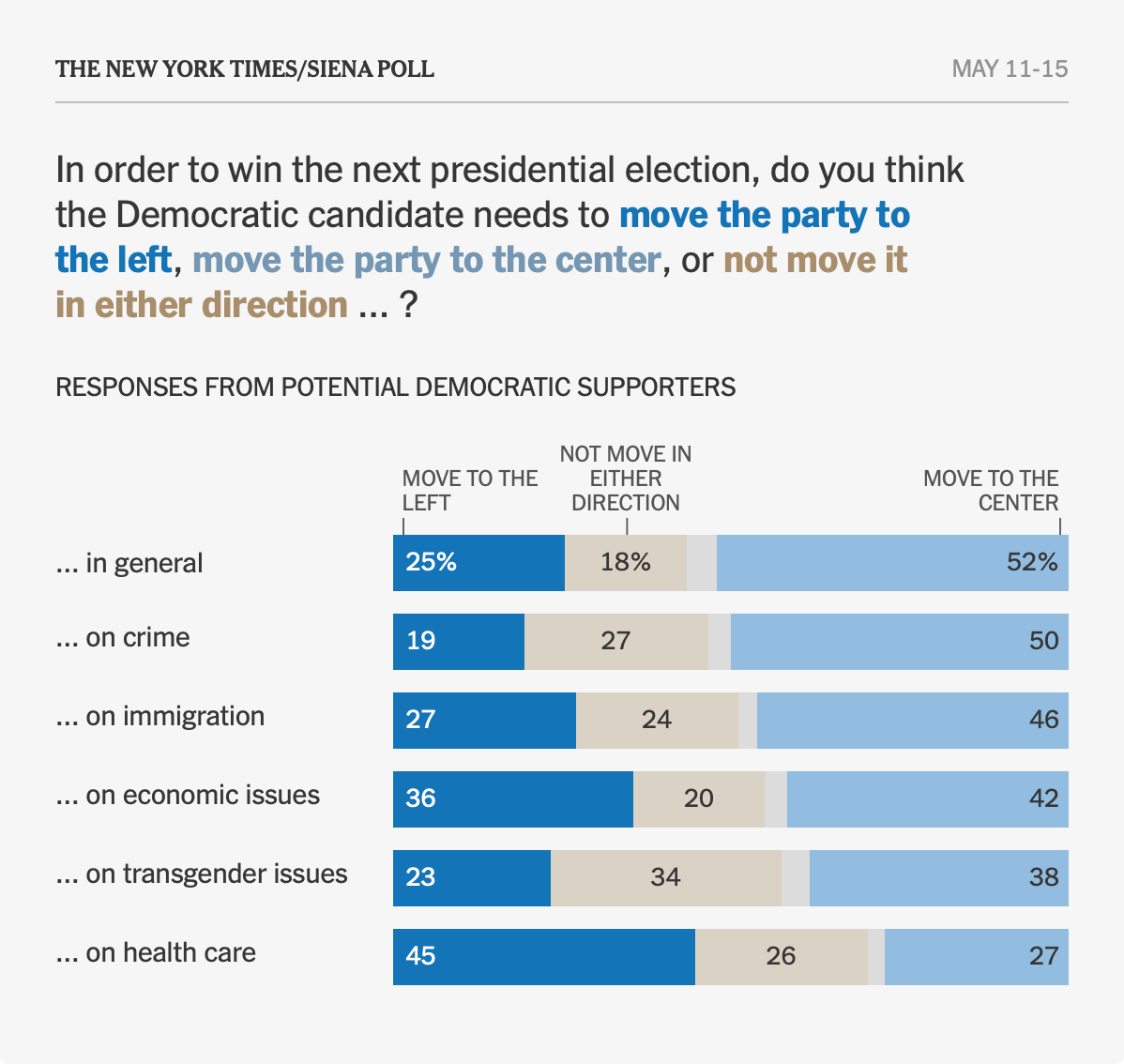
Earlier this week, Tom Edsall wrote in the Times summarizing two recent political science findings on what moves voters. One we covered here in New Research on How Moderation Works, but in different ways both demonstrate that voters actually vote on … wait for it … issues!
Voters actually care about issues! Not just how many tattoos you have or how good your vertical video operation is or if you are the first person of Maltese descent to be elected to the Springfield City Council, but whether or not you will effectively represent their views in our federal government. The Founders would be proud!
The Strategic Right
It isn’t just the left who knows that Democrats need to move to the center. Republicans can read polls, too - and read the “Red Boxes” that candidates use to instruct SuperPACs on how & where to spend money.
Late last month, a new SuperPAC called Lead Left started spending in a handful of Democratic primaries across the country. But there were clues that this was not just a progressive PAC. It filed its incorporation papers on April 24, registered out of a Staples in Tallahassee. On paper it seemed progressive enough: a left-coded name with anti-Trump framing, but it disclosed none of its donors. Within days it was spending millions to shape who Democrats would nominate in three of the most competitive districts on the 2026 map, while spending nothing on progressives in tough primaries in safe blue districts.
Shortly after the first round of spending, Punchbowl News reported WinRed, the Republican version of ActBlue, was embedded in the site’s metadata. In other words, the supposedly “progressive” group appeared to be wired directly into Republican fundraising infrastructure.
This group wasn’t about helping Democrats. It was about helping Republicans pick the Democrats they’d rather run against in swing seats this November. And those are the same candidates that legitimate progressive groups are backing.
In TX-35, Republicans are the only group that has been spending in support of Maureen Galindo, a fringe candidate who has raised less than $11,000 and whose vile anti-Semitic comments have been condemned across the Democratic party spectrum.
The Left-Right Pincer
It is not just shady PACs though. Republican leadership is doing this out in the open through its main PAC, the Congressional Leadership Fund.
Take CA-22, where a slew of progressive outfits - the Congressional Progressive Caucus, Working Families Party, and David Hogg’s PAC - are backing Randy Villegas, a young PhD who lives outside the district boundaries. The Villegas campaign website has a “Red Box” instructing those SuperPACs on where they want money spent. But GOP Speaker Mike Johnson can read the Villegas website just as easily as David Hogg can, and both are doing something eerily similar: sending mail to Democratic primary voters touting how progressive Randy Villegas is.
This means the more electable candidate, state legislator Jasmeet Bains - whose legislative district overlaps with most of the House district, and who ran 15 points ahead of Kamala Harris last cycle - is getting hit from both Republicans and progressives.
Such is life in the center. Defending against a Left-Right Pincer Movement is a notoriously difficult battlefield situation, and I won’t bore you today with how the Union army formed a fishhook defensive maneuver at the Battle of Gettysburg. But in this situation you should donate directly to Dr. Jasmeet Bains and also come to WelcomeFest on June 3 in DC (and check out her conversation with Lauren).
DC is Always the Last to Know
Because this news has not broken through in the Democratic establishment.
We frequently reference HouseQuake, the documentary on Rahm Emanuel’s merry band of moderate-to-conservative candidates who powered the 2006 Democratic House wave. At the victory party, Rahm says, “It’s been said that Washington often is the last place in America to get the news. Well let me tell you tonight, the news has arrived from every corner of the country.”
Many pundits and operatives want you to believe that Democrats need a fancy new formula, that the lessons of the 1990s and 2000s don’t apply. But does any of this from 2006 sound outdated to you?
Analyst in 2006:
The Democrats decided they had to be more flexible on social issues. People in the party care a lot ... But it just wasn’t winning them elections. So the choice was: you could continue to care about those things, and lose. Or you could show some moderation and some flexibility and have room for candidates who are speaking to a different part of the culture, and maybe win some of those.
News Reporter in 2006:
… tired of relentlessly being branded liberal, many Democrats running around the country are actually quite conservative. Shuler, the former Tennessee and Redskins QB has put incumbent Charles Taylor on the defensive, Taylor could lose to a Democrat … who sounds downright Republican on gun control and talks openly about his faith.
Candidate & Campaign Manager in 2006:
Know what Rahm says? Stay on message, stay on message stay on message … they are hammering us, trying to portray us as soft on immigration and tying you with the Democrat platform …
Anyone who was at last year’s WelcomeFest can tell you that applying these lessons in modern day politics ain’t boring.
And defending against the Left-Right Pincer is not about just hitting the left - it is about an offensive charge through the center to where the American people are. It’s democracy, and it’s fun as hell. Join us.
While it is necessary to keep close tabs on the wokean left in order to be successful in the primaries, us Welcome Party Democrats have to monitor Republican strategies that may surprise us in the general election. I submit, for your examination, columns in the WSJ today (5/21) by Carl Rove and Matthew Continetti. Rove summarizes the results of the gerrymandering wars that are on track to threaten Dem's chances in Congress. Continetti points out that Spanberger sandbagged her constituents by concealing her wokean core during her campaign. The Republicans will drill into the public consciousness, every wokean primary success; claiming that even a candidate that might appear to be moderate should be suspected of deceit. Meanwhile we spend our energies attacking Trump's every move, and not entertaining the possibility that at least some of his actions are decoys. If he maintains his present stress that the war in Iran is ultimately about preventing global proliferation of atom bomb technology, he may eventually win public support enough to influence the midterms.